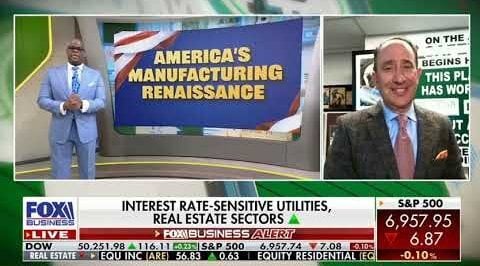
Interviewer: Now my next guest is also very optimistic about the future. I want to bring out Marlin Steel CEO, Drew Greenblatt. Drew, you know, let's start with some of the things that this administration's done differently, and I think people might be surprised about the tariffs, right? Seems like they have been more of a boon than a burden so far.
Drew Greenblatt: We are thrilled with the tariffs. It's been wonderful for our company and it's been wonderful for manufacturing in general because finally we're getting a level playing field. We're winning jobs that we never would have won in the past where people normally would have bought from China, Mexico, Canada. Now they're buying from Americans. We use only American steel, we only build in our factory in Baltimore or Michigan or Indiana. So, it really matters to the hometown heroes. All these factory workers, they depend on American policies being shrewd. And finally, we have a level playing field. There are so many good things going on with our policies right now. We're allowed to reinvest and then write it off. I think you're 100% correct. I think we're going to have a 5% GDP in the first quarter because all the stars are coming into alignment. It's a glorious time to be an American manufacturing. We're thrilled.
Interviewer: You know, the manufacturing data—we had the ISM manufacturing data came in at 52, absolutely phenomenal. And we had factory data that was better, Chicago PMI data that was better. And many are saying, hey, a lot of this, we go back—the pieces were put together last year, that one big beautiful bill, and now I think we're starting to see the impacts of it.
Drew Greenblatt: You're absolutely correct. Marlin is leaning in. We're making baskets and carts with technology that's good, but because of the big beautiful bill, we're investing in a big way. We bought our most expensive tool in company history, just shy of $2 million. It's a laser punch combination. It's called a Trumatic 3000. It'll make our parts 10 times faster than we're currently using, and it's going to make our team so much more effective, so much more productive, and this is because of the big beautiful bill. This is going to power us through. It's going to make our employees more valuable, and we're going to be able to pay them more, we're going to win more jobs. It's going to hurt the Chinese imports, it's going to hurt the Mexican imports, all those people buying from those countries. It's going to make it better for the American worker.
Interviewer: You know, there's still—and this is happening over and over again all throughout our nation—no, I know. I love your enthusiasm, and here's the thing though, there's still so many people out there who are still complaining, and one thing that bothers me is they say, "Well, it takes two years to build this. It takes four years to build this." In my mind, then we should start building yesterday. I just—isn't it worth it to reindustrialize our nation? By the way, I think it's also a major component of national security for us to reindustrialize this nation, bring back good paying jobs and to be able to be self-sufficient.
Drew Greenblatt: You nailed it. I think there's a massive sea change. It's right now a time where we're about to watch the decoupling of the American economy and the Chinese economy. People are going to stop buying from China so much and they're going to start buying from Americans. This is very good for the American manufacturing worker. It's very good for the poor people in our nation because they're going to have avenues to get into the middle class because American manufacturing jobs pay extraordinarily well. We all give health insurance, we give great 401k plans. We're going to be needing this talent to make these components here in America. We're going to start building things in America. It's going to be a fabulous experience for the American worker to get an avenue to get that car that you described or buy a home. It's a very optimistic, very positive time for the American factory worker.
Interviewer: What about the taxes? Isn't there a provision in there for factory workers?
Drew Greenblatt: So, right now, when our factory workers work overtime, which we ask them to do a lot, now they don't have to pay taxes on the overtime. It's extraordinarily good for those employees that grind so hard, work so hard week in, week out, finally they get to keep that money that used to be taxed. It's a fabulous thing for the middle class. It encourages our employees to work and engage more and put in those extra hours. Spend a little time away from your family, but you're making more money in the bank.
Interviewer: Yeah, yeah, and you know what? And being able maybe to do things for your family. The blue-collar wave, we want to see it come back and it is. Drew, you've always been at the forefront. Thank you for sharing your optimism and I love the fact that you're investing in your business as well. Thanks a lot.
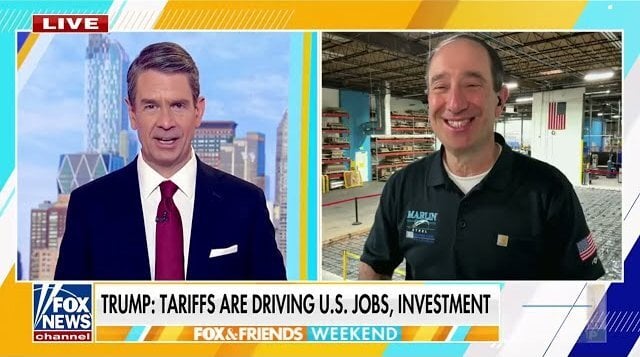
Interviewer: The future of US manufacturing is looking bright and he should know. CEO of Marlin Steel, Drew Greenblat, joins us now. Drew, it's great to see you. You saw the president speaking uh this week in Dearbornne. What do you make as a manufacturer, a steel manufacturer here in America? What do you make of the Are we seeing a renaissance in manufacturing?
Drew Greenblat: We are seeing a renaissance. This is a fabulous time to be a factory worker in America. We have a factory in Michigan that’s buried with work for the Ford plant. They make parts for Ford and General Motors. One shift works Monday through Thursday, but they’ve had to come in on Friday for overtime—and today they’re working Saturday overtime—because the Ford plant is so busy. It’s a blessing. By the way, they’re making overtime pay, no tax, because of the big, beautiful bill. Factory workers are really pumped. This is a good time to be an American factory worker. It’s really an exciting time.
Drew Greenblat: Absolutely.
Interviewer: Full disclosure to our viewers: Drew and I met in 2016. I was putting up posters on Instagram, and I posted a picture of us in your Marlin Steel plant in Baltimore. Back then, during the 2016 election, I was asking manufacturers which candidate would be better—Trump or Clinton. Since then, you’ve expanded in unprecedented ways. And right now, you have a big announcement.
Drew Greenblat: Exactly. This is a Fox & Friends exclusive. We’re optimistic and enthusiastic, and we’re leaning in. We bought a robotic laser cutting and punch combination machine and are installing it in Baltimore City. It’s the biggest investment in company history. The reason we’re doing it is because of the policies that allow us to write it off 100%.
We make baskets, and we laser cut the steel for them before shipping to companies like Ford and GM. We already have great technology, but this new machine will go ten times faster. It’s worth buying the most expensive machine we’ve ever purchased because it benefits our American workers and lets us compete. We’ll be able to compete with China, Mexico—we’ll make things here in Baltimore, here in America.
Behind me is a 3,000-square-foot piece of land. We’ve excavated all the concrete, and we’re laying new concrete for the machine. You can see the rebar. Tuesday, we’re pouring concrete for the new laser punch, the Trumatic 3000. It’s going to be revolutionary for our team. This is the kind of “leaning in” American manufacturing is doing across the nation. You’re about to see a big spike in business.
Interviewer: It’s the biggest investment in company history. And in just 10 seconds, Drew, it sounds like tariffs didn’t crush you as some economists predicted.
Drew Greenblat: We love tariffs—they give a fair, level playing field. For decades, policymakers haven’t considered the American factory worker. Finally, we have a chance to slay the competition with a level playing field. It’s great news for American factory workers.
Interviewer: Drew Greenblat, we appreciate you making this announcement, and good luck.
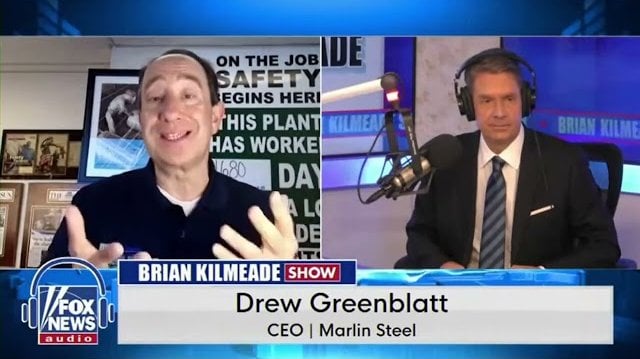
Interviewer: All right, let’s go to our guest. He is the CEO of Marlin Steel. In fairness, I met Drew in 2016 and interviewed him at his steel plant near Baltimore, where he was deciding whether Donald Trump or Hillary Clinton would be better.?
Drew Greenblat: Hello, good morning! Excited to have you on the Brian Kilme Show.
Interviewer: Hey Drew, it’s great to have you. I want to get your reaction. Obviously, tariffs went into effect at midnight. How is it impacting you as an American steel manufacturer?
Drew Greenblat: So, we are a fabricator with locations in Baltimore, Indiana, and Michigan, and we’re thrilled with these tariffs. Finally, we have a situation where our factory workers can thrive and prosper because we have a level playing field. This is fabulous news for the American factory worker.
I mean, tonight I’m going to the Ravens-Colts game. Think about how unfair it would be if the referees had made it 21-0 before the Ravens even got on the field—that’s what we’ve been dealing with for the last 50 years. Now, because of these policies, our American factory workers in Baltimore, Indiana, and Michigan have the opportunity to export worldwide and grow like never before. This is a wonderful time for America. You’re going to see the reindustrialization of America. It’s a tremendous, wonderful experience.
Interviewer: I gave you a shout-out on Fox & Friends talking to Kevin “Mr. Wonderful,” who understands these things well. You’ve talked about the reindustrialization of America. He said it will take some time and won’t happen overnight, but the conditions are set. Can you expand on that?
Drew Greenblat: That’s a good point. You can’t build a factory in a day or a week—it takes time. But people will start scouting land, constructing buildings, hiring HVAC and roofing contractors, and buying equipment.
If you’re a Japanese or German factory owner, you’ve been dealt a terrible hand: high energy costs, high taxes, and brutal regulations. Now look at America: a huge consumer market, a 15% tariff barrier for imports, and an opportunity to build factories here. Why build in France or Japan when you can build in the U.S.? That’s fabulous for the American factory worker—they’ll get opportunities to work at these new Japanese, French, or German-owned factories in America. Local suppliers, like box and pallet companies, will also benefit. People will get oil changes locally. It’s a win-win-win for the American factory worker.
Interviewer: Drew, you saw the big announcement at the White House yesterday: Tim Cook of Apple investing $100 billion to make all iPhone glass in Kentucky. What’s your reaction?
Drew Greenblat: This dovetails exactly with what I’m saying. Tim Cook is a smart guy. It makes financial sense to build in the U.S., not China or India. The Kentucky plant will hire a lot of people, pay them well, provide great benefits, and help the local community thrive. And Tim Cook is just one of many leaders who will make similar decisions. The mainstream media misses a lot of this. We’re in the front seat of American reindustrialization.
Interviewer: It’s fascinating to see the president’s real dealmaking, especially on chips and semiconductors. He said there’ll be a 100% tariff unless they’re built in the U.S.
Drew Greenblat: Right. Currently, we buy 70% of our chips from Taiwan—that’s madness. If China takes over Taiwan, we’ll lose 70% of our chip supply. That’s untenable. The new policies are very wise. We must make critical items like silicon chips, steel, and boats here. It’s about resilience, not just t-shirts or jeans.
Interviewer: And Drew, in your view, what will be the legacy of President Trump on American business and manufacturing?
Drew Greenblat: It’s multi-pronged. Energy will get cheaper by exploiting domestic resources. More nuclear energy will be available, which is cheap and carbon-free. Foolish regulations will be reduced, and tax policy will improve. These changes will make the U.S. the best place for foreign companies to build factories, which benefits our factory workers through higher wages, career certainty, and comfort in manufacturing careers.
Interviewer: It’s going to be something to witness. Drew Greenblat, CEO of Marlin Steel, a friend on the front lines of American manufacturing—thank you very much.
Drew Greenblat: Thank you. Appreciate it.
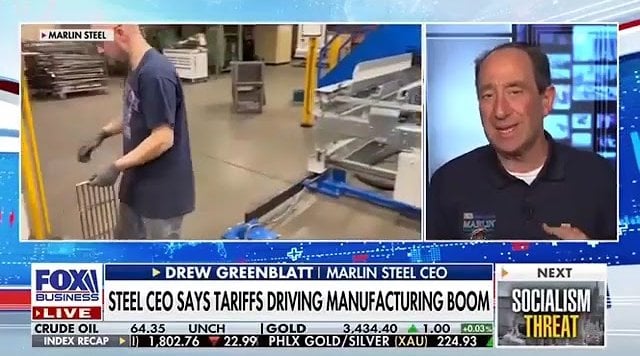
Interviewer: Our next guest says President Trump’s tariff boom is leading a major manufacturing shift—and the mainstream media is totally missing it. Let’s welcome Marlin Steel CEO Drew Greenblat.
All right, Drew, a major shift. Where, when, and how? I mean, we’re seeing this with the president’s tariff strategy.
Drew Greenblat: It’s happening right now. This is fabulous news for the American factory worker. All of a sudden, we have opportunities that didn’t exist just a couple of months ago. Finally, we have a tax policy that encourages investment in America today—equipment, tools, and resources for our teammates.
Right now, countries in Europe, Japan, and England are saying, “We shouldn’t build in England, France, Germany, or Japan anymore. We should build in America.” It’s a massive shift—very positive for American factory workers.
Interviewer: What industries with Marlin Steel are you touching? Also, for Larry Kudlow, how much will full expensing for new factory investments impact factory construction?
Drew Greenblat: This is going to be huge—and fast. If you’re a Japanese, French, or German company, you see higher energy costs, more regulations, and burdensome taxes at home. But if you move to America—your biggest market—you avoid the 15% tariffs. It makes perfect sense to move quickly, build factories here, and hire local American workers.
They’ll pay $80,000, $90,000, maybe $100,000 a year in compensation. And they’ll buy locally: boxes from local companies, pallets from local suppliers, baskets from Marlin Steel. We have factories in Indiana, Michigan, and Baltimore ready to supply them. Other U.S. factories will supply these new factories.
Suddenly, American factory workers will have plenty of job opportunities. Careers will be more solid. There may be layoffs overseas, but not in America. It’s a very optimistic time for American manufacturing. A wonderful time to be an American factory worker.
Interviewer: Drew, real quick—do we have the skilled workforce to meet this labor demand?
Drew Greenblat: There’s going to be a huge surge in job openings. That’s good because it gives people alternatives. They won’t necessarily need to be a barista or a restaurant server. They’ll have choices—with much better pay, career opportunities, 401(k), and health insurance—which is very common in our industry.
We’re talking automotive, industrial, pharmaceutical—all of these sectors are coming back to America. And people can do this without racking up a quarter-million-dollar debt for a four-year college degree that may be useless.
Interviewer: Drew Greenblat, thank you, sir.
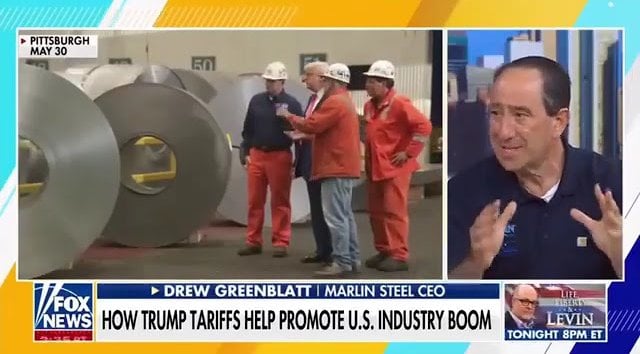
Interviewer: More countries are expected to negotiate trade deals this week ahead of President Trump’s Thursday deadline for steep reciprocal tariff increases. So far, a handful of nations have secured trade agreements, including last week’s major deal with the European Union. This is exciting news for Marlin Steel CEO Drew Greenblat, who joins us now. Drew, it’s great to have you here.
For context, I first met you in 2016 when I visited your plant in Baltimore, where you were making steel baskets. I asked who you supported—Clinton or Trump—and you said you hoped Trump would be a man about deregulation. Fast forward to today, with the economy having both good and bad news—GDP growth of 3% last week but a lackluster jobs report—how do you see all of this playing out with the trade deals and tariffs?
Drew Greenblat: We’re very excited and optimistic about the future. This is going to be a great time for American factory workers. What’s happening is that new policies are creating opportunities. Factory owners in Germany, Japan, and England are rethinking where to build. They face high taxes, expensive energy, and now a 15% tariff when shipping to their biggest client—America.
The logical choice is to build factories in the U.S. When they do, they’ll hire local American workers. Local suppliers benefit too: box companies provide boxes, pallet companies provide pallets, and Marlin Steel makes the baskets. It’s going to be a fabulous time for American factory workers.
Interviewer: Are you hiring, or sitting on the sidelines?
Drew Greenblat: No, we’re hiring. We’re very optimistic. We’re buying equipment, hiring talent, and growing in our factories in Indiana, Michigan, and Baltimore. This is the reindustrialization of America—a fabulous, optimistic time. The mainstream media is missing it, but it’s a great moment for factory workers.
These are good jobs. The average American factory worker earns over $80,000 a year with excellent benefits, including health care and 401(k). We need more jobs like this in the country. Overseas companies are going to start building here instead of dumping products into our market.
Interviewer: And just quickly, looking at Mexico and Canada, exports to the U.S. are 27% of Mexico’s GDP and about 18.5% of Canada’s. You say that matters.
Drew Greenblat: It matters a lot. Mexico and Canada may be small parts of our export market, but it’s critical for their economies. President Trump has a great opportunity to secure favorable deals with Canada and Mexico, as he’s already done with Japan, Europe, and other countries. This creates opportunities for American factory workers to make things here in the U.S. and ship overseas, rather than having products dumped into our market.
Interviewer: Drew Greenblat, CEO and founder of Marlin Steel, it was great to get your insight from a manufacturer on the front lines. Thanks for taking the time today.
Drew Greenblat: Thank you. Appreciate it.
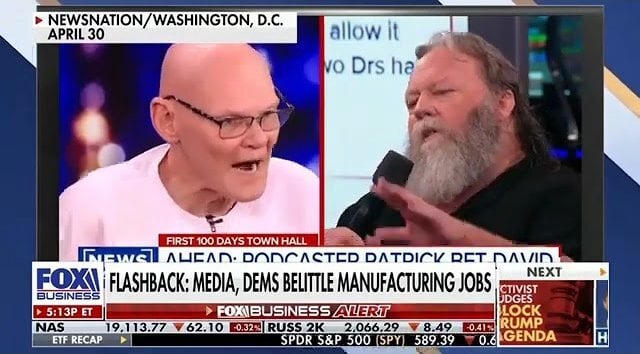
Host: Welcome to the show, Marlin Steel CEO, Drew Greenblat. Great to have you, sir. Thanks so much for being here. As the CEO of a steel company, I want you to walk me through how this is going to work because the liberal media wants us to think everything Trump does is terrible. Now, I'll tell you something. If Joe Biden had approved this merger, I would have been worried about it. But I know with President Trump approving it, you don't have a foreign company owning a US company. You're going to have a foreign company investing in the United States. That's what he's going to end up getting out of this, which is going to make the industry stronger.
Drew Greenblat: So, the Nippon deal is going to have over 10 billion dollar worth of cash coming from Japan, moving into America to improve uh factories that are very tired and old in America. And they're going to be putting in the greatest and latest state-of-the-art technology in these factories. Plus, they're going to be building a brand new factory. Plus, they're going to be hiring a lot of people. Sounds dang good to me. We're going to be building all of this in America. So, I'm in favor of this transaction. I'm I'm supportive that a lot of steel workers are going to get a lot of opportunities. Plus, all the American steel uh consumers, all the fabricators like Marlin are going to have another vendor that we could use that's providing high quality steel. This is going to be good for America because we're going to have a great uh new factory in our country with tens of thousands of new workers in our country. This is good stuff.
Host: This is all about the growth agenda. Let me just stop you for one second because the liberal media is claiming the opposite of what you're saying. They're claiming the manufacturing jobs are not coming back. Listen, tariffs do not equal manufacturing jobs coming back to America. And I don't want to live in a country that makes t-shirts. I can buy them from somewhere else. So, they're complaining about the factories clothing. They're—but remember when the Democrats wanted coal miners um to learn how to code? Watch.
Joe Biden (Archival Audio): Anybody who can throw coal into a furnace can learn how to program. For God's sake, the fastest growing job in the United States before CO was solar power technician. The same people who can do those jobs. they can be the people who go to work to make the solar panels.
Host: Yeah, that didn't work out so well. But yet, we're going to see manufacturing come back to steel plants.
Drew Greenblat: I think we are about to see the re-industrialization of America. I'm so very optimistic about the future. I'm very confident that the policies being put into place right now are going to have huge impacts on the middle class. And what's going to happen is we're going to see a tremendous amount of growth moving forward. Uh we have a whole series of things going in our direction. There's going to be massive tax cuts. We're going to have a situation where the uh overtime for our factory workers melts away. So they're going to be engaged. They're going to want to work more. We're going to have situations where all of a sudden because this new big beautiful bill, Americans are going to have an opportunity to reinvest back in their plants and get the greatest tools for our employees so that they can what? Japan, they could what? China. They could walk Mexico. And that's the thing here in America.
Host: It's a multi-pronged approach. It all comes together to bring the country forward. We really appreciate your time, Drew Greenblat. Thank you.
Drew Greenblat: Thank you.
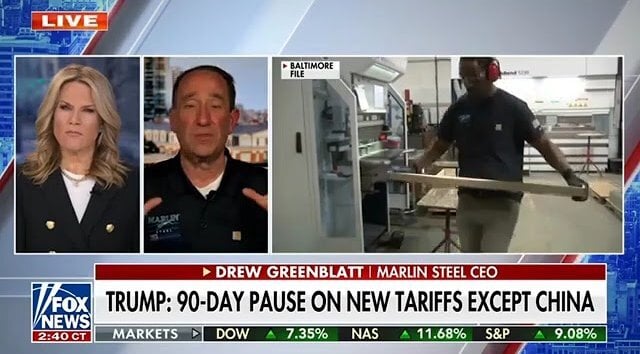
Interviewer: Okay. 125% tariff effective immediately on all Chinese goods. China of course is the world's largest exporter of steel to the world. We are the largest importer of steel. So what is the impact on our steel companies? Drew Greenblatt is the CEO of Marlin Steel Company employs about 115 people in Michigan, Indiana, and Baltimore. his company makes millions of pounds of steel a year. Um, Mr. Greenblatt, thank you very much for being here. I I I imagine this has been a bit of a whipsaw day for you as well. Um, as you have tried to manage these tariffs, tell me what what you were feeling yesterday about all this and what's different today.
Drew Greenblatt: We're thrilled with this outcome. I mean, you have 70s something countries coming to the president asking to slash their tariffs so that we have better access for our products. We make everything in Baltimore. We make everything in Indiana. We make everything in Michigan. And we export to 40some countries. It's so important for the American worker to get a fair and level playing field. Right now, we're up against some real challenges. Let me let me give you an example. We make this basket right here. It's a medical device basket. And we ship this, for example, to Germany. When we ship this to Germany, the German government charges our German consumers $128 to uh uh in tariffs for this basket.
Interviewer: Wow.
Drew Greenblatt: However, if our German competitor ships it to us a a knockoff of this basket, the American government will charge the American consumer a buck 25.
Interviewer: Wow.
Drew Greenblatt: That's wildly unfair to the American worker. That is massive disconnect. So, President Trump leaning in, protecting American workers, saying, "Hey, look, we got to have a level playing field, renegotiating these deals, which are wildly unacceptable." By the way, this is generations of of bad decisions, bad policy by Democrats and Republicans. This is not a political thing. This is, hey, we need to protect the American worker. Let's give them a fair shot. Let's give them an opportunity to sell overseas with a level playing field. If we do, we're going to thrive. We're going to hire millions of American workers to keep up with all the demand about to hit us.
Interviewer: So, what about China? What's your take on the 125% tariff uh on Chinese goods and obviously steel is a huge part of that?
Drew Greenblatt: So, China is a whole different kettle of fish. China, they debase their currency. They subsidize exports. They subsidize the steel. They subsidize the labor. They use force labor, concentration camp labor, the weaguers, to make parts that ship to America. They steal our intellectual property. You know, we have seven degree engineers and they come up with the most amazing innovations, most clever ideas, novel ideas. You know what China does? They cut and paste items, ideas from on our website and put it on their websites over in China, pretending they came up with the ideas. So, we need a level playing field, not just with tariffs, but also with intellectual property. We need it with environmental. I mean, we protect the Chesapeake Bay. They dump in the Yangy. So, we have to have fair par. So the American uh worker has a shot. President Trump is knocking down tariff walls to give us an opportunity so we could export all over the world and have fair deals against China and against other countries that are not playing by the rules.
Interviewer: Well sir, thank you Drew Greenblatt for joining us today. Marlin Steel. Really great to get your insight as someone who is on the ground uh have a lot of employees who are producing here in America and it's something that we all hope that we get to see more of as a result of all this. Thank you so much.
Interviewer: and the CEO of Marlin Steel. He's Drew Greenblat. Drew, it's a pleasure to see you. Thank you so much for taking time to join us. What's your take on the tariff fight? What do you think?
Drew Greenblatt: We're thrilled. It's going to create a lot of jobs in America, millions of jobs in America. It's going to really help our factory. You know, right now the system is not fair. It's not level for the American worker. So, for example, this is a basket we make in Baltimore City. And this basket right here, uh, when we ship it to Germany, they charge $128 in duties in custom tariffs against this basket to the German consumer. However, when this basket is made by a competitor in Germany and shipped to America, they're only charged a buck 25. That's wildly unfair to the American worker. If we want to have more prosperity in our country, more paths and avenues for the impoverished in our country to thrive and move up into the middle class, we have to create great jobs and that's going to happen with manufacturing and that's going to help by leveling the playing field.
Interviewer: So what would we what do you say to those who are concerned about tariffs causing inflation?
Drew Greenblatt: Well, I think it's going to be a onestep time, you know, where there's a one uh step day where things get uh rationalized. Yes, some t-shirts are going to cost a little bit more money, but in general, we're going to create millions, tens of millions of jobs in America where we're making things again in America, making a country strong and prosperous. We've gotten into a situation where we're a service economy and that's what we export. You know, half of America doesn't own stocks. Half of America doesn't have a $250 war chest in case there's an emergency. We have to create a path for the impoverished in our nation to have nice jobs, $80,000 a year jobs and and be sufficient and and grow into the middle class. Let's get your manufacturing of those kinds of jobs.
Interviewer: Got it. Let's get your reaction to Senator John Kennedy on all of this. Listen to this.
Senator John Kennedy: I hope he negotiates zero tariffs with as many of them as we can. Europe's offering zero trade barriers. I'll take a dozen. Taiwan, I'll take a dozen. Vietnam's offering zero trade barriers. I'll take a dozen. I hope Prime Minister Carney in Canada does. But I don't know what the president's going to do. I know I I don't know what's in his head. Uh I think I know what's in his heart, but I don't know what is in his head. But I know what I if I were king for a day, I'm not and I don't aspire to be. I would pounce on these zero tariff deals like a ninja. I'm not going to um feain understanding. I have no idea what the impact is going to be on the American economy or the world economy. I listen to all these economists uh confidently predict that it's going to do this or going to do that and they're very self-confident. Uh most of them uh act like they discovered gravity. Uh but they they don't know what's going to happen and they going to they have a record to prove it. So we'll just have to wait and see. It's it's been painful and and uh but it may turn out well. It may not. If it doesn't turn out well, I think the president will recalibrate.
Interviewer: Drew, what's your reaction to what you just heard?
Drew Greenblatt: Zero00 sounds interesting. However, there's more to it. I mean, when we compete with China, we're sometimes competing with uh groups of people that will steal our intellectual property. So, that's not tied into 00. So, you need more than just 00. You have to have intellectual property protection. You have to have you have to make sure they're not desoiling the environment. We're very careful to make sure that the Chesapeake Bay near our factory in Baltimore is never desoiled. They just dump into the Yangy, right? They they use slave labor, the Weaguers. They have 3 million Weaguers in concentration camps. This is this is part of the disconnection where we're up against. Uh it's more than just 00. We 00 would be a good start, but we need more than that. We need a parody of environmental. We need parody in uh intellectual property. It's it's a whole relationship. Got it. Uh that that's critical to uh make it fair for the American worker.
Interviewer: Totally fascinating. Really interesting. Drew Greenblat, thank you for so much. CEO of Marlin Steel there. Good to see you. Thanks for joining us.
Interviewer: Back with us now the CEO of Marlin Steel in Baltimore. He is Drew Greenblat. Drew, a lot of good news today. It's great to see you again. What do you make of all this good news? If we get really free trade deals, including with China, do you think we will see both an economic and stock market boom?
Drew Greenblatt: Absolutely. You're going to see a huge boom. We're going to have an opportunity to sell to other countries fair for the first time in decades where we could have a zero zero deal maybe with Japan and South Korea. These are countries for decades have been taking advantage of us. And the loser in this is the American worker. We're going to be able to hire a tremendous number of American factory workers here in Baltimore, in our other factories in Indiana and Michigan. and they're going to be able to make parts that will then ship overseas. This is going to be fabulous for the middle class. We're going to pull people up from poverty into the middle class because we're going to be making making things here in America and shipping overseas. It's it's a great time to be in American manufacturing. We're seeing the impacts already where our steel mills went from two week uh turnaround time on shipments of tractor trailers of steel. Now they're 12 weeks. That's because people are starting to buy buy now and build up their inventory and start uh cranking up those these machines that have been dormant for so many decades.
Interviewer: You know, Drew, it's interesting you say that. We we got more news coming in. We got more and more companies looking to in expand inside the United States. Ro is going to invest 50 billion in US manufacturing, for example. Let's show the list. So when you see this growing list now moving into the dozens, uh now we're also hearing the White House is working on at least 70 trade deals. One estimate said they're talking to 130 nations. You know, how long do you think this will take? Because in the first Trump term, it took months to do the new NAFTA deal with Mexico, Mexico, and Canada. Now it's dozens of countries. Uh it looks like they are moving and we're getting more information. Trump has no intention of by the way of firing Fed Chair Jerome Powell. So there seems to be this table is getting set. We we're expecting to possibly see these trade deals coming in the next week or so. That's what we're hearing. What do you what do you think?
Drew Greenblatt: Time to buy stocks is right now because the future is bright. I'm very optimistic about the future. What's going to happen is we're going to see a big increase in people's expectations of profits in the future when all of a sudden we can trade into Japan or South Korea, etc. at a 0% tariff rate. All of a sudden, American factories are going to start hiring more people. They're going to go out and buy cars, buy homes. The stock market's going to boom. This is a very neat opportunity right now. Buy low, sell high. Now's the time to buy.
Interviewer: Drew,
Drew Greenblatt: we're we're doing it ourselves. We're buying equipment. We bought a $300,000 machine from Chicago. We bought $250,000 worth of equipment from a different Illinois factory. We're bulking up our capital expenditures. We're hiring people. We're we're leaning in because we're so enthusiastic about the future. 0% tariffs Phenomenal.
Interviewer: You are leaning in. Interesting stuff. Drew Greenblat, thank you for being with us tonight. It's great to see you.
Interviewer: Joining me now, someone who will actually see the immediate impact of Trump's tariffs. Drew Greenblat, president of Martin Steel, Marlin Steel, a steel fabrication plant in Baltimore. He's thrilled about Trump's liberation day. Drew, um, now you're saying these tariffs just level the playing field. But are people going to be paying more for baskets?
Drew Greenblatt: I think what's going to happen is we're going to see a surge in American manufacturing jobs because all of a sudden we're getting an atbat that we never had before. In the past, we would ship these to ch to Germany and the German would charge our consumers in Germany $128 for each one of these expanded metal baskets made in Baltimore with American steel. By the way, our German competitor that ships to America, they only have to pay a $1.25 in taxes.
Interviewer: Wow.
Drew Greenblatt: It's not fair. It's hurting the American manufacturing worker. We're going to create millions of jobs in America. Great jobs. Jobs that pay very well, 80,000, 90,000, $100,000 a year with health insurance, with 401k matches.
Interviewer: What do people need to understand of what and I've been watching so many old clips from the um early 2000s, mid 2000s of factory closures and factories have been closing for some time even before that. It it it hits me because I came from a bluecollar family and what happens when you have to lay someone off to or shut down an entire division? What happens to a community?
Drew Greenblatt: You destroy the community. All of a sudden everybody is on food stamps. They can't afford their car payment. They can't afford their mortgage. They have to move into a trailer. Uh they have to go to food banks to make it work. This is this is the wrong way to go. We have to create paths for the poor, for the impoverished in our country. Give them an avenue. Give them an opportunity to get to the middle class. Manufacturing is the way to go.
Interviewer: I I every time I go back and I see made in the USA and any of my I smile. I love it. I hold it with I but pride in America. I cry and just bring it back and the workers doing this work. By the way, this is a really nice basket. That's really heavy. Germany should pay for pay pay the same type of rate coming back into our country.
Drew Greenblatt: Give it to us even Stephen and we'll welcome them every time.
Interviewer: Drew, thanks so much for coming in the studio. really appreciate it.
Interviewer: American-made using American workers. Some US companies that have factories right here in the state celebrating Trump's tariffs, especially on China to level the playing field. Baltimore based Marlin Steel Wire Products is one of them. And CEO Drew Greenblatt joins us now with his take on what's happening. Good morning to you, Drew. Good to see you. Welcome to the National News Desk.
Drew Greenblatt: Hi. Hello. Good morning.
Interviewer: Your plant makes wire baskets and sheet metal for industries ranging from aerospace to food processing. So, explain why you are in favor of these tariffs and how they level the playing field for your company.
Drew Greenblatt: We're thrilled. This is great news for the American worker. We need a level playing field to thrive and to prosper, to hire more people. Right now, American workers have shackles on them. We have all these deals created over decades that are very bad for the American worker. And what's happening is because of that, we lose less. We lose these jobs. We lose the quotes. We lose the jobs. So, we don't hire people. Let me give you a quick example. This is a basket we make in Baltimore using American steel. This basket right here is a medical device basket. And we ship these all over the world. And when I ship these to Germany, for example, the German government charges us $129 for each basket as an export duty to the German consumer. Now, if a German company takes this basket, knocks it off, and ships it back to us, our consumer has to pay a tariff of a buck 25.
That inconsistency is so unbelievably unfair to the American worker because it's very difficult to ship it, you know, break into the German market, British market or the Chinese market when these countries have these huge, huge tariffs against us and we have these tiny tariffs against them, right?
So what happens is the other guys win and the American worker loses. So hopefully hopefully we're going to have really soon tariffs that are give us par. And if we have parody, the American worker is going to crush it. We're gonna grow so many jobs, manufacturing jobs. We have factories in Indiana, Michigan, Baltimore. We're going to hire many, many people. And this is going to happen through all the other factories throughout our nation. It's a very optimistic, exciting time.
Interviewer: Drew, you make everything here in America. You import nothing. So explain how China has stolen, you know, all the innovation you spent a lifetime building, especially when it comes to automation.
Drew Greenblatt: It's terrible. So, we have seven degree engineers. This is our secret sauce. They're coming up with these killer innovations, these wonderful ideas that are very unique. And that's how it we differentiate ourselves so that food processing companies, medical device companies, they all buy from us because we're coming up with these really slick ideas. What happens is Chinese companies go to our website and they cut and paste our ideas onto their website and pretend that it's their concepts. Worse, they sometimes do such a bad job of cutting and pasting they'll include our part number and and the most crazy thing is sometimes they'll inadvertently include our logo when they put it on their website. It It's terrible. And then what happens is American companies will then buy these things from these Chinese companies not knowing they're buying a knockoff. Wow.
You know, so it's it's very frustrating, but the bottom line is I think I think we're really close to revolutionizing our experience. We're going to re-industrialize American manufacturing. We're going to hire tens of millions of people if this outcome goes the way I'm anticipating. It's very exciting.Interviewer: And I got to ask you, why did you decide to base your factories here in the US? And what would you say to other CEOs who've chosen to to build their factories overseas?
Drew Greenblatt: Well, I love America. And I think when you create a manufacturing uh facility in America, you're going to hire local people. You're going to pull people out of poverty. You're going to create American jobs. These are great jobs, by the way. 80,000 a year, 90,000 a year, 100,000 a year. Over 98% of American factories have health insurance. And we all offer, many of us offer 401k, and Marlin, we have a very generous match. These are great career jobs. Everybody owns a car. Many of them have a car for them and their spouse. More than 50% of my employees own homes because they're paid well. These are real careers. So, we need more of this in America. This is going to be such an exciting positive time for America. We're we're at this neat catalytic point right now. Uh I'm very bullish on America.
Interviewer: Are you are your employees uh concerned about what's happening at all? Are you seeing the immediate impact of of Trump's tariffs within your own business?
Drew Greenblatt: So, that's a good point. You know, people uh obviously don't want to pay more for t-shirts, right? And they don't want to, you know, when you go to Amazon or Walmart, you know, because they buy a lot from overseas, their costs are going to go up a little bit. That's a negative. But I think the overwhelming theme is, hey, we're going to create a lot of jobs. We're going to have a lot more job security because all of a sudden, you know, if we're allowed to ship overseas and have a zero zero tariff situation, not a disconnected one, we're going to win a lot of jobs. We're going to have a lot of opportunities for American workers. It's it's a bright time. You know, this temporary craziness with the stock market, it's going to settle down. What's going to happen is people are going to start realizing, hey, we're going to start building factories in America. There's going to be a lot of enthusiasm in the future. Buckle up. It's going to be exciting. It's coming.
Interviewer: Well, I love your enthusiasm. Uh CEO of Marlin Steelwire Products, Drew Greenblatt. Pleasure talking to you this morning. Thanks for joining us.
Drew Greenblatt: Thank you. Bye-bye.
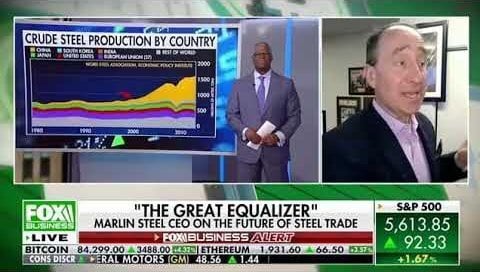
Interviewer: So over the past uh 45 years, manufacturing just absolutely devastating. Look at that. This is where we were in 1979, almost 20 million workers and in manufacturing. Now it's down to 12.7 million. Now here's the thing. This decline became even more acute after 2001. That's when China was admitted into the uh into the World Trade Organization. And that right there is when the the downside even got worse. Uh of course it was it was allowed these sort of special carveouts. By the way, those carve outs still exist. They still consider China to be quote unquote an emerging market. Since then, of course, manufacturing output has soared and China, the red line, and stagnated here. At the center of all of this, folks, is steel, right? We know it's the building block of modern societies. It's how we defend ourselves. And our next guest is the owner of a steel fabrication plant in Baltimore. He says the great equalizer is finally coming. So, let's bring in Marlin Steel CEO Drew Greenblatt. Drew, you recently told an audience uh that it's Sandtown versus Shanghai. Explain.
Drew Greenblatt: That's exactly right. I'm all in on America. We only make it America in Indiana, Michigan, and Baltimore. Four miles north of where I'm standing right now is in Baltimore is a town is a section of our town called Sandtown. It's blighted. They've been pummeled by the economy. It's not right. We want to help them. We want to create jobs so impoverished people can have the middle class lifestyle of manufacturing. And we want to help Sandtown, not Shanghai. And you nailed it with your opening uh introduction there. When we make a basket in America, for example, this basket made in Baltimore City. This is a Marlin basket. When we ship it to China, we have to pay a $13,728 duty to ship it for the privilege to ship it to China. When they ship it the same basket to Baltimore or to America, they only have to pay $8,445.
That's not right. That's $5,200 difference. That hurts the poor guys in Sandtown, in Baltimore. We want to hire more people in Baltimore, more people in Indiana, more people in Michigan. It's actually even worse with Germany. If we ship this basket, this stainless steel basket, we call it an expanded metal basket. If we ship it to uh Germany, it's $12,896 in customs duties. That's outrageous. Why? Because if the Germans ship it to here to Baltimore, it's 125 bucks. When you wonder why we went from 20 million employees in America that are doing manufacturing down to 12, that's the reason—we made it so unfair to our poor American workers. I want to double the size of Marlin, hire more people, bring people into the middle class.
Interviewer: You know, it's amazing, Drew. I love the way you laid that out. And what one of the things I thought is that we'd have we had a grand epiphany, right? Our sort of hat-and-begging during COVID-19. I think about this. Still waiting on peers and we're hoping that stuff arrives that we created in this country. We thought about, we invented and still we had to wait for it to come on boats from China. I thought maybe that would have changed enough minds and still there's a lot of resistance out there particularly from the establishment. Do they have it so good that the status quo is okay from them despite hurting Americans?
Drew Greenblatt: You nailed it. You know, in the middle of COVID, China stopped shipping IV poles to America because they wanted to keep the IV poles in China. Guess what? We stepped in. Our factory in Baltimore learned how to make IV poles. And our biggest two years ever were in COVID year 2020 and 2021 and then into 2022 making these IV poles stepping in. Well, guess what happened? As soon as China started shipping the IV poles back, a lot of American companies went back to China because it was so cheap, right? But they're forgetting in China, they desoil the environment. They use labor that's in concentration camps. They they uh subsidize the steel. They subsidize the labor. They subsidize the uh exports. We don't get those kinds of subsidies here in America.
Interviewer: Right. Hey Drew, let me let me jump in for one second, my friend, because we're running out of time. But I I I want to ask you another part of this because it's this is where we get some push back. Why some people say we should have open borders. The Chamber of Commerce is saying that we're about 600,000 manufacturing job openings that there there are yet to be filled. And and so you wonder where does what happens because we're not training those folks. Where does it fall in society, schools, businesses, uh because President Trump, he's he's cutting these contracts every day to bring these factories back. Do we have the workers here, American workers, to get them up and running on day one?
Drew Greenblatt: That's absolutely a challenge. It's going to be uh we're going to have to like bring baristas that are not getting health insurance and not getting uh uh any kind of uh vacation and and uh um good benefits. We're going to have to introduce them to manufacturing and people in uh uh you know uh more menial jobs, right? The average American factory workers getting paid 80 grand a year average. This is an extraordinarily wonderful avocation. Very clean, interesting. uh and you could really thrive and create a middle class with this. So, I think we're going to have to shift from the service sector, you know, restaurants, baristas, housekeeping to uh more lucrative manufacturing opportunities.
Interviewer: I love it, Drew. Thank you so much. really appreciate you.
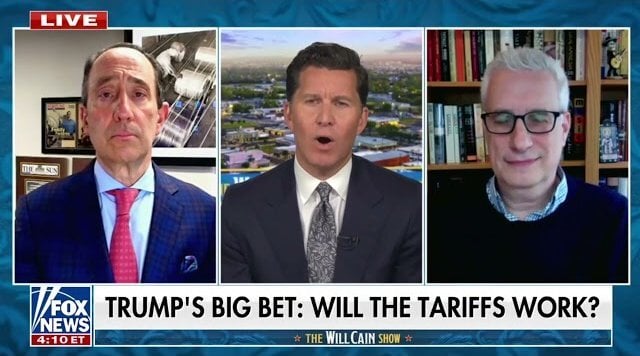
Host: Marlin Steel CEO Drew Greenblatt and senior writer at the Washington Examiner David Harsanyi joins us now. David, how you doing? Good to see you. We've been friends for a long time. We might have a bit of disagreement, but I humbly say no one knows how this is all going to play out. This is a big bet by President Trump. You just think he's making a bet on something he shouldn't, which is the dominance of the American economy.
David Harsanyi: Well, I I think that the what Batya said over there in that long clip. I don't agree with those things. Obviously, there are problems. We don't live in a utopia. When there's creative destruction, people suffer. But, you know, we we focus on that and we ignore the booming uh, you know, suburbs in Texas or Florida or Nevada. You know, we we we we we live a pretty good life in the context of the world. In fact, I think we're the best economy, you know, in the world, you know, a real country, meaning not Monaco or something like that.
And, you know, the prescription should be targeted. It should be China maybe or something. But this is just, you know, on everyone and it's not even about reciprocal trade, right? I mean, we we there are I forgot how many countries, but dozens that have lower tariff, you know, weighted tariff rates than we do. We're still, you know, Israel removed all their tariffs and we're still going to tariff on them. So, um, it's protectionist policy. I think historically it's proven that it doesn't work in the long run. I'm not saying we're going to collapse. We're incredibly wealthy, but I just think it's unnecessary pain.
Host: Still, David, I've seen Rand Paul make the argument for free trade, suggesting every partner in a voluntary trade is made out the better. But the question is whether or not we're participating in free trade, right, Drew? I mean, we're talking about fair trade. And so what Trump's argument is is we're resetting this back to free trade with everybody on an equal playing field. It's not free and fair as we sit here today. Drew?
Drew Greenblatt: You are absolutely correct. We're having a big challenge right now. We're up against a number of countries where it's wildly against the American worker. So, we make wire baskets and racks in Maryland, in Indiana, and Michigan. And we compete all over the world, China, Mexico, Germany. This is an example of one of the baskets that we make right here. Okay? And we ship this to England, for example.
And when we ship a hundred of these to England, the English government charges us 12,000 uh 12,000 uh uh uh I'm sorry, Germany. I misspoke. $12,896. But if they they ship a 100 baskets to us, it's only $125. So we have a wildly unfair playing field. And if you want to create more middle class jobs, if you want to pull people up from poverty and give them an opportunity with this great American economy, you have to give them a fair opportunity. And right now, it's not fair. Also, we're competing with China where they have uh uh they desoil the environment, they subsidize the the renminbi, they they uh use slave labor against us. It's it's wildly unfair for the American worker.
Host: So, David, um I know you just argued for a more targeted approach to this. I also know you're an economic libertarian. You're a capitalist. Again, I've known you for a long time. I want to ask you a question that I thought President Trump asked pretty well yesterday. I do think it's a fair question. If tariffs make you poorer, why does everyone else use tariffs? Why is everyone else have high tariffs on us while we have low tariffs if they're so bad?
David Harsanyi: Well, I mean, if you look at the list of countries that have low tariffs, they're all rich countries. Sometimes there's some, you know, some country thrown in there in Africa or something that doesn't have tariffs. And when you look at higher tariffs, India, China even, they have far they're far poorer than us. They have their per capita GDP is far less than ours. Why should we follow countries that are less successful than we are in bad economic policy makes no sense to me.
Now, you know, it is unfair. You're never going to have perfectly fair trade in the world and everyone's going to I wish there were no tariffs at all. I mean, that would be best. But that's not really the argument Donald Trump's making. He's saying we're going to get rid of the income tax. He's saying that protectionism will create this country where we're completely self-sufficient and all of that. So, I mean, we keep talk talking about the and listen, he changes his mind every day, right? But I mean, that's not what this policy is. We're not making things fairer. We're just going after everyone.
Host: One last question you Drew and this is where David and I started. It's off that clip from Batya talking about the deeper problems in the middle class. You represent the steel industry. I do think while we are prosperous, I think you're right about that, David. We are prosperous. We have seen an economic divide and you run a risk if you hollow out the middle class if you de-industrialize and you don't have a working base. You have a problem, a long-term problem in your country. And I'd imagine that's what you've seen in steel, Drew.
Drew Greenblatt: Absolutely. Four miles north of us is a blighted community called Sandtown. They desperately need jobs. Okay. And we have to focus on Sandtown. We should not be focusing on Shanghai. Let's protect the poor people of S of Sandtown. Let's give them opportunities. Let's give them an a a a path to the middle class so they can buy a car, own a home. Let's not be let's focus on fair for the American worker. Then then just give us a shot and we will welcome them every time.
Host: Okay. I think it's an incredibly complex debate. I welcome both of your points of view. I have this debate humbly. I and I think everybody should. Who knows how the decisions of literally hundreds of millions of people across the globe and 350 million here in the United States, which is what an economy is, hundreds of millions of decisions, will play out over what I think is a long-term bed.
Host: The CEO of Marlin Steel. He's Drew Greenblat. Drew, it's a pleasure to see you. Thank you so much for taking time to join us. What's your take on the tariff fight? What do you think?
Drew Greenblatt: We're thrilled. It's going to create a lot of jobs in America, millions of jobs in America. It's going to really help our factory. You know, right now the system is not fair. It's not level for the American worker. So, for example, this is a basket we make in Baltimore City. And this basket right here, uh, when we ship it to Germany, they charge $128 in duties in custom tariffs against this basket to the German consumer. However, when this basket is made by a competitor in Germany and shipped to America, they're only charged a buck 25. That's wildly unfair to the American worker.
If we want to have more prosperity in our country, more paths and avenues for the impoverished in our country to thrive and move up into the middle class, we have to create great jobs and that's going to happen with manufacturing and that's going to help by leveling the playing field.
Host: So what would we what do you say to those who are concerned about tariffs causing inflation?
Drew Greenblatt: Well, I think it's going to be a onestep time, you know, where there's a one uh step day where things get uh rationalized. Yes, some t-shirts are going to cost a little bit more money, but in general, we're going to create millions, tens of millions of jobs in America where we're making things again in America, making a country strong and prosperous. We've gotten into a situation where we're a service economy and that's what we export. You know, half of America doesn't own stocks. Half of America doesn't have a $250 war chest in case there's an emergency. We have to create a path for the impoverished in our nation to have nice jobs, $80,000 a year jobs and and be sufficient and and grow into the middle class. Manufacturing of those kinds of jobs.
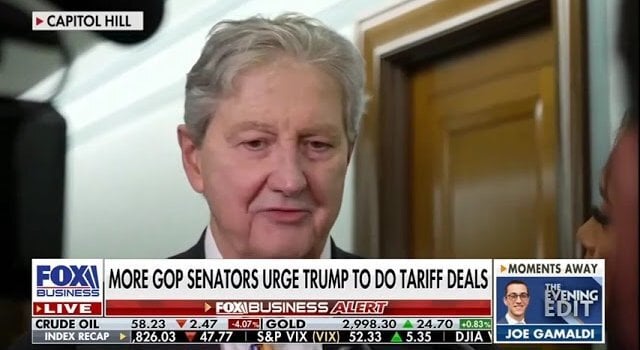
Host: Got it. Let's get your reaction to Senator John Kennedy on all of this. Listen to this.
Senator John Kennedy: I hope he negotiates zero tariffs with as many of them as we can. Europe's offering zero trade barriers. I'll take a dozen. Taiwan, I'll take a dozen. Vietnam's offering zero trade barriers. I'll take a dozen. I hope Prime Minister Carney in Canada doesn't. But I don't know what the president's going to do. I know I I don't know what's in his head. Uh I think I know what's in his heart, but I don't know what is in his head. But I know what I if I were king for a day, I'm not and I don't aspire to be. I would pounce on these zero tariff deals like a ninja.
I'm not going to u feain understanding. I have no idea what the impact is going to be on the American economy or the world economy. I listen to all these economists uh confidently predict that it's going to do this or going to do that and they're very self-confident. Uh most of them uh act like they discovered gravity. Uh but they they don't know what's going to happen and they're going to they have a record to prove it. So we'll just have to wait and see. It's it's been painful and and uh but it may turn out well. It may not. If it doesn't turn out well, I think the president will recalibrate.
Host: Drew, what's your reaction to what you just heard?
Drew Greenblatt: Zero zero sounds interesting. However, there's more to it. I mean, when we compete with China, we're sometimes competing with uh groups of people that will steal our intellectual property. So, that's not tied into 00. So, you need more than just 00. You have to have intellectual property protection. You have to have you have to make sure they're not desoiling the environment. We're very careful to make sure that the Chesapeake Bay near our factory in Baltimore is never desoiled. They just dump into the Yangty, right?
They they use slave labor, the Weaguers. They have 3 million Weaggguers in concentration camps. This is this is part of the disconnection where we're up against. Uh it's more than just 00. We 00 would be a good start, but we need more than that. We need a parody of environmental. We need parody in uh intellectual property. It's it's a whole relationship. Got it. Uh that that's critical to uh make it fair for the American worker.
Host: Totally fascinating. Really interesting. Drew Greenblat, thank you for so much. CEO of Marlin Steel there. Good to see you. Thanks for joining us.
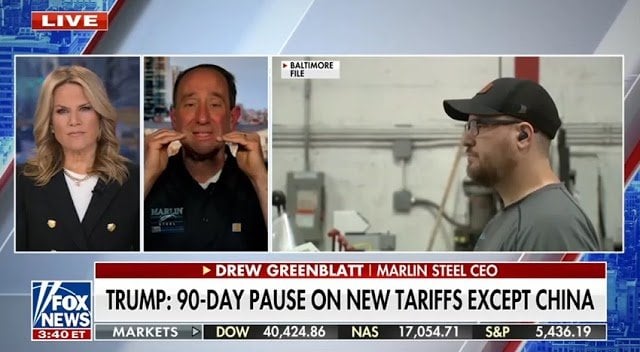
Host: The world's largest exporter of steel to the world. We are the largest importer of steel. So what is the impact on our steel companies? Drew Greenblatt is the CEO of Marlin Steel. Company employs about 115 people in Michigan, Indiana, and Baltimore. Company makes millions of pounds of steel a year. Mr. Greenblatt, thank you very much for being here. I imagine this has been a bit of a whipsaw day for you as well, as you have tried to manage these tariffs. Tell me what you were feeling yesterday about all this and what's different today.
Drew Greenblatt: We're thrilled with this outcome. I mean, you have 70-something countries coming to the president asking to slash their tariffs so that we have better access for our products. We make everything in Baltimore. We make everything in Indiana. We make everything in Michigan. And we export to 40-some countries. It's so important for the American worker to get a fair and level playing field. Right now, we're up against some real challenges.
Let me give you an example. We make this basket right here. It's a medical device basket. And we ship this, for example, to Germany. When we ship this to Germany, the German government charges our German consumers $128 in tariffs for this basket. Wow. However, if our German competitor ships it to us—a knockoff of this basket—the American government will charge the American consumer a buck 25. Wow. That's wildly unfair to the American worker. That is massive disconnect.
So, President Trump leaning in, protecting American workers, saying, "Hey, look, we got to have a level playing field," renegotiating these deals, which are wildly unacceptable. By the way, this is generations of bad decisions, bad policy by Democrats and Republicans. This is not a political thing. This is, hey, we need to protect the American worker. Let's give them a fair shot. Let's give them an opportunity to sell overseas with a level playing field. If we do, we're going to thrive. We're going to hire millions of American workers to keep up with all the demand about to hit us.
Host: So, what about China? What's your take on the 125% tariff on Chinese goods and obviously steel is a huge part of that?
Drew Greenblatt: So, China is a whole different kettle of fish. China, they debase their currency. They subsidize exports. They subsidize the steel. They subsidize the labor. They use forced labor, concentration camp labor, the weaguers, to make parts that ship to America. They steal our intellectual property. You know, we have seven degreed engineers and they come up with the most amazing innovations, the most clever ideas, novel ideas. You know what China does? They cut and paste items, ideas from our website and put it on their websites over in China, pretending they came up with the ideas.
So, we need a level playing field, not just with tariffs, but also with intellectual property. We need it with environmental. I mean, we protect the Chesapeake Bay. They dump in the Yangtze. So, we have to have fair parity. So the American worker has a shot. President Trump is knocking down tariff walls to give us an opportunity so we could export all over the world and have fair deals against China and against other countries that are not playing by the rules.
Host: Well sir, thank you Drew Greenblatt for joining us today. Marlin Steel. Really great to get your insight as someone who is on the ground, have a lot of employees who are producing here in America, and it's something that we all hope that we get to see more of as a result of all this. Thank you so much.
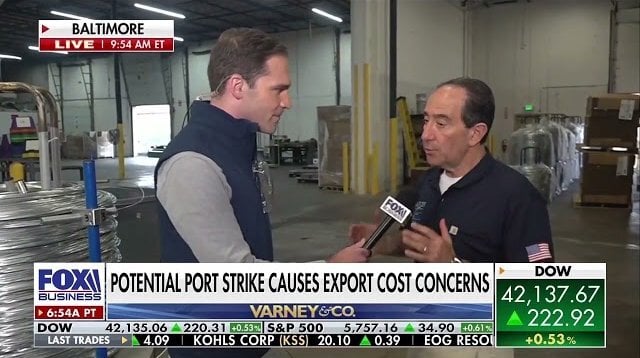
Stu (Host): All right, let’s go to the latest on this potential strike at various ports around the country. Grady Trimble is actually at a factory in Baltimore. Grady, we want to know how much would a strike cost manufacturers.
Grady Trimble (Reporter): Just this company alone, Stu could have to pay hundreds of thousands of dollars more in shipping if, for example, they have to switch from uh uh cargo ships to air cargo. This is Marlin Steel. They make all sorts of steel products like these paint bucket handles, carts, uh trays, all sorts of stuff are made here. You can see this uh steel spool going into the machine. Drew Greenblat is uh—well, you're the CEO and part of your job right now is coming up with a contingency plan. If this strike happens, what do you do?
Drew Greenblatt: We're we're we're having challenges because we want to ship all over the world. We ship to 45 countries. We make it all in Baltimore. We make it all in Indiana. We make it all in Michigan. And it it ships out of this port here in Baltimore. And if it we can't get it through this port, we're gonna have to put it on airplanes. And that's gonna cut into your margins big time.
Grady Trimble: Terrible.
Drew Greenblatt: We must ship on time. That's critical. It's terrible that this strike is happening because it’s going to disrupt our smooth flow to our clients.
Grady Trimble: And we're still several days out. Maybe they avert a strike. But even now, you're you're planning as if it's happening, right?
Drew Greenblatt: Absolutely. We’re right now talking to different uh entities like FedEx and UPS to put it on airplanes to fly it all over the world.
Grady Trimble: Got to come up with a plan B. I guess that's what good CEOs do, Sue.
Sue (Anchor): So I'm told. All right, Grady, thanks for joining us. That was good stuff.
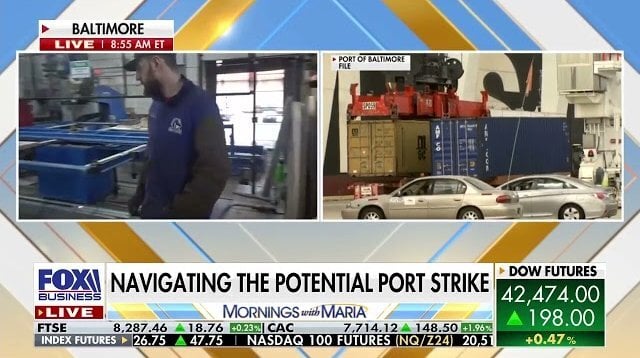
Maria Bartiromo (Anchor): Welcome back. Financial uncertainty for manufacturers who ship goods through US ports. Fox Business is Grady Trimble, live in Baltimore this morning with more. Grady.?
Grady Trimble: Hey, good morning, Maria. We're at Marlin Steel, where they make these metal baskets, cards for various industries, and they ship these products all over the world. Drew Greenblatt is the CEO here at Marlin Steel, and you're seriously concerned about this strike because you ship out of the Port of Baltimore, as well as ports all up and down the East Coast of the US. What happens if this strike happens in a few days?
Drew Greenblatt: This is a problem. We make everything in America. We use American Steel. We make it in Indiana, we make it in Michigan. We make it here in Baltimore City. That port is critical to us. When we have challenges where we can't ship out of here, it causes problems, and our clients are going to get upset because we're not going to be able to ship on time. We export all over the world. It's really holding us up.
Grady Trimble: Now you're trying to come up with contingency plans. Do we to apply our orders to the customers because you still got to get them there on time, but then that eats into your margins. How bad would that be?
Drew Greenblatt: It's going to be a beat down. The best way is on a boat. That's cheap. It's very expensive to ship on an airplane, but we got to make it work. We got to make these clients happy. The reason why they come to us is because we ship quality engineered very quickly.
Grady Trimble: Maria, we've been talking a lot about imports into the US and the supply chain problems as a result of that, but this is going to affect these businesses who export as well if this strike happens. Maria?
Maria Bartiromo (Anchor): Well, we'll see if they go on strike. We're all waiting and watching. Grady, thank you. Grady Trimble.
David (Host): There is a risk of a looming work stoppage at ports along the East Coast and Gulf of Mexico, causing financial uncertainty—to say the very least—for a lot of US manufacturers who ship their goods out. That includes Marlin Steel, located near the Port of Baltimore. Grady Trimble is on the floor at the Marlin Steel factory in Maryland with the very latest on the impacts of this potential strike. Grady?
Grady Trimble: And David, with this potential port strike looming, businesses are bracing as if it's going to happen. We're at Marlin Steel, where they make all sorts of steel products with US steel—including baskets like this one, carts, paint bucket handles, and all sorts of stuff made right here in the Baltimore area. I have Drew Greenblatt, the CEO, here with me. Drew, your issue is not that you're importing materials you need to make these products—because it's all US products—but you ship it out; you export. So if this strike happens, you won't be able to deliver on boats, at least on ships. What do you need to get out to your customers?
Drew Greenblatt: This is a huge problem. We make everything in America. We only use American Steel. We make it in Indiana, Michigan, and Baltimore, right here. And if this strike happens, it's going to disrupt us, and we're not going to be able—it's going to make it challenging to ship on time. We're not going to be able to ship on time through boats, so we're going to have to fly things, and that's very expensive.
Grady Trimble: How much more expensive is that? And is it you who's going to have to eat that cost?
Drew Greenblatt: We're going to have to eat that cost because we made firm commitments to our clients to ship on time, every time, and it's going to be brutal. It's going to be hundreds of thousands of dollars a week for the next couple weeks, just to be straight up—just to be honorable with our clients.
Grady Trimble: And so, like I said, you're planning as if this strike is going to happen, even though it still could be averted. You've got to come up with a Plan B.
Drew Greenblatt: We're very concerned it's going to happen. So our plan is: talk to UPS, talk to FedEx. Get airplane pricing, because we can never let our clients down.
Grady Trimble: Yeah, so David, this is just one company of dozens—maybe even hundreds or thousands—dealing with this as they wait to see what happens with these dock workers. David?
David (Host): Great report. Grady Trimble, thank you.
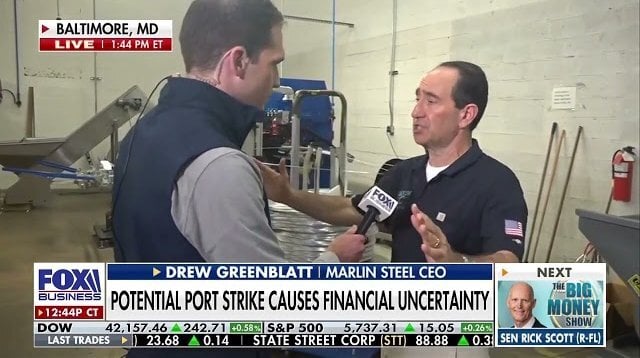
Brian: The country is bracing for a potential port strike that could cost the economy $5 billion a day. Fox Business's Grady Trimble joins us from the Marlin Steel factory floor in Baltimore. Grady, how are they preparing for this?
Grady Trimble: Well, Brian, at this point they're expecting the strike to happen. Obviously, that's still up in the air. We've got a few days to see what happens. And we've been talking a lot about the impact to imports, but this is a business, Marlin Steel, that would be gravely impacted by the export issue. They make all their products like this uh paint bucket handle, baskets, carts, all made out of American steel, but then they ship it all over the globe. And I've got the CEO with me, Drew Greenblat. Uh so I I just mentioned you're you're basically planning for this strike to happen. What are you doing as a contingency plan?
Drew Greenblat: This is really a big challenge for America and American manufacturing. We need good ships to be able to ship our parts all over the world. We ship to 45 countries. We may have to fly these parts overseas rather than put them on boats like we normally do.
Grady Trimble: And that really cuts into your margins. That would be bad news for your business.
Drew Greenblat: But we got to ship on time every time. Our mantra is quality engineered quick. We got to always ship on time. So in this case, we may have to fly things to make sure our clients are always happy, which is quicker. It's just uh how much more expensive? It's hundreds of thousands of dollars we're worried that we're going to have to spend over the next four, five, six weeks to make to be honorable to our clients.
Grady Trimble: And by the way, just tell us a little bit about this machine we're watching as these uh uh paint bucket handles come off. How how many can this crank out?
Drew Greenblat: So, this machine right here is using wire from Tennessee, plastic grips from Iowa, all made in Baltimore, and we're making 5-gallon paint can handles on this machine and one-gallon paint can handles on the other machine. So, when you go to a big uh um department store to get paint, you're picking it up with Marlin bucket pail handles. We're real proud of that.
Grady Trimble: All right. And plan B is uh I guess fly by air or ship it over to the West Coast where the ports might not be on strike. We'll see what happens, guys.
Brian: Wow, Grady. I've never thought about where my paint bucket handles come from, and now I know, and it's fascinating. Good stuff. Thank you, sir.
Grady Trimble: I love that. All made in the USA.
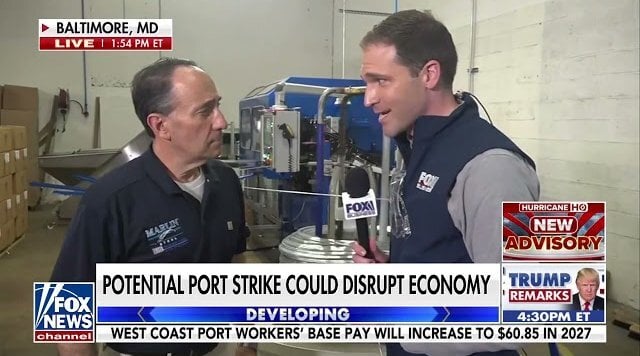
John: The risk of a union walkout at ports from Texas up to Maine is causing financial uncertainty for thousands of companies, possibly creating shortages and leading to higher prices. FBN’s Grady Trimble is at a factory that depends on shipping mainly through the Port of Baltimore. Grady, we already saw that interruption in ship traffic from the Francis Scott Key Bridge collapse. How would a strike affect them?
Grady Trimble: Well, it would be huge, John. When the bridge collapsed, they were able to use other ports along the East Coast, but this would impact every single port on the East Coast. We’ve talked a lot about the impact to imports, but this company where we are, Marlin Steel, is particularly concerned about exports. They make all sorts of steel products like these handles for paint buckets as well as metal baskets and carts and all sorts of other stuff. What they do is they send their products all over the globe from ports on the East Coast. Drew Greenblatt is the CEO, and you’re basically planning for this strike to happen and coming up with Plan B, but it’s going to cost a lot more.
Drew Greenblatt: It’s scary. You know, we make everything here—here in America. We only make things in Indiana, Michigan, and Baltimore. We export to 45 countries. It’s critical that our clients get everything right on time. That’s mission-critical, and this is going to make it very difficult. So we may have to fly these devices, baskets, and racks and carts on airplanes rather than by boat.
Grady Trimble: Very expensive. How much more expensive?
Drew Greenblatt: Hundreds of thousands of dollars over the next couple weeks and months we’re going to have to spend. This is really challenging because we’re fighting China every day. We’re fighting Mexico every day because we make it all here in America.
Grady Trimble: Yeah, you were just talking about this. This steel is from Tennessee, and it’s better quality than the stuff that comes in from China. You pride yourself on that, and because of that, you don’t have to rely on imports, but your customers are elsewhere in some cases.
Drew Greenblatt: Exactly. We only use steel from America. We only make it in America, so this is one more thing that’s slowing us down. We want to hire more talent; we pay great; we offer generous benefits. But this is one more obstacle that makes it difficult to really prosper and thrive. We want to really throttle and get to the next level.
Grady Trimble: So, John, this is one of dozens, probably hundreds, maybe even thousands of companies that are bracing for the impact of this potential strike.
John: Well, let’s hope they work it out before it comes to that. Grady Trimble for us in Baltimore. Grady, thank you.
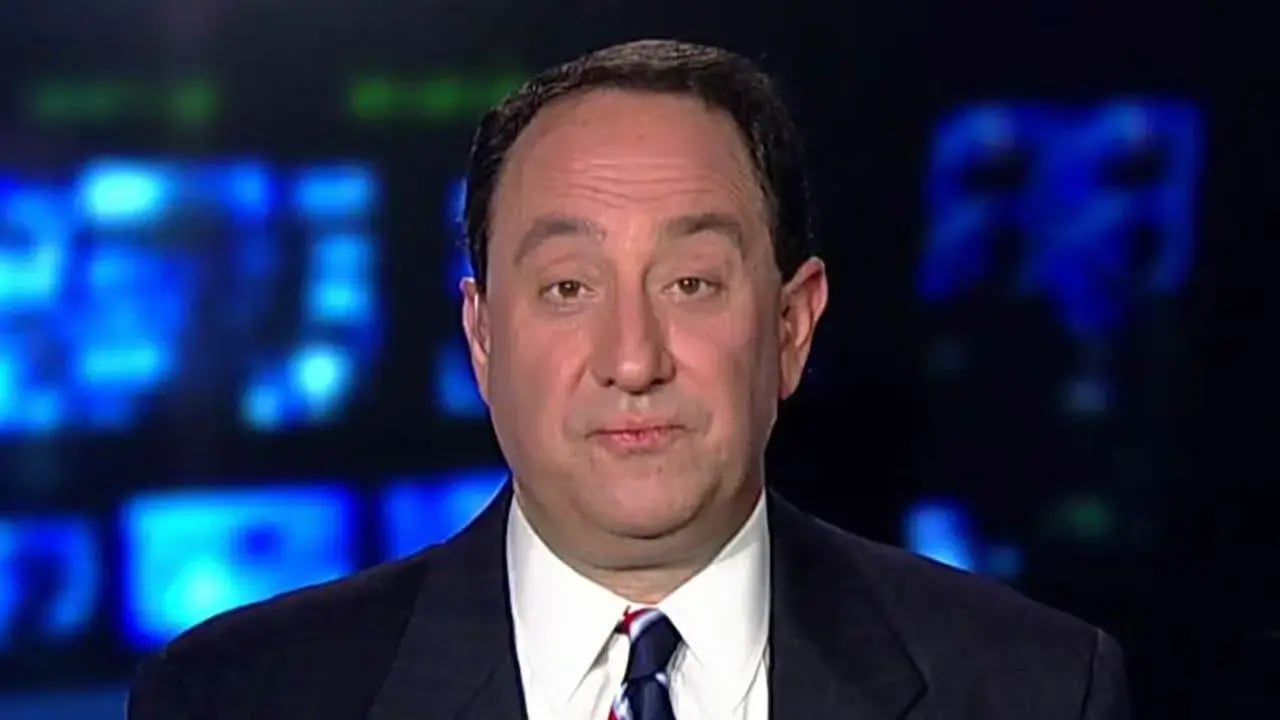
Host: First, Republicans in the House unveiled their plan, and yesterday Senate Republicans did the same, a response to the GOP plan. But can the final bill be a win for the American worker? Our next guest thinks so, and he's willing to stake his manufacturing business on it. Joining us right now is the president of Marlin Steel Wire Products in Baltimore, Drew Greenblatt, joining us from our nation's capital. Drew, good morning to you.
Drew Greenblatt: Hi. Hello. Good morning.
Host: Okay. So just like the House bill, under the Senate bill, the corporate rate would be reduced from 35% to 20%. Would you explain for folks at home how lowering the corporate rate is going to help everybody?
Drew Greenblatt: Absolutely. What that means is that companies like Caterpillar, Emerson, and Boeing, when they compete with their foreign rivals, are going to be able to lower their prices to accommodate the cheaper tax rate. This is going to mean that Boeing and Caterpillar win more jobs. When they win more jobs, we're going to ship more airplanes; we're going to ship more tractors. By the way, Marlin makes baskets for these guys, and we're going to have to hire more people. Boeing's going to have to hire more people. Caterpillar is going to have to hire more people. All American factories are going to see a huge surge of production in the USA if we have competitive tax rates compared to China, Canada, and Germany. Right now, we're underwater. We're in deep problems because we can't compete with these countries. It's going to be great for the American worker.
Host: In fact, your company does compete with companies in Mexico and China as well. Explain personally how it would impact you.
Drew Greenblatt: We make everything in America. We buy USA steel from Indiana and Illinois, and we export to 39 countries. We make it 100% in the USA. If this tax bill happens, what's going to happen is we're going to get a lot busier. We're going to have to hire more talent. We already are all in. We know it's going to happen. We're enthusiastic about it happening. And we've invested over a million dollars—we're a small company—$1.2 million in new technology and new automation. We have all kinds of electricians in our factory to keep up with this enthusiasm. It's very exciting for the American economy. It's good news for the American worker.
Host: Okay. But when you look at the individual tax rates, they're going to stay at seven brackets in all, and they might go down as little as about 3% in total. But does it simplify things like the president said?
Drew Greenblatt: Yeah. Well, the president said he wants it much simpler, and I think that's what we're going to get. 90% of Americans will be able to file their whole tax package, their tax forms, on a postcard. I mean, H&R Block is not going to like that, but all the Americans are going to love it. This is a good thing for the nation because, all of a sudden, our standard deductions are going to double from $12,000 a year to $24,000 a year. Plus, they're expanding the child tax credit. This is good for the average American, and this is going to be wonderful for American factories. We're going to hire a lot of people to keep up with all the new growth and all the new optimism coming into our country.
Host: Well, you're very optimistic. Let's see what happens next. Drew Greenblatt, we thank you very much for joining us today from our nation's capital.
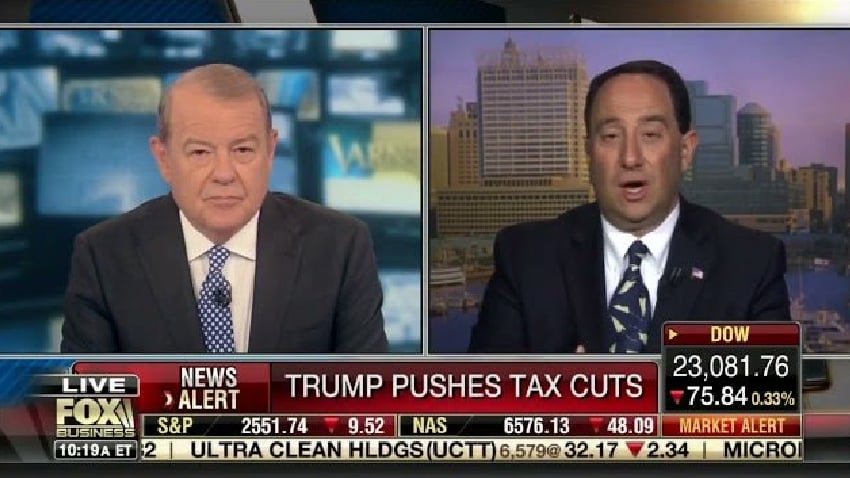
Stuart Varney: ing his tax cut plan to make companies more effective. Roll that tape again, please.
Donald Trump (Audio Clip): In addition to simplification, the other pillar of our tax plan is reducing our crushing business tax so that we can restore America's competitive edge. Today, our business tax rate is 60% higher than our average economic competitor. This is a giant self-inflicted economic wound. That is why we will cut the corporate tax rate from 35% all the way down to not more than 20%.
Stuart Varney: So if you get that big corporate tax cut, you come—the rate comes all the way down to 20%. Will the companies which benefit from that tax cut invest in new factories, new plant and hire new workers? Will they do that with the extra money? Let's ask. Drew Greenblatt is a Trump supporter and he's the CEO of Marlin Steel. Will you build new factories? Will you hire new workers? You, Marlin Steel, if you get that tax cut?
Drew Greenblatt: Stuart, buckle your seat belts. You're about to see a huge surge in manufacturing wages, manufacturing jobs, because all of a sudden, people are going to be pouring cash that's been sitting on the sidelines for years and years into this new found optimism.
Stuart Varney: Okay? And I'll repeat the question. I will repeat the question, Drew. And you know what the question is? Will you at Marlin Steel, if you get this tax cut, will you be building a new steel plant or two? Will you be hiring new workers?
Drew Greenblatt: I told President Trump himself that because of this tax reform plan, we're investing over a million dollars into our factory. Right now, we have electricians in our facility this moment, drywall guys. We've ordered new robots, new automation. We're going to be creating new jobs. We're hiring more people to handle all this enthusiasm and excitement because I know that tax reform package is definitely going to happen. Our country desperately needs it. Our economy is going to flourish because of it. It's going to create tremendous prosperity in our nation.
I mean, not only is it the simplification, but it's going to be able to uh—and it's also going to cut our taxes for the big companies, but also the little companies. Their rates are going to go from 39% to 25%. So, there's going to be a tremendous amount of activity, positive activity, new jobs, new wage growth. It's exciting times for America and manufacturing in particular.
Stuart Varney: Now, why do you say that you're absolutely certain that we will get a 20% tax rate for corporations?
Drew Greenblatt: Because uh we've listened to Secretary Mnuchin in private meetings. We've also met with Vice President Pence, President Trump. We've met with Senator McConnell. We've met with uh Congressman Ryan. They—they are meeting once a week to get this accomplished. Kevin Brady talked with us explicitly about things like getting instant expensing done which is going to be an amazing uh uh excitement for the economy. People are going to invest in their factories and in their robots and their automation giving our employees the best tools. They're meeting once a—once a week so they have a concerted approach as opposed to how they uh f—uh dealt with other uh regulations and other policies. This one is going to be with a cohesive approach and I think it's working. It's already passed some of the first hurdles and they're going to get this done by Christmas. It's exciting. It's going to really do great things for our economy.
Stuart Varney: Well, you answered the question. Drew Greenblatt. That's pretty good. I mean, I'm used to a lot of hedging here, you know. Well, we might do this or we ought to do that.
Drew Greenblatt: It's definitely happening.
Stuart Varney: That was definitive and we like it. Drew Greenblatt, Marlin Steel. Thank you, sir. We appreciate it.
Drew Greenblatt: Thank you.
Stuart Varney: Good stuff.
Drew Greenblatt: Thank you.
Stuart Varney: That was good stuff. Answered the question.
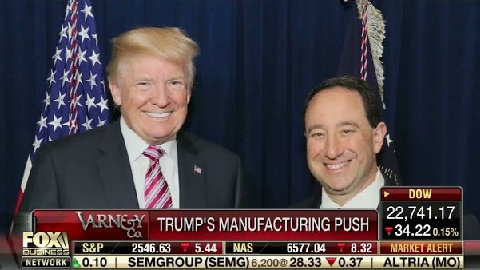
Stuart Varney: Whatever. You know, you don't really like that song.
Charles Payne: I do like that song. It's a good song.
Stuart Varney: Very good. Charles, you're all right. All right, guys. I miss you. Stay around for a while. Okay. I don't know. I don't know. I'm following directions. Apparently, we're keeping you.
Charles Payne: Okay. Good.
Stuart Varney: Right. The president is hosting leaders of the manufacturing sector at the White House a little later on today. Marlin Steel's chief executive, Drew Greenblatt, joins us now. I believe he—I'm not sure you're going to be at the White House later on, but he's certainly joining us right now. Drew, the president's been making a push for manufacturing. Um, you're a steel kind of guy. Do you want steel import tariffs?
Drew Greenblatt: Well, we are very excited about the future of the economy. Manufacturers in general are over 90%. And matter of fact, the president is embracing manufacturing. Two of our employees will be in the Oval Office today when he's making some announcements about manufacturing. One of his big initiatives is tax reform, which I was—had the privilege of welcoming him to the National Association of Manufacturers board meeting uh last week, 7 days ago, where he announced tax reform.
It's going to be tremendous for our nation. We're really poised for great things. Our nation's like a coiled spring. The American manufacturing renaissance is really going to happen, and this president's plan for tax reform is going to do wonders for getting this economy really rocking. We're very excited.
Stuart Varney: Yeah. I—I got it. But I have to ask you, there has been some talk about putting tariff barriers on imported steel because maybe they're dumping it on us. Would you like to see barriers, tariff—tariffs on imported steel?
Drew Greenblatt: So u—tariffs are—you know, there's some industries that are negatively impacted, some industries that are positively impacted. Uh you know, we have to study this more carefully. Uh you—the bottom line is is that the tax reform plan that the president is pursuing is going to do such wonderful things for our nation. That's what we should be focusing on today because I believe today is manufacturing day and that's going to have a huge impact.
Right now we have massive dislocation where Canada is charging a 15% tax on their factories and in America we're charging 40%. That's just not tenable for our uh small and medium-sized manufacturers. And our nation's going to really prosper. We're going to be hiring a lot of talent to keep up with all the increasing demand with this—this new initiative.
Stuart Varney: Hold on a second, Drew. If you get the tax cut that's being talked about, you will go out and hire more people for your steel company. That correct?
Drew Greenblatt: Absolutely. And more importantly, we're already doing it because he announced it a couple days ago. We're all in. We're spending $1.2 million. We have construction workers on our facility today making additions, knocking down walls, moving machines around to accommodate the surge in business. We're anticipating. Optimism is over 90% for the manufacturers three quarters in a row. We're fired up. Manufacturers are enthusiastic about the future and this is before the tax cuts are installed, which are going to happen this year. We're very optimistic. It's an exciting time for the American manufacturing renaissance.
Stuart Varney: Drew, I can tell you're all pumped up and I don't blame you. Thank you very much for joining us, sir. Big day today.
Drew Greenblatt: Thank you, sir. Got it.
Stuart Varney: Thank you. Uh I am just fascinated—
Stuart Varney: What would happen to the US-Canada friendship if President Trump tears up NAFTA? Let me give you a number here: every year $544 billion in trade occurs between the two countries. And you know what that works out to every 24 hours? 400,000 people and $1.5 billion in goods transferring across the 4,000-mile border daily. It is far more critical, though, for Canada as 3/4 of all Canadian exports head straight to the US.
Let us bring in former Ambassador to Canada James Blanchard, also former Michigan Governor, and we're thrilled to have you here, along with a guy named Drew Greenblatt. He's the CEO of Marlin Steel, a Baltimore steel and wire company that does a big chunk of his business with Canada and Mexico.
Ambassador, to you first: what does it look like to you? Did Prime Minister Trudeau save any part of NAFTA, or is he already simply ready to strike a fresh deal with the US?
James Blanchard: Well, I think NAFTA can be tweaked. I was there when we signed it, when we finished it. You know, it started in January 1994. So you can modernize uh NAFTA or relations with Canada very easily. So I don't see any major change. I mean, it's—first of all, it’d be self-defeating for us to do that.
I mean, and by the way, the busiest trade corridor between our two countries is Detroit-Windsor, and we do more trade with Canada than we do all the European Union added up, and it supports—I don't know—maybe about 7 million jobs in the US. So not much I think will happen other than maybe update it to have more standardized goods and services, allow better free flow of labor, a lot of different things—e-commerce things like that. So I—I think everything will be fine. I think the meeting went quite well today actually, and the real target is Mexico and how you do that. And remember, Mexico is important to us; they're not just an ally on a border, but they're important to our economy as well.
Stuart Varney: Well, to the Canadians though, um, they sell more to us. But let's not—let's not ignore the fact that we're a stock channel, we're a market channel, and people are watching right now and they own stock in companies here based in the US that get a ton of revenue from Canada and from dealing with Canada—everything from Ford to Costco, Home Depot, Valero Energy, ConocoPhillips—huge amounts of business dealings there. Um, so—so do we—do we simply accept that we are going to have really good relations with Canada, Ambassador, and that it’s—nothing better change in that regard when it comes to border taxes and border tariffs?
James Blanchard: Yeah, I—I—I think you're right. I think good relations will continue. I really do. I don't—I don't see a problem with tweaking NAFTA and modernizing it. I mean, we have a totally integrated automotive industry, totally integrated energy industry. We can't live without that any more than they can. Okay? And there's a lot more there: financial services, agriculture, uh, infrastructure. It's—it's a partnership that works, and nobody in their right mind, frankly, would try to alter it in any significant way.
Stuart Varney: Let me bring in Drew Greenblatt. You're with Marlin Steel, you're the president, you're the CEO of—uh, you—you make steel and wire. How much business do you do with Canada?
Drew Greenblatt: About 20–25% of our business every year is with NAFTA—Mexico and Canada. Probably about 10–15% is with Canada alone. Canada is hugely important for Marlin and other factories throughout the nation.
Stuart Varney: Where do you stand on the president's belief that NAFTA must go?
Drew Greenblatt: I—I think the president is right that we need to refine and tweak NAFTA. It's a—a—a document that was created over 20 years ago. A lot's changed. The iPhone was not invented yet; uh, the internet was in its infancy at this point. Uh, so it could be uh revised, refined. There's a lot of important things we can add and improve. You know, it's—trade with Canada, trade with Mexico is really important for America.
Stuart Varney: Let me just interrupt you because we're—we're showing video of your operations. A lot of American flags here, but you're not just jingoistic. You are willing to sell to countries that will absolutely buy from you. So is there anything that you fear or panic about? If—look, everything at one stage is—is appropriate, at another might be inappropriate. NAFTA’s an old deal. You've got to—as—as we're using the word of the day—tweak it. But which part of it do you need to see tweaked and which part of it do you need to stay the same so that you keep selling your goods across the borders?
Drew Greenblatt: That's—that's a great question. You know, Marlin exports to 39 countries. However, like you said, Canada is really important for us. Things we need to make sure is that when we ship a car to Canada or they ship a car back to us, the—the taxes are the same each way. Same thing with supplies—uh, parts and supplies. We ship baskets into Canada for their factories, so we want to make sure a Canadian basket maker has the same tax coming into America as we have going into them.
We need a level playing field. If we get a level playing field, I'm content because the American manufacturing community will rise to the occasion. We'll do super things if we have a level playing field. That's all we need. And if President Trump can get that accomplished, he'd be a huge success with the Canadian trade and Mexican trade.
Stuart Varney: I want to thank both of you very much. Uh, Drew, good luck to you, and Ambassador James Blanchard, it's a pleasure to have you both.
Charles Payne (Host): All right, guys. I've been banging the drums that we are on the verge of a manufacturing renaissance. And today, President Trump met with a group of manufacturers at the White House after news that manufacturing optimism is stronger than ever.
President Donald Trump (Archive Audio): This was the highest level of optimism that our manufacturers have expressed in 20 years.
Charles Payne: Well, the man you just heard from was from the National Association of Manufacturers. He's the CEO, Jay Timmons, and he met with President Trump today and he joins us right now along with Drew Greenblatt, who was also at that meeting. Uh Jay, I've got to start with you. I'm looking at these numbers and 93% optimism. This is from a quarter before that was 77%, and then the quarter before that we were 61%, and as President Trump pointed out, a year ago at 56%. I mean, this is mind-boggling stuff. How does optimism jump this high to an all-time high?
Jay Timmons: Well, it's because you have a president, someone in the White House, and you have a Congress who's focused on those policies that will help manufacturers be more competitive. You talk, you talk all the time, Charles, about a renaissance in manufacturing. The way to achieve that is if you have the right policies in place. If you have the right tax policy, the right regulations, and the right uh focus on infrastructure, you get that done. And you're exactly right. And that's why manufacturers are feeling pretty good about the future.
Charles Payne: Drew, you're a manufacturer. You're in the steel industry. Uh we also got news out of the White House today. More efforts to stem unfair trade next week. The prime minister of China comes to town. Steel is going to be centrally a central focus. Are you already though seeing some signs of a shift, a sea shift in your business?
Drew Greenblatt: Yes, actually I told Donald Trump, President Trump today that we're at an inflection point right now where we're going to about to see the economy launch. We're going to see American manufacturing renaissance happen. It's such an exciting time and the poll results demonstrate that many manufacturers believe have that sentiment. That means people are gearing up. They're getting ready to hire people. They're getting ready to buy more equipment. It's a very optimistic time.
Charles Payne: All right, guys. I want to ask both of you because I thought this was interesting. The Philadelphia Fed report, the last one had a supplemental question and it's very similar to the question Jay that you guys have on in terms of the challenges, right? For you, the number two challenge was getting quality workforce. Same thing with the Philadelphia Fed. Labor shortages 60%, skills mismatch 68%. These are mind-boggling numbers. It suggests that we could be on all cylinders if we had the right workforce. Jay, I'll ask you first. What can we do about that in this country?
Jay Timmons: Well, no doubt uh about 350,000 manufacturing jobs go unfilled today because we don't have the right skill set. And if you look at the growth in man, if we do nothing, if we don't fix tax policy, if we don't fix our regulations, we're still going to create about three and a half million manufacturing jobs in the next decade. 2 million of those will go unfilled. So, this is really a problem that business is taking on. We're working with uh institutions of higher education. We're working with uh secondary education, secondary schools to get young people more interested in a manufacturing career. But we have to focus on those science, technology, engineering, and mathematic uh uh courses to uh encourage young people to get focused on manufacturing and the jobs that support manufacturing.
Charles Payne: But the the thing I found interesting again going back to that to the Philadelphia Fed thing uh Drew was the computer thing was 24% say yeah we need computer thing but there people say we need we have trouble with basic math reading and writing and then at the top of the list Drew was just working the equipment working the tools so you don't need a four-year degree for that right there's a way that we can find folks out there who want to work and they don't have to get you know a gazillion dollars in student debt they can find some way to get these jobs?
Drew Greenblatt: You're absolutely right. And these jobs are great jobs. I mean, the average pay is $83,000 a year. That includes the benefits. And if the company's an exporter, it's over $95,000 a year. And uh 97% of us offer health insurance. So, these are the kinds of jobs that we need to coddle. Our challenge, like you're demonstrating, is that when we interview people, they don't know how to do a fraction even though they have a high school degree or they don't know how to craft an email to our clients like Boeing or Merck or Toyota. So, we have to teach just very basic math and and and the root cause is that our schools need to up their game and give us better talent and we need to have that STEM education uh infused into all of our schools and we need to really focus on that. Otherwise, we're doing a massive disservice to this generation of kids graduating from school right now.
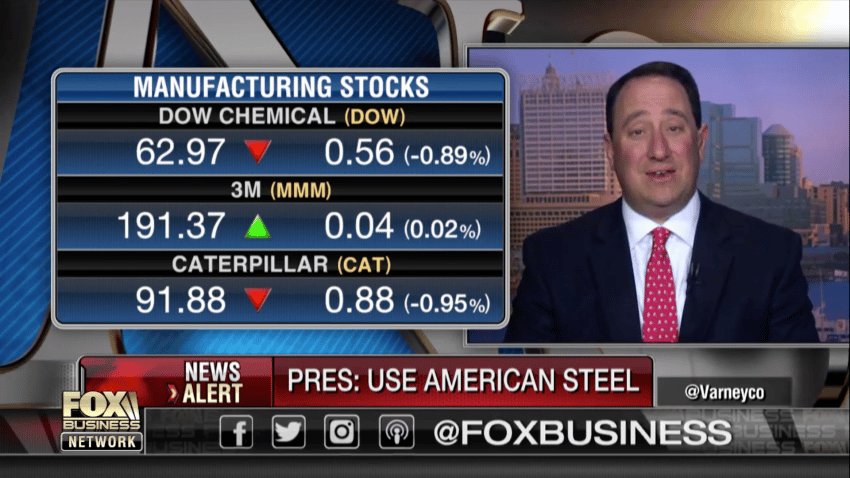
Host: Story. President Trump meeting with the manufacturers last week. Joining us now, Drew Greenblatt. He's the CEO of Marlin Steel. He was in the meeting with the president at the White House and he's got a big smile on his face. Good morning to you, sir. Welcome aboard.
Drew Greenblatt: Hello. We had a great Friday morning. Uh we were in the Oval Office. It was truly a—a inspiring event.
Host: Okay. I want you to tell us one thing, the most important thing that would bring steel jobs back to America, manufacturing jobs to America. What is that one thing that you most need to get that done?
Drew Greenblatt: I think the tax cuts. Uh right now we're bidding on a huge job. Our—our factory which is based in Baltimore City—if that's being created in Europe and we're competing with a German company and my taxes when you add up the health insurance, the FICA, the FUDA, everything uh the state etc. I'm north of 50%. I'm competing with a German company whose uh tax rates much lower.
So we win this job, we're gonna hire a lot of unemployed steel workers and if we lose this job, it's going to be because of the tax rates. The German company's very formidable. We make everything in America. We use 100% USA steel from Indiana, from Illinois. So, we want this job very badly. And this is where it really matters. This is where the rubber hits the road. And if President Bush—I'm sorry, President Trump—can get this pushed through the uh Congress, we're gonna have a huge American manufacturing renaissance.
Host: What was the the mood in that meeting? I'm—I'm sure it was a very positive mood because the manufacturers—go ahead, sir.
Drew Greenblatt: Sure. The reason why we are there is because the National Association of Manufacturers does a quarterly survey of all of its members and they've been doing this for many, many years, decades. And this—and we just uh compiled the results recently and it was the highest results in history over 20 years they've been compiling this and the—the—the optimism of these manufacturers was over 93%. That's from 56% right before the election. The American manufacturers, the job creators, the people that stroke the checks that hire the people are pumped up.
Host: Okay, let me ask you. Have you seen—have you seen any better results, more orders coming into your company since the election?
Drew Greenblatt: We're seeing nice bookings in the month of March. Uh April, we're supposed to get some big orders. Hopefully, we'll get this one uh for that big factory out in Europe. Uh we're looking at some very large orders. Also, uh domestically as well. Most of the industries that are hot right now that are buying our baskets are the automotive industries, the pharmaceutical industries, and the medical industries. Those are the industries which are really uh getting white hot.
Host: Marlin doing well. Drew Greenblatt, thanks for joining us, sir. We appreciate it.
Drew Greenblatt: Thank you.
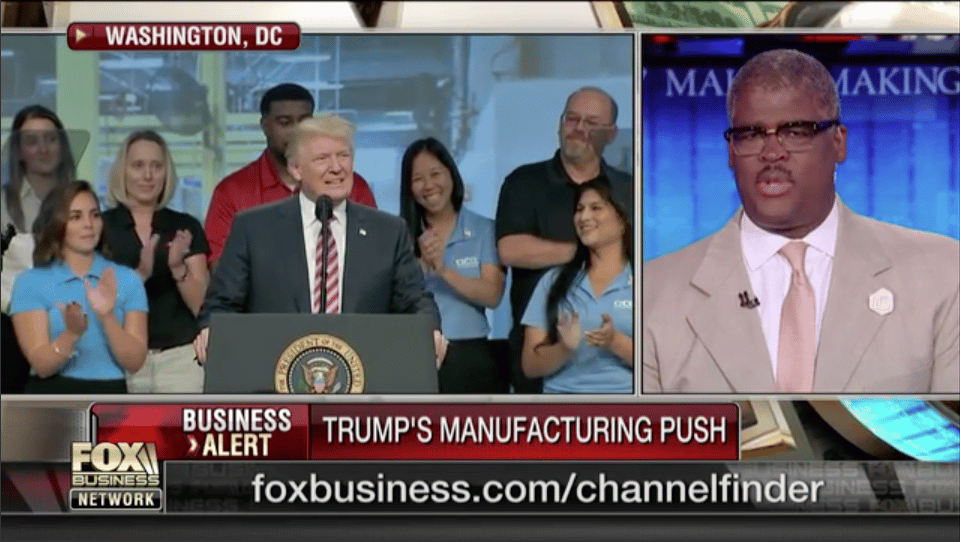
Charles Payne: President Trump addressing a meeting at the National Association of Manufacturers in Washington earlier today, declaring that quote, "The era of economic surrender is over." Roll tape.
President Donald Trump: For decades, the policy of Washington DC on the subject of manufacturing was a policy best summarized in one word: surrender. They surrendered. Under my administration, the era of economic surrender is over and the rebirth of American industry is beginning. America is winning again.
Charles Payne: You know, I've been pointing out all year long signs of a burgeoning renaissance in manufacturing and it was sparked by the election of Donald Trump. Those animal spirits were seen immediately in optimism surveys, including the National Association of Manufacturers. And as you can see, it's been holding even as GOP leadership has stumbled of late. Here to discuss between now, Marlin Steel President Drew Greenblatt, who actually met with President Trump today, uh, also back with us, Ned Ryan.
Charles Payne: First of all, Drew, we're going to throw up a photo of you and the president because that was pretty cool stuff, man. Secondly, let me ask—I look at the data. I look at it very closely, and what we're seeing is indeed a manufacturing renaissance. How important is it now that the rest that that parts of the Trump economic agenda go through?
Drew Greenblat: It's hugely important. Our nation, our factories are like a coiled spring. There's such optimism. There's so much cash on the sidelines. That's all going to come off the sidelines. It's going to be invested back into factories, buying new equipment, building new factories, getting more automation, hiring more people. There's a tremendous manufacturing renaissance burgeoning. It's exciting. This is really an optimistic time for us.
Drew Greenblat: Matter of fact, the National Association of Manufacturers does a quarterly survey. Three quarterly surveys in a row since the president was elected have been over 90% on average. It's a stunning number. We're enthusiastic about the new paradigm coming uh being unveiled. These tax reforms are going to be huge job creators. We're talking about going from 40% for the small and medium-sized manufacturers—a 40% tax rate—to 25. This is going to be great. We're going to be investing and growing.
Charles Payne: Ned, why does President Trump have to go to blue—I'm sorry, red states to the heartland to sell this? I understand that people want to hear the message and it's great and to have that enthusiasm, but it feels like he's spending more time selling fellow Republicans than anybody else.
Ned Ryan: It’s kind of a shame, Charles. At some point, some of us are starting to question what's the point of Republican majorities if we can't push through—not a Trump agenda, not a Republican agenda—a common sense agenda. This is common sense. If you're taking the corporate tax from 35 to 20, you make us highly competitive. If you take it from 39.40 for small businesses to 25, you're making us highly competitive. You're going to see a 4% growth in the economy.
Ned Ryan: And it is a little frustrating for him to have to do this. But at the same time, after the healthcare debate, Charles, I don't think he can leave anything to chance. And he should be putting pressure on everybody, Republican and Democrats, to say this is a must and it's not my agenda. It's a common sense agenda that puts the American people first. And again, we want to see the economy grow. We want to see more jobs. The thing that I think is interesting about this, Charles, this tax reform—they don't—we don't want an international approach to business tax anymore. We want it territorial. We want more of our money, the revenue, to stay on American shores to again be invested into the American economy. And that's one of the exciting things about this Trump plan.
Charles Payne: Drew, you know, as I looked at the survey today from them, two things stood out. Your point about the 90% average is holding pretty tough there. But, uh, small business optimism has come down a lot. It's down to 84% from 92% in the first quarter. The smallest of manufacturers. So these small guys are saying, "Hey, you know, we're excited, but we need you to hurry up and regulations aren't the problem. The regulations are why the numbers held up. President Trump, all the actions he's taken, but for the smallest of American manufacturers, the clock is ticking, isn't it?"
Drew Greenblat: Well, we need—we need a sense of urgency. We need Capitol Hill to get moving. It's time. I mean, enough talk. We got to get—we got to get points on the board. We're in the red zone now. It's time to push it through. We got to score. And that means broad-based tax reform. That means simplifying the taxes. That means letting us invest right now and get some testosterone into the system and let's get those animal spirits roaring. What will happen is a lot of jobs will be created. It's a really exciting time. We're so close.
Charles Payne: And that's infectious, right? New jobs beget new jobs. Animal spirits beget animal spirits. We all rock and—
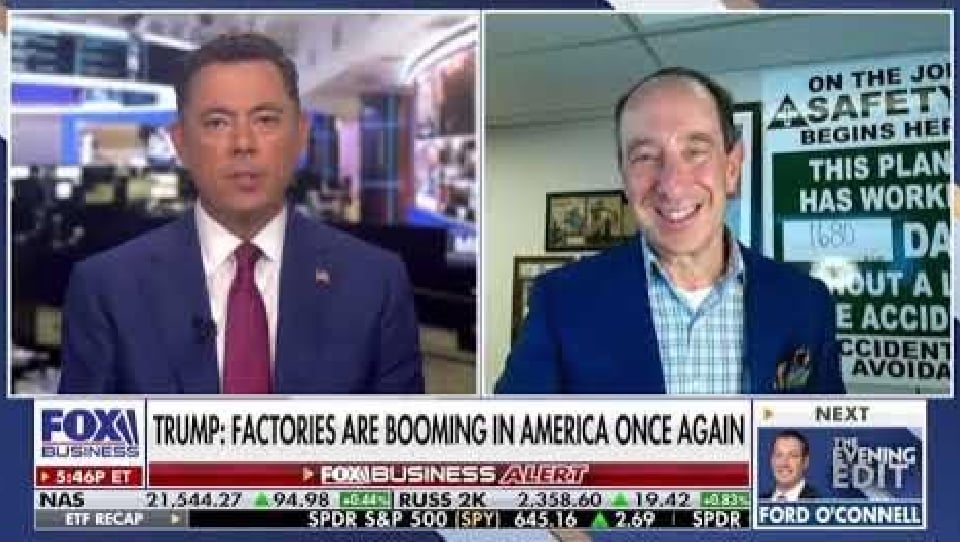
Host: Joining me now for reaction on Trump's tariffs is CEO of Marlin Steel, Drew Greenblatt. All right, Drew, uh, you experienced Donald Trump and his policies. You also had Biden and his policies as well as Obama's. What's the difference between the two?
Drew Greenblatt: We are seeing huge positive optimism in American factories. What's happening is all of a sudden we have a level playing field with our foreign competitors. I mean, think about this most recent Europe deal where the Europeans, if they ship to us, they have a 15% headwind on every single basket they ship into America. But when we ship into Germany or Italy or France, we have 0% tariffs. That's a huge deal. That's fabulous for the American worker.
Plus, we have great new tax policies. These tax policies make it much easier to buy technology. That machine you see on the screen right now—we're buying another one. It's coming this week. Why? Because we're so enthusiastic. We're so optimistic about the future. We're going to run this new puppy three shifts a day. It's a robotic welder. It's going to run in our factory here in Baltimore. We have—this will be our third one in Baltimore. We have three more in our Indiana plant. These machines are going to be rocking because of all this reshoring. American factories are very optimistic. We're going to have to hire more people. We're right now hiring people here in Baltimore. We're very pumped about the future.
Host: Well, uh, that's good to hear, uh, because you employ some really good, talented people who make, uh, who actually make things with their hands, and that's so important. Let's listen to Donald Trump today on manufacturing.
Donald Trump (Audio Clip): Factories are booming compared to before I took office. Domestic auto production is going to be—it's going to be so thrilling in two years when you see the numbers because they're building plants all over the country. They're all coming in because of tariffs.
Host: All right. Marlin Steel is 100% manufactured in the United States. Always has been. And but some of America's most popular furniture brands like Restoration Hardware and Wayfair, their stocks have been taking a bit of a hit with the push to move manufacturing domestic. What do you—how do you expect this to play out? Where is the market going for those products that America loves to consume?
Drew Greenblatt: You know, we used to make a lot of this in Hickory, North Carolina, all through the Carolinas, in South Carolina, etc. Uh, I'm not saying it's all going to come back into America, but I think a lot of these large retailers are going to reconsider. It doesn't always make sense to always buy overseas. I'm hoping they come back.
We only build in America. We only use American steel. We ship from factories—our factories in Indiana, Michigan, and in Baltimore, where I'm standing right now. And we ship to 44 countries. It works. You can build in America. You have to pay your guys really well. You have to give them the best tools. You have to come up with really innovative designs and engineering. If you can do that—quality engineered quick—you can thrive and prosper in this global economy. It shouldn't be a race to the bottom.
Again, I'm not saying we're going to win every t-shirt fabrication company. Okay? But the high-end things—aerospace, you know, uh, building ships—that should all happen in America. The—the silicon chips. We should be making that in America. Right now, we buy 70% of our silicon chips from—from Taiwan. That's untenable because China's jonesing to take over Taiwan. We need to make our chips in America. So, these are the kinds of things that have to get brought back. The president is right. We need to build things in America using American labor, growing American jobs, recreating the re-industrialization of America. It's a very optimistic, exciting time for our people.
Host: Yeah, Donald Trump—President Trump's been as committed to growing American manufacturing as anybody we've seen. Thank you, Drew Greenblatt. We really do appreciate—