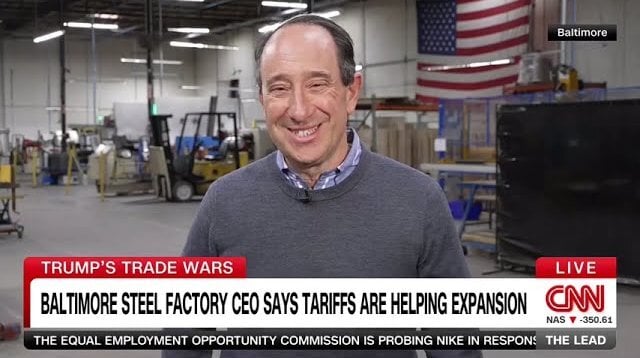
Interviewer: In our money lead, it's time for our Business Leader series, where we talk to small business owners coast to coast about the impact of President Trump's tariffs that he pledged on the campaign trail and throughout this past year would bring manufacturing jobs back to America. So let's check back with the very first factory owner we visited, very first factory we visited, to talk about these tariffs with the owner, Drew Greenblatt, the CEO of Marlin Steel, just up by I-95 in Baltimore, Maryland, joins me now. Drew, thanks so much. You were enthusiastic about the potential of the tariffs when they were announced, and business was going well the last time we checked in with you. How are things now? You feel the same still feel the same way?
Drew Greenblatt: Well, the numbers are in. We had our best year ever in 2025. So we are so excited about 2026. It's going to be even better in 2026. We just bought the most expensive tool we've ever bought. It's a laser punch. It's going to be installed in this factory in about two months. We can't wait for it to come. It's going to make our team go 10 times faster than they're currently going. They're moaning in China. They're going to be sad in Mexico because we're going to be building here in America. We're going to be buying a lot of American steel and we're going to be able to export to many more countries. We're going to be much more competitive. So we're leaning in. We bought another 3D bender from our vendor in Chicago. And we've also bought a couple forklift trucks and we've also bought a couple more press brakes. So we're very enthusiastic about the future. Times are going to be good.
Interviewer: So it sounds like you're adding a lot of new equipment to your factory, which is fantastic. Have you been able to add new jobs? Have you been able to grow your business?
Drew Greenblatt: Absolutely. We're hiring people. We're hiring locally in our factory in Indiana, in our factory in Michigan, and here in this factory in Baltimore City. We're paying great wages. We have offered great health insurance. Manufacturing jobs are extraordinary jobs. This is how we pull people up from poverty and into the middle class.
Interviewer: Have you had to raise prices at all?
Drew Greenblatt: So we have raised prices because steel costs have ouched up over the year. I think we're now leveling off. We're now getting jobs that we never ever would have had an opportunity to take a look at because all of a sudden people are recalibrating. They're saying, you know, really, should I buy from China? Should I buy from Mexico? Should I buy from Canada? Should I buy from Europe? No. Let's buy in America because all of a sudden the prices are more level. We're getting opportunities we never had and because of that we're hiring people and we're buying equipment. We're leaning in. 2026 is going to be the best year ever and it's going to even beat our 2025 which was our best year ever.
Interviewer: So as you know, not every factory is thriving right now and we've spoken to a lot of people who do not feel about the tariffs the way that you do. It depends obviously on the size, the industry. Do you have any advice for those business owners about how to navigate the system to their advantage?
Drew Greenblatt: Well, if you're making it in America, you don't have tariffs. You don't have to deal with customs duties, you don't have to wait for the boat to come across the ocean. You're you're enriching your local community. So I implore people to buy American. I implore people to build your factories in America. You don't have the drama of buying from overseas. You don't have them stealing intellectual property from overseas. The the American worker needs opportunities, build in America. It's good for your community, it's good for the locals. I I think it's an astute policy for local companies and local governments to encourage building in the USA.
Interviewer: Drew Greenblatt, CEO of Marlin Steel in Baltimore, Maryland. Thanks so much.
Drew Greenblatt: Thank you.
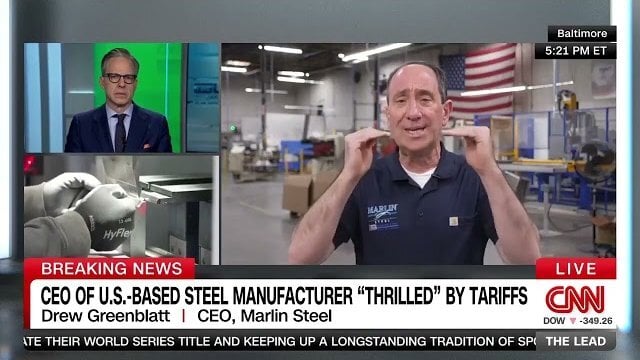
Host: Money lead despite recession warnings. Some applaud President Trump's tariffs. The CEO of Marlin Steel in Baltimore, Maryland, says he's thrilled with the tariffs. His plant makes wire baskets and sheet metal for industries ranging from aerospace to food processing. Here's what one factory worker of his told us.
Marlin Steel Worker: One of the products that we made was—uh, our competition was from Canada and they were using Chinese steel. And it's become more profitable and it's—it's exciting. Uh, so I'm very optimistic about it.
Host: Joining us now is the CEO of Marlin Steel, Drew Greenblatt, who joins us from the floor of his company. Uh, Drew, thank you so much for joining us. So, you say you're a big fan of the tariffs. Uh, your company exports to dozens of countries, including China. Chinese leaders now say they're prepared for a full-on trade war with the United States. If China stops buying Marlin steel, how much of a hit will your business take? Or will the tariffs help you in other ways that make up for it?
Drew Greenblatt: Tariffs are going to be very good for the American manufacturing worker. We're very excited about this new leveling of the playing field. Right now, when we export, for example, this basket to Germany right here—it's a precision medical basket, a medical device basket—when we ship that to Germany, the German government taxes our—pro—our clients $128.95 per basket. If that—if a German competitor ships it to America, it's $1.25 per basket.
It is so unfair what's happening to the American worker. They can't compete when you have that kind of unlevel playing field. We're talking about an opportunity finally to create a lot of millions of American jobs, middle-class jobs, if we could get it fair. We're not looking for something over the German factory workers or the British factory workers, the Chinese factory workers. We just want to be fair. If we're fair, the American uh—uh, technology, creativity, work ethic is going to just do extraordinary things and we're going to create millions of American jobs with this new paradigm. It's wonderful news.
Host: It would be great to have the American manufacturing base back in the United States. I wonder how you counter the arguments of people such as Vice President JD Vance a few years ago. He feels differently now, but a few years ago he was saying it's less about uh, tariffs and more about automation and education when it comes to manufacturing jobs uh, in the United States. What do you say to that?
Drew Greenblatt: Well, absolutely. You have to have automation and you have to have clever manufacturing techniques. You know, we have seven degreed engineers. We make everything in Baltimore, everything in Indiana, everything in Michigan. We—we import nothing, but we're using wonderful in—uh, innovations, novel ideas, coming up with crazy great new products.
And then what happens is over in China, they totally cut and paste our innovations and put it on their websites. This is what we're competing against. They're using slave labor to compete against us. They're debasing their currency. The stakes are so unfair for the American worker. Let's just try to have things fair and we're gonna whoop them. We're gonna hire millions of people throughout our country.
You got to remember, 50% of Americans don't own stock. Millions of Americans don't have $250 in any kind of war chest emergency fund. Why is that? That's because they're working at jobs where they can't get paid well. In American manufacturing, our workers are getting paid 80,000 a year, 90,000 a year, 100,000 a year. American manufacturing jobs are phenomenal. This is going to be flourishing if we can have a fair parity with trade—uh, with these trade inequities.
Host: So, among those who own stock are your employees because you offer your employees a 401k match. Uh, have any of them said anything to you uh, about their concerns about the direction of the stock market? Um, particularly any who might be close to retirement.
Drew Greenblatt: We absolutely have had a couple people anxious about their stock market—about the stock market. But again, you know, our goal is that we're going to sell millions more dollars. So, we have to hire many more people. If we do that, we're going to hire them at very good jobs with very good pay, wonderful benefits with the 401k match.
True, there's some companies that have been buying t-shirts from Vietnam and China and they're going to have to pay a couple more bucks for a t-shirt and then the American consumer is going to have to pay more for a t-shirt. That's obviously not pleasant for those American consumers. But I think there's going to be an overwhelming surge of hiring in America as things level out, as American factories ramp up and people have to hire talent, buy machines.
We've invested money in buying new machines because we're so enthusiastic, so optimistic about the future. That's going to start happening throughout the nation and people are going to be leaning into the future. This is a very exciting time for the American manufacturing worker. We're going to be able to pull people from poverty into the middle class that used to not have an avenue. They had no shot at getting into the middle class. We're going to be able to offer them a shot.
Host: Drew Greenblatt, thank you so much. We'll have you back. Good to hear.
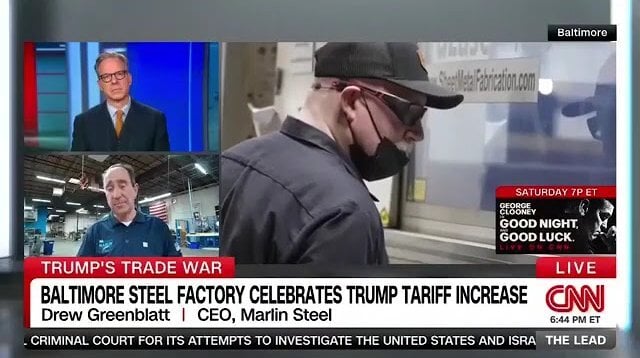
Host: But let's now turn to today's business leader. Our series talking to small business owners coast to coast about Trump's tariffs. Many are feeling uncertain. Some are excited about the developments. My next guest is, uh, a two-timer. It says he first spoke to us back in April. He was optimistic about the tariffs. He's the CEO of Marlin Steel in Baltimore. Uh, and uh, now that President Trump has raised the tariff on steel from 25% to 50%, we wanted to check back in with Drew Greenblatt, who joins us now. Uh, Drew, what do you make of Trump's decision to increase the tariffs on steel imports?
Drew Greenblatt: So, we only buy steel in America from steel mills that are in Michigan, Indiana, Tennessee, Pennsylvania. Uh, so we're not buying any imported steel. However, domestic mills have had much longer lead times—gone from two weeks to eight weeks, 12 weeks. We've also seen steel prices increase as more and more factories are buying domestic, reshoring and buying local. Uh, bottom line is, though, there's a lot of optimism going on. There's a tremendous amount of companies coming to Marlin and our sister plant, Matson, in Indiana and Michigan. What they're doing is—what they're receiving is a deluge of opportunities where companies are rethinking their supply chain and they're saying, "You know what, maybe we should build it here in America." So, we're getting this fabulous uh, a lot of at-bats, and we've landed a couple. We're really excited about that. There's some big ones percolating. We're very enthusiastic about the future. We've been hiring people. We've been buying equipment. We're leaning into this excitement.
Host: So, you were—you were enthusiastic when we talked to you in April about the prospect of tariffs. Uh, it's been about two months since so-called Liberation Day, April 2nd. Uh, have the tariffs lived up to your high expectations?
Drew Greenblatt: Yes, because we're getting more jobs. Our—our enthusiasm about the future's increased. When we talk to our uh, other companies in the industry, they're feeling the surge of opportunities. They're feeling the surge of uh, at-bats. They're seeing good things on the horizon. Plus, there's a lot of other things going on that's positive. Regulations are going down. Inflation is going down. We're also seeing a huge tax deduction going in place—hopefully soon, before July 4th. There's going to be opportunities for companies like myself to buy equipment and instantly expense it. Our factory workers are not going to have—have to pay taxes on overtime. So, there's a lot of optimism, a lot of enthusiasm in American manufacturing. Companies overseas are going to be able to build factories inside [the US] and they're going to be able to write it off instantly. So, it's many, many positives going our—our way.
Host: There are some warnings from other steel and aluminum—aluminum-reliant industries about this blanket tariff increase. Uh, they're concerned the cost to make products like vehicles, like canned goods, could go up, and they say this—this could mean eliminating jobs. What's your take on that?
Drew Greenblatt: I think there's going to be some industries which will see some of their costs go up. But you got to remember, the big picture is we have to have a thriving, solid steel industry. It's a critical element to building ships, building airplanes, uh—uh, you know, making cars. If—if we're completely hoping that other countries uh, that we may have adversarial relationships with, [don't] cut us off one day, we're going to be in—in big trouble. We need a thriving, solid steel industry that can support the domestic market and also export. Uh, this is a—a wise policy to strengthen our economy so that our—our industries could be self-sufficient. It should be true for steel; should be true for silicon chips. You know, right now we buy 80% of our silicon chips from Taiwan. We need to make sure that we build critical things here in America so we're self-sufficient. God forbid we get into an adversarial relationship with a partner that today may be our trading partner, but tomorrow may not be so friendly.
Host: Speaking of getting into an adversarial relationship with a partner, uh, I don't know how much you've been following of the Donald Trump–Elon Musk breakup, but Musk today tweeted among other things that the tariffs are going to cause a recession. Uh, no concerns uh, by you?
Drew Greenblatt: I—I—I focus on bookings. I focus on—I have big fat bookings. Uh, that is the leading indicator for our enthusiasm. That's our—our order book. Our border [order] book is huge right now. And the inquiries we're getting are going to make it even bigger. That's what I focus on. I don't focus on Twitter. I don't focus on um—uh, other uh, things chattering in our ears. I focus on what are my clients saying and uh, making sure my employees are happy, making sure my employees are safe. Uh, I'm trying to grow this business. I'm reinvesting in new technology, new equipment, hiring great people. I got to focus on what's important. I—I don't watch the tutor-sphere [Twitter-sphere]. I—I focus on, you know, my taking good care of my employees, and good things will come.
Host: You sound wise. The business, one more time, is Marlin Steel. It's based in Baltimore, Maryland. And the guest again is Drew Greenblatt. Drew, I'm—I'm glad things are still working out so well for you. Uh, really happy to hear that about you, your company, and your employees.
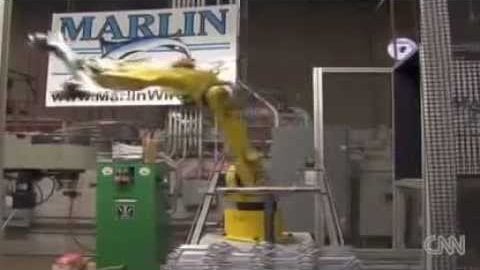
Carol Costello (CNN): As one economist put it, "It's the trade deficit, stupid." As long as imports outweigh exports, countries like China will continue to boom while the United States continues to struggle. President Obama has a plan, but is it good enough to fix what's broken?
You want a dose of "Yes we can" in a "No we can't" economy? Welcome to Marlin Steel.
Carol Costello (CNN): Wow, this is serious!
Drew Greenblatt: We make everything here. We export all over the world.
Carol Costello: In Baltimore, Maryland, Marlin Steel is up and running 24/7 and hiring, by making then exporting what it calls the "best damned wire baskets in the world."
Carol Costello: That's crazy! I've never heard of such a thing—like America exporting goods to Taiwan!
Drew Greenblatt: That's exactly right. We shipped wire baskets to Taiwan. It can't get any better than that. I love it!
Carol Costello: Marlin Steel is the exception. Just about one percent of U.S. companies export goods to foreign countries.
President Barack Obama (Clip): So tonight, we set a new goal. We will double our exports over the next five years. An increase that will support two million jobs in America.
Carol Costello: Analysts say that is possible, but only if the President acts aggressively. His Commerce Department is trying. Marlin Steel is able to export without financial risk because if his foreign customers don't pay their bills, under a new program, Uncle Sam will.
Greenblatt says fantastic, but he wishes the Commerce Department would fix what's really broken.
Drew Greenblatt: Right now, there's 120 million people in Korea, in Panama, and in Colombia that we should be selling to, and we're not because we don't have free trade agreements with them.
Carol Costello: That phrase "free trade" is loaded. Many lawmakers are wary of the idea because not every country plays by the rules. Ron Kirk is America's Trade Ambassador. Want to talk about China?
Ron Kirk: I'd love nothing more.
Carol Costello: Many economists say China keeps its currency exchange rate artificially low, which makes American exports more expensive and China's goods a whole lot cheaper. Is China a currency manipulator?
Ron Kirk: Um, you know, that's a judgment for ultimately Tim Geithner to make.
Carol Costello: But a lot of people in the country would say it's so obvious that China is manipulating its currency. It's so obvious—why not just say it and deal with it?
Ron Kirk: We have engaged China about the need to rebalance their economy, just as we are rebalancing ours. And I understand the American voters are angry. I understand the American voters want us to throw around a lot of strong verbiage.
Carol Costello: That's difficult when the United States is in China's debt and depends on China to help America deal with countries like North Korea. Greenblatt is frustrated by that, but he's not giving up. Twenty percent of his goods are sold overseas and, yeah, he can compete with China even now. China makes things cheap. You can't possibly do that and compete.
Drew Greenblatt: You're right. We can't beat them in price. We beat them because we have great engineering. When—when an American box comes in, it comes in on time, it comes fast, and that's how we're gonna beat China. Because we're fast, we're great quality, and we have great engineering. And—and that's our secret recipe. That's our secret sauce.
Carol Costello: Greenblatt employs 30 people right now. He says for every million bucks he makes exporting goods, he'll hire eight more people. It's what the Obama administration is shooting for, but it's got one other big hurdle. There are plenty of people in this country who blame free trade for massive job losses in America's Rust Belt. Free trade to them is a dirty word.
Carol Costello, CNN, Washington.
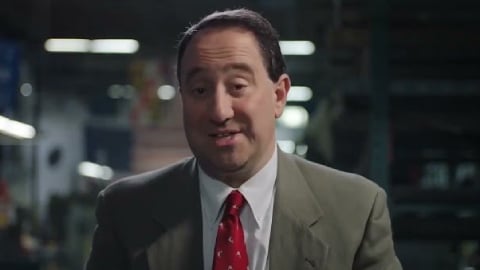
Drew Greenblatt: I believe in the American manufacturing renaissance. The American worker is an amazing worker. They're motivated. They're making things happen. And uh, we're doing our part here in Baltimore.
Baltimore people are—are real. They're straightforward. They tell you like it is. They work hard. And uh, I'm very blessed to be surrounded by uh, my team.
My father uh, was an entrepreneur and uh, so I got a business degree uh, every night at the dinner table. I bought Marlin Steel in 1998. It was a 30-year-old company straight out of a Charles Dickens novel. We've come a long way since those days.
Marlin Steel made wire baskets for the bagel industry for 30 years. And I thought when I bought the company, we were going to sell wire baskets to the bagel industry forever. Boy, was I wrong. We had imports come in from overseas that cost less than the steel. So all of a sudden, our business fell apart. We could either die, close down the shop, or we could pivot.
Right around this time, we got a phone call from an engineer who needed a customized basket. And that was my epiphany that that was our future. That was the way we were going to get out of this mess. Now, we focus 100% on custom baskets that are extraordinarily high quality.
We're not just creating jobs. We're creating careers, middle-class lifestyles. We're supporting the community. We had people that didn't own cars, didn't own homes. Their Social Security plan was their retirement plan.
Now we have a parking lot full of cars. More than half our employees own homes and everyone has a 401k. I mean, we have people that put kids through college here. We're paying for several people to go to school at night. We're furthering people's education. We're very proud of where we've come.
We want our city to thrive and grow and prosper. Manufacturing pulls people from poverty into the middle class. I mean, this is—this is what it's all about.
My name is Drew Greenblatt. I'm the owner of Marlin Steel.
Narrator: A White House official points out that, in context, the President was highlighting the need to, quote, "do everything possible to prepare the next generation with the skills needed in a changing workplace."
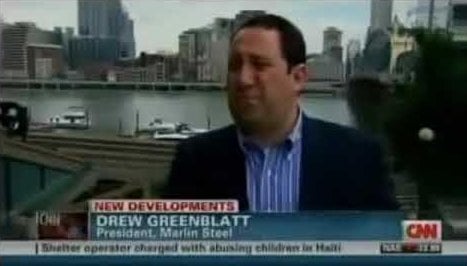
Drew Greenblatt, who was invited to hear the President speak, agrees. He's the owner of this Baltimore-based company that makes industrial steel baskets. He says robots and other technologies may cost jobs in the short term, but it is the only way his company can survive.
Drew Greenblatt: We had old, outdated equipment, and the only way we could transform and come to be viable in the—with this crush of Chinese competition—was to be extremely efficient, very effective. And that's with robot technology.
Narrator: Realizing the importance of this battleground state, the GOP went after President Obama.