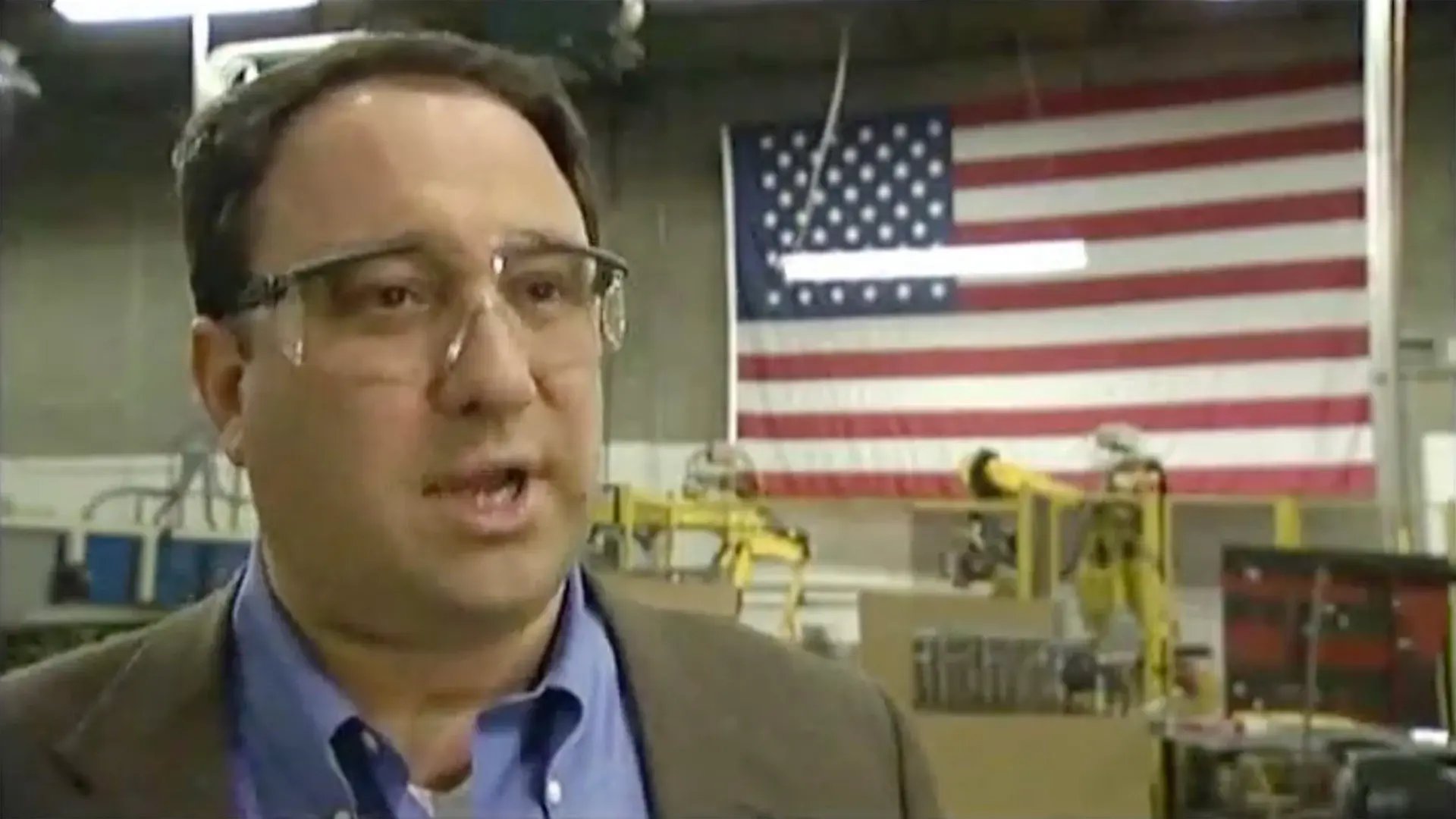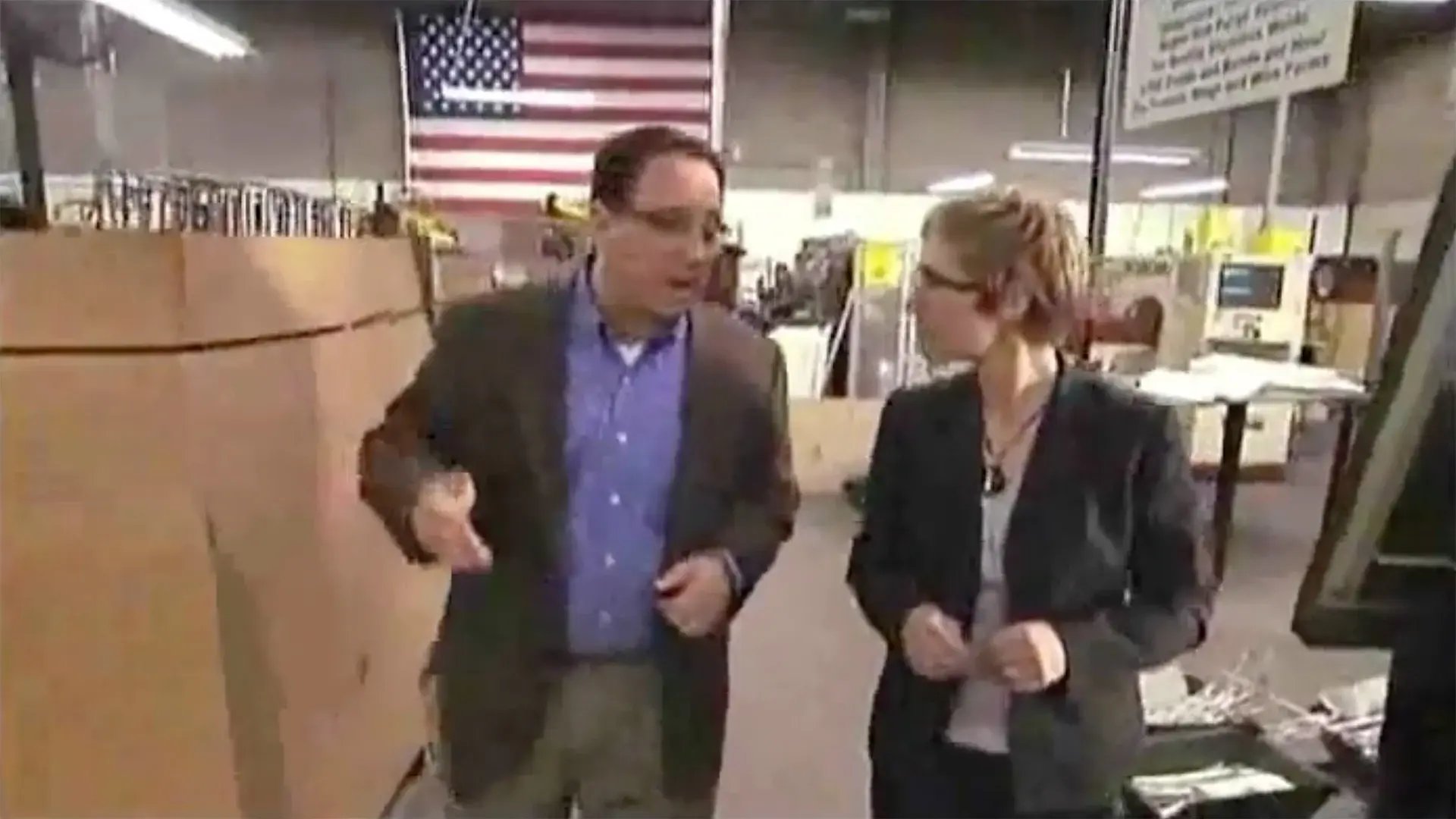
Narrator: Drew Greenblatt is the owner of Marlin Steel in Baltimore and a longtime supporter of President Trump's tariffs. He says that levies helped level the playing field for American businesses.
Drew Greenblatt: I was very disappointed. It's a setback for the American middle class. It's a setback for poor people in America that had a chance to climb into the middle class with great manufacturing jobs. It's very disappointing, the Supreme Court ruling.
Narrator: Yehh, we heard there, and this is an estimate from the Tax Foundation, which is nonpartisan, that the tariffs cost American households $1,000 last year. It is expected to be more in 2026, depending, of course, on how these tariffs shake out. Is that, you think, then a price that you're willing to pay or the middle class would be willing to pay for potentially better jobs in the future?
Drew Greenblatt: So, U.S. manufacturing for decades has been competing with countries like China, where they subsidise the steel, they subsidise the labour, they use labour that was possibly in jails, they despoil the environment, they debase their currency, they use state-owned enterprises to compete with American manufacturing companies. And that's wildly unfair. And we have to have a level playing field. And tariff policy makes it fair for American factories. And then once it's fair, we can hire locals. We could bring poor people into manufacturing, pay them extraordinary wages, wonderful health insurance, match their 401ks, create great careers for them.
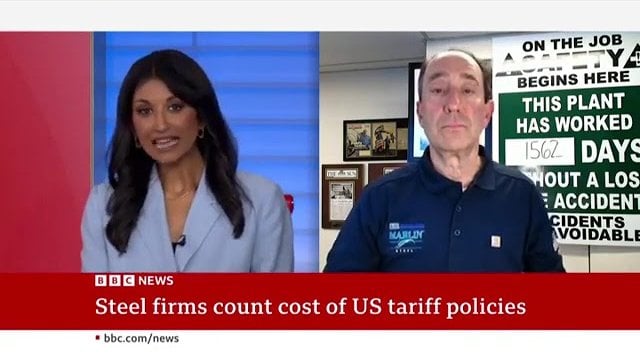
BBC Host: ...rich history of using steel, and he pledged to safeguard steelworkers' jobs. We can talk about that now with Drew Greenblatt—excuse me—President of Marlin Steel in Maryland. Drew, it's very good to see you again. Great to have you back on the program. Uh, you know, I want to ask you first of all what you made of the vice president's message talking about a renaissance in manufacturing.
Drew Greenblatt: Uh, we completely agree with his enthusiasm for USA manufacturing. We're about to see a massive reindustrialization of American manufacturing where we'll be self-sufficient. We're not going to be counting on uh, countries that are adversarial. Uh, that might shut down our pharmaceuticals, might shut down our steel production. Uh, all—um, you know, 80% of silicon chips are made in Taiwan. We need to make things in America, create middle-class jobs so we're more self-sufficient and we're more secure.
BBC Host: I know that you've supported these tariffs as a boon for your business. At the same time, we saw the information this week that GDP—the economy—shrank. There's a lot of uncertainty on the markets, and we've heard from many business leaders that businesses are holding back on investments because of all of this uncertainty. Is that having an impact on your business?
Drew Greenblatt: Actually, it's the opposite. If you parse the data, what really happened was the private economy—private investment—surged in the first quarter. Enormous wins. But what happened was the government sector got a little smaller. This is because of DOGE, of course. So if you dive into the data, Americans are investing a tremendous amount into factories, into their companies right now.
And this is a sign of optimism because when you buy a big piece of equipment, the next thing you do is you hire people to run those pieces of equipment. So this is a very positive leading indicator of all the things that we've been talking about. You could see it with the steel—uh, the availability of steel. When the president was inaugurated, steel mills were shipping in two weeks. Now they're shipping in 12 weeks. There's a lot of—
BBC Host: Can I ask you? You say—you say there's enthusiasm and optimism. That's not reflected in what we have heard or seen in consumer sentiment, and it's not reflected in what we've heard from businesses. So you think that's going to turn around?
Drew Greenblatt: I think cash speaks more than what people tell pollsters. Cash surged in the first quarter. Private investment—investing in capital expenditures—skyrocketed in the first quarter. This is a phenomenally good leading indicator. What people tell pollsters is a lot of times shaded by their political views, but people are still buying. People are still going to the market. People are still leaning in.
At—in Baltimore, we bought a quarter-million-dollar 3D bender from uh, a Chicago factory. Separately, we bought a quarter of a million dollars' worth of straighten-and-cut machines for our Indiana factory. We're very optimistic. American manufacturing is optimistic. We're hiring people and buying equipment. The—the headline news is—is a little bit clouded by what's happening with Washington getting a tiny bit smaller.
BBC Host: All right, Drew Greenblatt, President of Marlin Industries, thank you so much for joining us. It's great to have you again on BBC News.
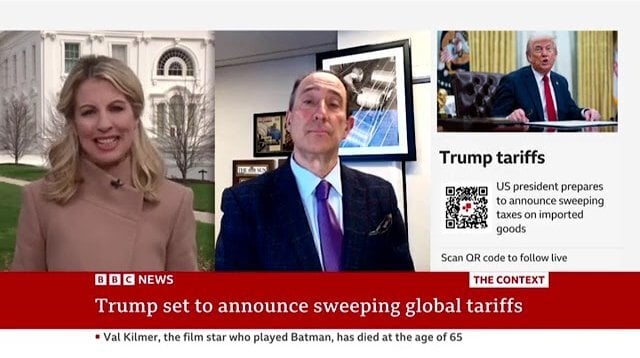
BBC Host: about that. Now, I'm joined by Drew Greenblatt. He's the CEO of Marlin Steel based in Baltimore, Maryland, not far from where we are here at the White House today. Thanks for being with us, Drew. Now, you're in favor of these tariffs. Tell us a little bit about how you see it helping your business.
Drew Greenblatt: Absolutely. These tariffs are going to be great for American manufacturing. There's a lot of disconnections with our trading partners that need to be leveled out. If we do this, it's going to be very fair for the American worker.
Let me give you an example. We make baskets in Maryland and Indiana and Michigan, and we export these baskets to 40 countries. This is an example of one of those baskets. It's called an expanded metal basket.
When we ship a hundred of these to Great Britain, uh, the English government gives us a tariff of $9,445 if we ship a hundred of these to England. However, if an English factory that makes pickling baskets ships to America, the tariff is only $125. That's not fair. That's not equitable. We need to have a fair and level playing field. And I think what's happening right now is it's a reset. Let's just be fair with our trading partners. If that happens, it'll be good for the American worker and we'll be able to hire more people and pull them from poverty.
BBC Host: Now, if American companies continue to import from other countries, though, they will inevitably pass those tariffs onto the consumer. So, it could in fact see rising prices here, less disposable income, and a drop in spending. Does that concern you at all?
Drew Greenblatt: Well, Marlin Steel makes everything in America, and we only uh use American steel. So, we're not impacted by uh this import issue. Uh that being said, I think a lot of factories are going to be built in America like Mercedes-Benz, like Hyundai. A lot of these companies are going to build factories in America. They're going to then hire local people. Then they're going to buy steel baskets from companies like Marlin Steel. They're going to buy pallets locally and they're going to buy boxes locally.
It's going to be very good for people that are poor in America because they'll have avenues. They'll have paths to get into the middle class. American manufacturing pays very well—on average over $80,000 a year. And uh we're going to pull a lot of people into the middle class; they're going to be able to buy homes, buy cars. This is going to be really great for the American uh middle class.
BBC Host: Your view isn't shared widely at this point. Do you see—do you understand why that is, or can you appreciate that point?
Drew Greenblatt: Absolutely. I mean, there's companies like, you know, Walmart and Amazon where they're importing a tremendous amount of stuff from overseas. They're buying from countries that have slave labor. They're buying from countries that despoil the environment. They're buying from countries that subsidize their currency. That's unacceptable. It's not fair to the American worker. So, uh, yes, there might be some places where, you know, t-shirts cost a couple more bucks. You're right. But I think the overall tide is going to be very good.
BBC Host: I'm sorry for interrupting you there, Drew. I'm sorry for interrupting you. We're just almost out of time. We have to take a break. But thank you so much, Drew Greenblatt, for speaking to us. Do stay with us here on BBC News.
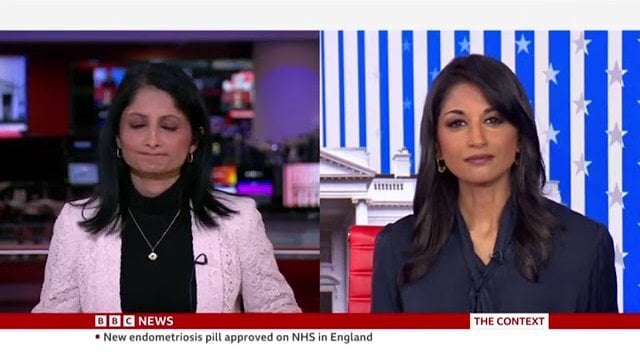
Sumi Somaskanda: Well, let's uh, join two guests to talk about this in more detail. Drew Greenblatt, CEO of Marlin Steel based in Baltimore, and Kimberly Clausing, professor at UCLA and a former Treasury official in the Biden administration. Start with you, Drew. Um, you're a steelworker. What do you think of these tariffs?
Drew Greenblatt: Uh, we're very optimistic about the future. This is a good approach. It's been remarkably unfair for decades. Uh, China and other countries have been importing into our country, not treating their environment safely, not being good to their employees. We compete with companies that use slave labor, they debase their currency, they subsidize their steel, they subsidize their labor, they subsidize their exports. It's wildly unfair. We want to grow American middle-class jobs. We want to pull people from poverty. We need a level playing field. We need a fair playing field.
Sumi Somaskanda: Um, now you agree with these tariffs, but there's been a fallout of course because there's been retaliation. For example, we're hearing um, that uh, the EU has obviously done retaliatory tariffs. Um, do you think this is going to [last] in the long run? There's been concern of course the markets have been falling. Are you concerned about this actually impacting American pocketbooks?
Drew Greenblatt: No. I think in the long term it's going to be very good for the American middle class because—
Sumi Somaskanda: In the short term, you concede, Scott [Drew], there might be some pain.
Drew Greenblatt: No, I think it's going to go well. I think we're going to see a lot of jobs created. We're very busy. We're buying a lot of equipment. We're buying a lot of steel. We're trying to keep up with demand. We're—we're hiring vigorously. We're enthusiastic about the future. You know, uh, America has been given the shaft for decades. You know, it's been a very unfair environment for us to have it uh, for us to compete.
Sumi Somaskanda: Kimberly, I want to get your thoughts on what we're hearing from a steel manufacturer here—that the US has been treated unfairly for decades and this is righting a wrong.
Kimberly Clausing: I disagree with several of the things that your prior guest said. First of all, the tariffs aren't distinguishing between countries based on their treatment, and the EU and Canada certainly don't use slave labor and have been very good partners to us in terms of the way that they treat our products as well.
Um, if you look at the evidence on the steel tariffs from the last times that we've put steel tariffs on, they do create a small number of jobs in the steel industry, but they hurt other industries even more for a couple reasons. One, steel is an input that's used in things like appliances and cutlery and cars. And when you make steel more expensive, you make production in America of those other goods more expensive. And the evidence indicates that you lose more jobs in those steel-using sectors than you create in the steel sector.
Plus the retaliation, as you point out, is also very harmful to US exporters, including firms like Boeing, including auto firms, farmers—you know, all of them get hit by the retaliation and the whiskey distillers that you mentioned earlier. And it certainly affects consumers' pocketbooks. We see that very clearly that the last rounds of Trump tariffs generated hundreds of dollars of additional costs. The tariffs that he suggested so far would—would create more than $1,200 worth of costs for typical um, median households in the United States. That's a big tax increase. And in fact, if he follows through on all of his tariff promises, it would be the largest tax increase in more than a generation, hitting the middle—
Sumi Somaskanda: Can I just ask you? Can I ask you—what we're hearing from the Trump administration is that some of what you've described is going to be a temporary disruption. What do you think of that?
Kimberly Clausing: I don't think that that's true either. Uh, you look at the markets—the markets really are foresighted. They can see what's going, you know, they—they're taking into account things that will happen in the future. Those get priced into stock prices right now. So the fact that stocks are falling is telling you that the market perception isn't that something as good is going to happen in the long run it's that this is harmful and this will continue to be harmful.
And we see this from other countries, too, that have gone down this road. When you erect really high tariff barriers in this willy-nilly fashion, it rarely leads to economic growth. And on the contrary, the evidence suggests that it harms economic growth. It harms productivity and it reallocates things in society away from stuff that we're good at making towards things that other countries could perhaps do at a lower cost.
Sumi Somaskanda: Drew, potentially a short-term high, but if you listen to what Kimberly is saying there—harms economic uh, growth. It harms economic productivity. It's harmful, Kimberly's saying.
Drew Greenblatt: Indeed. Kimberly works—Kimberly works at a think tank and has never had to do payroll before. I have to compete against China. I have to compete against Mexico. I have to create jobs. I have to make payroll. I have to grow companies. So I—I understand, and many other people—entrepreneurs in our nation—understand: when you compete with countries that don't play by the rules, [that] despoil the environment, have subsidies from their governments, debase their currency, it makes it unfair to the American middle class.
What we're trying to do is have a fair and level playing field. And uh, with all due respect to Kimberly, you know, the reality is we got to create jobs for poor people in America. I'm pro-Sandtown. That's a—that's a—a—a blighted community four miles from my factory. If I get more jobs, I'm going to hire more people from Sandtown. That means less jobs will be viable in Shanghai. That's not my concern. My concern is growing jobs in America. And we're going to grow more jobs in America if we have a level playing field.
Sumi Somaskanda: Drew, let's bring Kimberly in to answer some of the points that you've made. Kimberly, with respect, Drew saying, you know, you work for a think tank. You perhaps don't have the view that somebody at the coalface like Drew has.
Kimberly Clausing: Well, I—I certainly don't have the knowledge of the steel industry that Drew has, and I respect his detailed knowledge of that industry. But the problem is I do have an understanding of data and the prior experience of other countries who've gone down this road.
And we've done this experiment with steel tariffs before and we see over and over again that while it could help, of course, the steel industry relative to not having the tariffs—and he's exactly right, that happens—there's a lot of other industries that rely on steel as an input. So if you're thinking about the competitiveness of the auto sector or a sector that's making cutlery and it's trying to compete with firms in other countries that have tariff-free access to steel—so their steel is much cheaper—so you're hurting the ability to make things like airplanes and appliances and those products in the United States. You add that together with the retaliation and the net effect on the economy as a whole is negative, even if the steel sector and the town that Drew hires from ultimately does better.
Drew Greenblatt: Okay. Reciprocal trade should be free. So we should be even uh—so when we trade with China, they should have the same uh, export uh, and import fees that we have. But that's not the case. Nor is it true with Canada. I mean, Canadians and—and Mexicans don't have the same uh—uh, export and import uh, fees that we have, just like the Europeans. It's—it's just not a fair fight.
And—and Kimberly has to contemplate the impact on the impoverished American that doesn't get an opportunity to move into the middle class because jobs are not available because they're in Shanghai and they're not in Sandtown. We have to think about increasing jobs for the poor people in America that are foreclosed from any opportunities because of the policies of the last couple decades.
Kimberly Clausing: Yeah. The administration's policies so far don't distinguish based on country's policies. They're putting the same tariffs on Canada. We've had free trade with Canada since 1989 and free trade in auto and auto parts since 1964. They're picking on some of our closest trading partners and allies in a way that's completely, you know, non-discriminatory with respect to their underlying policies.
It's kind of a willy-nilly approach. It's not targeted at particular things that countries are—are doing wrong. They—they're veiling it in this notion of reciprocity, but there are plenty of countries that treat us perfectly fine and we're—we're also subjecting them to these ad hoc tariffs and it's ultimately going to be bad for the economy and you can see the markets, investor uncertainty, and consumer confidence are all reflecting that right now.
Sumi Somaskanda: Okay, we've clearly got our finger right on the central part of this debate right now. And I want to bring our—our wider panel in as well, Janette and Bill, who've been listening to this conversation. Very curious to get your take because it does seem like this is going to be a central argument for both sides to discuss here. You know, is this really about protecting American workers and—and strengthening the US economy, or is it actually going to detract from it? Um, Bill, what's your take on this?
Bill: Well, what's very confusing about Trump's strategy, he's not very clear what his endgame is. Is this a negotiating tactic—go hard with tariffs now and then work out deals bilaterally to reduce tariffs overall? Or is having higher tariffs an end in and of itself because America is going to be uh, have more jobs brought back here if we have higher trade barriers?
Trump has said contradictory things on this point. His staff says different things at different times what the reasoning is, and because of that confusion, I think it's why you've seen this giant market selloff, because there's not confidence about where this is all going to land. And we talk a lot about Trump being a great businessman, a great salesman—he's failing on that regard right now. He has not brought the country, the public, the business community in on what his thinking is, and so there's great uncertainty about what's going to come around the corner.
Sumi Somaskanda: Now Kimberly, where is this going to land? The markets are falling. We've seen other countries like uh, Canada hit the US with retaliatory tariffs. We're hearing that the EU may have a second wave of tariffs which could include tariffs on things like chandeliers, toilet seats, lawnmowers, and swimwear of all things. I mean, this—uh, this tit-for-tat going to continue on. And as Bill was asking, where does it land?
Kimberly Clausing: It's very difficult for the US economy because we're lashing out at all of our trading partners, you know, in different groups—the BRICS nations, the EU, Canada, and Mexico. But, you know, China, you know, it's expanding and it's going to continue to expand because once you tear off some of them, the trade just moves to others. For our trading partners, they have every incentive to build relationships with each other rather than us. We've proven to be an unreliable trading partner and they'll have more safety valves, so they might be able to afford to retaliate against us because Europe can say, "Okay, well we can build relationships with other countries in the world that aren't following these isolations."
Sumi Somaskanda: Does that worry you, Kimberly, if you know, strong allies like the EU are going to look to other countries—China for example?
Kimberly Clausing: Absolutely. I don't think this is in the interest of the United States when you want to bring the world together to give them an alternative to the China model, right? You want to trade more with the countries of Asia and Europe and around the world that—that are good, reliable partners and allies. You don't want to trade less with them, right? So, the fact that we're starting off these trade wars with some of our closest friends seems wrongheaded both for international relations but also for our economy, which is deeply integrated across North America and across the Atlantic.
Sumi Somaskanda: Okay, Kimberly, Bill, you're sticking with us anyway. Drew and Kimberly, if we could uh, keep you for a bit longer. Sorry, I said Janette instead of Kimberly—I'm going to get everyone's names mixed up—but if you could all stay with us, we're just going to take a quick break, but we will continue this discussion because there's still a lot to get through around the world and across the UK. This is BBC News.
Sumi Somaskanda: Welcome back. Uh, we're back with our panel and with our guests Drew and Kimberly as well. We've been talking about tariffs and the economy. And Janette, I want to bring you into this discussion in just one moment, but I—I do have a question out of curiosity for Drew as a CEO of a steel manufacturer there. Uh, Drew, if we talk about um, producing and buying within the US—uh, US steel, American steel—can the domestic industry produce enough for what is needed in the US, or is there going to be a disruption in terms of actual raw product?
Drew Greenblatt: It's going to be a challenge. Uh, everybody's going to have to crank up uh, capacity. Uh, you know, we make medical device baskets, we make uh, sheet metal fabrications, wire forms for aerospace, for medical devices, for food processing. Uh, it's going to be a challenge. Uh, we're going to have to crank up. But wouldn't that be a blessing if we have to hire more people and to keep up with all of this?
We purchased uh, many machines in the last couple months uh, to keep up with all the enthusiasm, the excitement. People are leaning in. People are excited about making things in America again. This is a wonderful uh, change of events and people are—are—are—are excited hiring people. That's our biggest problem is looking for talent. We can't uh—it's—it—it—it's bringing people on and training them. It's a blessing.
Sumi Somaskanda: Okay. Okay. Janette, I want to get your take on all of this. How you see this? Is this as an opportunity as Drew described it?
Janette: It is an opportunity to bring manufacturing back to America because we've lost manufacturing jobs they've been outsourced to China and to other places. However, I do agree with Bill that the market is very confused right now because no one really knows what Trump's strategy is with the market um, with the tariffs. Are we using them as a negotiating tactic with different trade partners, or are they going to be across the board?
And markets just don't like to be confused. They like certainty. So, right now there's a lot of people sitting on their hands, not investing, and that's why you're seeing the numbers drop. Um, but the other thing I wanted to bring up is Trump is under tremendous pressure to bring consumer costs down in the United States. That was the one—of the biggest platforms he ran on. So, if we see costs going up over the next six months—and I think you're going to see in the summer is really going to be the pinnacle of that—I think you're going to see this strategy shift a little bit because there's going to be a lot of public pressure on the president to get costs down.
Drew Greenblatt: Yeah, Janette—I'm just uh, reading something. Oh, sorry. Go on—jump [in]. With all due respect, I think costs are going to go down. Um, oil—we're going to do drill, baby, drill. There's going to be a lot of petroleum available, so gas prices are going to come down. Interest rates are already coming down. Deregulation is just starting to have an impact. So, costs are going to come down a lot.
The Biden inflation, you know, 9% inflation that we were experiencing month in, month out—that's going to be gone. And it's going to be a very optimistic, enthusiastic time for the future. This is before all the tax cuts that come in and accelerated depreciation where we could buy a machine and instantly accelerate the depreciation, which means that we can lean in, buy another robot. What does that mean? Well, then we have to hire somebody for day shift. We have to hire somebody for night shift. We have to hire somebody for weekend shift to keep up with the new technology. All of a sudden, we're more effective. We're more efficient competing with China.
So, this is going to be a good thing for the middle class. This is going to be a good thing for poor people. You know, we've gone 2,200 days without a safety incident in our factory here in Indiana. And it's great for our team. In China, they don't treat their employees that way, right? They don't take labor and—they don't care for labor as much. We want to build as much as we can in America because it's cleaner, it's safer, and it creates property taxes locally. It creates people buying cars locally. It's good to have a thriving middle class in America. We don't want to export those jobs like Kimberly likes.
Sumi Somaskanda: Drew, I want to ask you this though. We're just seeing reports in the um, FT uh, Tesla saying that levies could make it costlier to produce vehicles in the US. So, that kind of goes against what you're hoping for, doesn't it?
Drew Greenblatt: Well, I—there's going to be some costs that go up. You're accurate. There's going to be some costs that go down. I think the blended rate—the costs are going to go down. Energy is going to be cheaper. There's going to be less deregulation [more deregulation]. There's going to be less taxes and there's going to be a lot of jobs created. It's going to be a very positive mix. It's a good thing coming.
Sumi Somaskanda: You're saying a good thing coming. We should say that in the—in the short term, of course, there could be a lot of price disruption, but Kimberly, I want to give you the—the chance to respond, of course.
Kimberly Clausing: Yes. You know, I'm not an offshorer per se. And I think that there are a lot of great ways that we can address offshoring, including in the tax code where we have a big preference for foreign income relative to domestic income and for foreign investment relative to domestic investment.
But there's a problem with some of the logic that Drew points to. If the labor market is really tight—which he is—he notes that it's hard to hire these workers and you're trying to make more steel. Where is that going to come from without increasing costs? So you have to pull resources away from other sectors, right? You have to shrink the other sectors to make the steel sector bigger because you can't just grow the amount of labor in the economy. In fact, what we're seeing with the deportation strategies is actually going to reduce the amount of labor in the economy, not grow it. So you can expect steel to get more expensive directly from the tariff and that's going to hurt employment in all these other sectors which are going to have to shrink in order to get the resources for steel. So this isn't going to be like a big boon to the middle class this is going to be a tax increase and it's going to hurt their jobs.
Sumi Somaskanda: Really vibrant discussion. I wish we could continue, but we're actually at the end of our program. Maybe we should all just come back tomorrow and have the same discussion. It sounds great. But, uh, thank you so much to our panel: Bill, Janette, Kimberly, and Drew. Great to have you with us. And thank you for watching The Context with me, Sumi Somaskanda. Rajini will be back for a bit more. So stay tuned. I'm going to—