
 On Thursday, March 16, 2017 (tomorrow, at the time of this writing) Marlin Steel CEO Drew Greenblatt is set to join a panel discussion at the Aspen Institute’s Summit on Inequality & Opportunity on the arena stage at the Mead Center for American Theater in Washington D.C.
This discussion, titled “Why Good Jobs Are Good Business,” is just one of many panels that will be convened throughout the day. Other topics of discussion will include:
- Earnings inequalities and the wealth gap in America
- Financial difficulties facing the working class
- Opportunities for fighting poverty through technology, jobs, and growth
As noted on the Aspen Institute website, the goal of the summit is to provide a “nonpartisan dialogue about the widening opportunity gap in the United States” that gathers together hundreds of policymakers, thought leaders, and business owners—which will hopefully spark ideas for resolving this gap.
What’s the Panel About?
The “Why Good Jobs Are Good Business” panel will be mostly concerned with how employers can help turn a struggling business around by providing employees with the tools and incentives to excel.
Marlin Steel itself serves as an excellent example of how good jobs are good for businesses.
In 1998, when Greenblatt first bought Marlin Steel and moved operations to Baltimore, the company was primarily focused on making commodity bagel baskets for large bagel chains.
However, the bagel store market soon imploded under the pressure of the Atkins diet and low-carb craze, then Chinese government-subsidized competitors swooped in and started selling commodity baskets for less than the price of the steel needed to make them.
What’s the Impact of Giving People Better Jobs?
The company was quickly headed for extinction—until Marlin Steel made a change. Where the company once focused on minimum-wage workers making commodity baskets, that focus shifted towards improving workers’ toolkits and training to produce custom wire forms for precision manufacturing applications.
The results have been tremendous.
Marlin Steel went from shrinking to explosive growth, increasing revenues and employee salaries several times over from what they once were. Employees that once couldn’t afford a car to drive to work now have homes and cars, with spare cash to set aside for retirement or to buy things—stimulating the local economy in the process.
Improving the tools and training available to its workers has allowed Marlin to grow and be successful despite fierce, and uneven, competition.
How Can We Grow Jobs and Make Sure They’re Better Jobs?
Aside from individual employers making the difficult investment in employee training and tools, one way we can grow good, high-paying jobs in the USA is to focus on improving our nation’s infrastructure for water, transportation, energy, and education.
Refocusing on raising America’s ASCE infrastructure score from the D+ it currently is to a B or an A could provide a lot of good, high-paying jobs nationwide.
In a previous panel discussion on the ASCE 2017 Infrastructure Report Card, Drew Greenblatt discussed how the state of America’s infrastructure is hurting job creation and business results. One highlight was how the state of America’s infrastructure will cost the nation “3.7 trillion dollars in GDP penalties” if we continue to put off infrastructure improvements.
Another panelist highlighted how damage to American infrastructure costs $9 a day per family, and fixing this damage would cost between $3-4 per family each day.
You can catch the entire panel discussion in the YouTube video below:
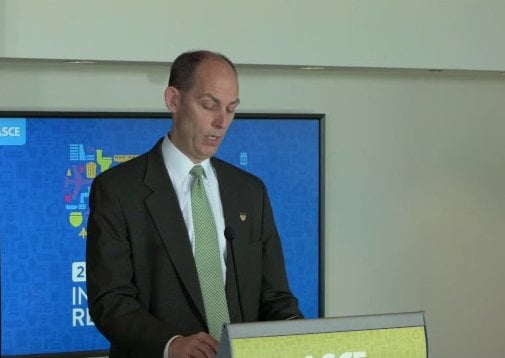
Tom Smith: Everyone, go ahead and take your seats. We'll go ahead and get started. I just want to say thank you to everybody for being here, and good morning. My name is Tom Smith, I'm the Executive Director of the American Society of Civil Engineers, and it's a great pleasure to be here with everybody today on this beautiful sunny day. I'm pleased to serve as the master of ceremonies during today's event, as we announce the grades of ASCE's 2017 Infrastructure Report Card. During the, with this report card, we're going to share our recommended solutions to raise the grades, and we're gonna have some thoughtful discussion about what those solutions look like in reality.
We are particularly honored to be joined later this morning by a number of distinguished guests, including Connecticut Governor Danil Malloy, former Pennsylvania Governor Ed Rendell, DC Water CEO George Hawkins, and Marlin Steel Wire CEO Drew Greenblatt. And we're also pleased to be coming to you today from the Knight Conference Center at the Newseum here in Washington DC. Every day, the museum posts the front pages of newspapers from all 50 states outside its doors.
More than a few times in the last four years, there have been front page stories about aging, underperforming, and even failing infrastructure across the country. And just this morning walking across, I saw at least three articles on infrastructure. From water main breaks like the one that flooded part of UCLA's campus a few years ago, the 2015 Amtrak accident in Philadelphia, lead in drinking water pipes in Flint, Michigan, and other communities and to DC's water metro system, and most recently the events at the Oroville Dam.
Our nation's infrastructure is making headlines for all the wrong reasons. As the nation's oldest engineering society and the organization representing over 150,000 members of the civil engineering profession, the stewards of infrastructure, ASC holds a responsibility to inform the American people about the country's infrastructure in the name of public health, safety, and welfare. In fact, one of ASCE's strategic initiatives calls for raising awareness of this all too often forgotten backbone of our society and economy and advocating for action to repair, rebuild, and modernize our infrastructure using sustainable and resilient practices.
Since 1998, we have done this through our National Infrastructure Report Card. The concept of the report card first originated with the congressionally chartered National Council on Public Works Improvement Report, Fragile Foundations, a report on America's public works released in 1988. A decade later, when the government indicated it would not be updating that report, ASCE set out to conduct its first expert assessment of the nation's infrastructure. Over the six report cards we've done since 1998, we've expanded the infrastructure categories, examined, and refined the methodology.
But the report card still holds to the familiar A through F format, the grading system that we all know so well. We've deployed this model not just with quadrennial national report cards, but in collaboration with our sections and branches throughout the country in state and regional report cards which are prepared on a rolling basis. In 2017, the infrastructure report card, just as it did in 2013, evaluates 16 categories of infrastructure. Aviation, bridges, dams, drinking water, energy, hazardous waste, inland waterways, levees, parks and recreation, ports, rail, roads, schools, solid waste, transit, and wastewater.
The report card is prepared by the ASC Committee on America's Infrastructure, which for this report card includes 28 civil engineers from around the country with expertise across all the 16 categories that I just mentioned. With ASC staff, the committee evaluates Data and reports from government agencies, the private sector, nonprofits, and other organizations, and meets with technical and industry experts to gain a wider view of the nation's infrastructure. The committee then examines each category in the context of eight criteria before determining a grade.
Those criteria include Number one, condition. What is the infrastructure's existing and near future physical condition? Number two, capacity. Does the infrastructure's capacity meet current and future demands? Number three, funding. What is the current level of funding from all levels of government for the infrastructure category as compared to the estimated funding need? Number four, future need. What is the cost to improve the infrastructure? Will future funding prospects address that need?
Number five, operation and maintenance. What is the owner's ability to operate and maintain the infrastructure properly? Number six, public safety. To what extent is the public safety jeopardized by the condition of the infrastructure, and what could be the consequences of failure? Number seven, resilience. What is the infrastructure system's capability to prevent or protect against significant multi-hazard threats and incidents? How able is it to quickly recover and reconstitute critical services with minimum consequences for public safety and health, the economy, and national security?
And finally, number eight, innovation. What new and innovative techniques, materials, technologies, and delivery methods are being implemented to improve the infrastructure. And to refresh your memories from your school days as to what each grade means. And hopefully these are pleasant memories, probably some pleasant, some not so much. A, exceptional. Fit for the future in excellent condition. That's what we're shooting for. B Good, adequate for now, but some elements show signs of general deterioration that require attention.
C, mediocre, requires attention, some elements exhibit significant deficiencies with increasing vulnerability. Poor, at risk. Many elements approaching the end of their service life, condition and capacity are serious concern, with strong risk of failure And finally, F, failing. Critical, unfit for purpose with signs of imminent failure. Upon assigning the grades, the committee then makes recommendations to raise the grades for the nation's infrastructure generally and in each of the 16 categories.
Participating in the report card process is an enormous undertaking, particularly given that the committee members are all volunteers, with many having demanding day jobs, in addition to their ASC involvement. This commitment to raising awareness of the nation's infrastructure and its condition embodies civil engineers' ethical and civic obligations, one they take very seriously. On behalf of the Society, I thank these volunteers and turn it over to the Chair of AC's Committee on America's Infrastructure, Mr. Greg DiLoretto. Greg is a past president of ASCE.
In fact, he was president in 2013 when we issued the last infrastructure report card. The former CEO of Tualatin Valley Water District and Metropolitan Portland, Oregon. He's a leading expert on water infrastructure issues. Greg will share with us the 2017 infrastructure report card grades, as well as provide insight into the mounting infrastructure investment needs across the 16 categories. We will then turn it over to the current president of ASCE, Dr. Norma Jean Mattei. Who will share ASC solutions to raise the national infrastructure grades.
Norma Jean is a professor of civil engineering at the University of New Orleans and was appointed by President Obama to serve as one of the three civilian members of the Mississippi River Commission. Which was established in 1879 to develop plans to improve the condition of the Mississippi River, to foster navigation, to promote commerce, and prevent destructible floods. She served on the Committee on America's Infrastructure Greg, I'll turn it over to you.
Greg DiLoretto: Well, thank you Tom, and it's a pleasure to once again be part of the release of the infrastructure report card, particularly at a time when there is renewed interest at all levels of government in addressing this critical issue. I'd like to take a moment to echo Tom's thanks to the 27 volunteer members that worked with me on the creation of the 2017 Report Card for their hard work and collaboration, including our Vice Chair Steve Curtis and several members who are here today. In 2013, as Tom mentioned, I was the president of ASC at that time and aided in the release of that report card, and I thought I had a full appreciation for what goes into putting it together, prior to being the chief executive, I was a public works director in three different cities in the Portland, Oregon area. So I have an understanding of infrastructure in a variety of categories.
But really serving on the committee and speaking on this topic for the last four years around the country, and frankly around the world has given me a better perspective on what our infrastructure condition is and what it means for Americans. Now, it's a testament to the responsibility and obligation civil engineers hold. for our society, as we seek to raise the awareness of the need to invest in the maintenance, planning and construction of our infrastructure and to provide it in a state of good repair and a satisfactory quality of life for all Americans. The ASCE report card has brought Americans awareness of infrastructure and its importance to our quality of life and economy, along with a greater understanding about the increasingly concerned state of our nation's aging infrastructure.
Public opinion polling shows that a significant number of Americans, 87% in one recent poll just last month, agree the federal government should increase its investment in infrastructure. This growing recognition with transcends political ideology has led to candidates for elected office increasingly including infrastructure improvements and investments in their platform. Consider these two quotes from two well-known officials. The bridges and highways we failed to repair today will have to be rebuilt tomorrow at many times the cost. Rebuilding our infrastructure is common sense. an investment in tomorrow that we must make today. And crumbling infrastructure will be replaced with new roads, bridges, tunnels, airports and railways gleaming across our very, very beautiful land.
These two statements The first from President Reagan in 1982 and the second from President Trump during last week's address to Congress demonstrate that for nearly three decades, our elected officials have known that America's infrastructure has needed attention, improvement and investment. Yet even when the President of the United States has called for it, Many leaders at the federal level has eschewed their adequate investment, shirking their responsibilities in watching out for American families, and caring for the very backbone of our economy. While some investment and progress has been made, it is not enough to prepare our nation for a 21st century economy on a 20th century infrastructure with 20th century dollars.
Meanwhile, other nations have committed to infrastructure investments that will attract businesses, innovations and jobs of tomorrow, jeopardizing America's economic leadership in the global economy. For example, China spends more on economic infrastructure annually than the combined efforts of North America Western Europe. Infrastructure spending between 1992 and 2013 annual average as a percentage of gross domestic product, for China, 8.6 percent, for the United States and Canada, 2.5 percent Western Europe, 2.5%.
And Japan is expected to spend 1.5% more of its gross domestic product on infrastructure to meet its economic needs during the next 15 years, in order to avoid substantial growth slowdown. The United States is underspending by about 7/10ths of a percent. As you are about to see in the report card grades, America's infrastructure challenges are significant and cause for concern, but the good news is they are solvable.
But reversing our infrastructure's backward trajectory after decades of underinvestment requires transformative action from Congress, the states, infrastructure owners, and most importantly the American people. Needless to say, since ASCE's first infrastructure report card in 1998, the grades have not been ones to make Lady Liberty proud. ASCE has yet to give an overall grade out of the D range. And that remains true for 2017 infrastructure report card, where America's cumulative GPA is once again a D plus That cumulative grade of D+ reflects the significant backlog of needs facing our nation's infrastructure, particularly in three categories that experienced a decline in the grade this year Parks, solid waste, and water. and especially transit, the report card's lowest grade at a D minus.
And six categories of grades remained unchanged from 2013. Aviation, bridges, bands, drinking water, energy, and roads with all but bridges stalled in the D range. Yet, there are some signs of improvements. We saw seven categories with slight improvements hazardous waste, inland waterways, levees, ports, rails, schools, and wastewater. Where we see areas of infrastructure improve, those categories benefited from strong leadership, thoughtful policymaking, and investments that garnered results. These improvements demonstrate what can be accomplished when we innovate solutions that move projects forward as implemented.
So let's take a little closer look at each of these categories to see what has or in many cases, hasn't improved in the four years since I was up here talking about the 2013 report card. The transportation categories represent some of the most recognizable infrastructure in our country, and it's probably the first thing that Americans think about when they hear that word infrastructure. So for roads, the grade is the D, same as it was four years ago. More than two out of every five miles of America's urban interstates are congested, and traffic delays cost this country $160 billion in wasted fuel and time. On average, Americans waste 43 hours a year stuck in traffic, or in other words, one of your two weeks vacation gone.
Aviation, grade D, the same as last time. US airports serve more than 2 million passenger miles every day, and congestion is growing. It is expected that by 2020, 24 of our 30 major airports will experience Thanksgiving Day peak traffic at least once a week. On top of that, we have a $42 billion funding gap between now and 2025 in airports. Bridges received a grade of C+, that's the same as it received last time. Over 200 million trips are taken every day across our nation's nearly 59,000 structurally deficient bridges, about 9.1%. Now, structurally deficient doesn't mean they are unsafe, but it does mean they require more repair and more frequent inspections.
Transit, transit is our worst grade this time. It is a D minus. The nation's transit systems are chronically underfunded, resulting in aging infrastructure and a $90 billion maintenance. backlog. Overall, those categories of transportation have the largest funding gap across the 16 categories of infrastructure $1 trillion. Now, inland waterways which had one of our lowest grades last time in 2013 of a D minus, is actually up to a grade of D. Yet most of our locks and dams in this country are well beyond their 50 year design life and nearly half of our vessels experience delays. Investment in the waterways system has increased in recent years, but upgrades on the system still take decades to complete.
Our ports grade went up from a C to a C+. The United States nearly 1,000 ports serve as the gateway through which 99% of overseas trade passes through, which is responsible for 4.6 trillion dollars in economic activity, it's over a quarter of the US economy, highest grade this year is for rail which went from a C+ to a B And the reason is, the private freight rail industry has made significant investment in recent years. In fact, they made $27 billion dollars in investment in 2015 alone. Dams grade remained the same at a D. Our nation's dams are aging, and due to increased development, the number of high hazard potential dams continues to rise, currently at 15,500. And we have an investment gap of nearly $45 billion to repair aging, yet critical high hazard potential dams.
Levees was also our lowest grade in 2013 at a D minus. It's up to a D, and additional investments were made, but 40% of Americans live behind levees that were originally built to protect farmland. Drinking water, the grade remains the same at a D. For the first time though in 40 years, Americans are using less water due to increased deficiencies and declining industrial uses. Yet, there are still an estimated 240,000 water main breaks per year in the United States wasting over 2 trillion gallons of treated drinking water every year.
The wastewater grade went up from a D to a D+. Our nation's nearly 15,000 wastewater treatment plants protect the public's health, safety, and environment, but more than 56 million new users are projected to be connected to the system. over the next two decades at an estimated cost of $271 billion to meet those needs. Solid waste, which had our highest grade in 2013 of a B has gone down to a C+. as a result of recycling rates that have plateaued. Overall management of our solid waste across America is in fair condition and sufficiently funded, but there is a way I need to change the way we think. of how solid waste is generated, managed and used as a resource.
Hazardous waste, the grade went up from a D to a D+. We have over 18,000 sites and associated 22 million acres of land related to the primary hazardous waste programs that comprise Much of our nation's hazardous waste infrastructure, and more than half of the United States population lives within three miles of a hazardous waste site. But recent proposed funding cuts for EPA could lower that grade, and would have a serious impact on public health and safety. Energy, the grade remains the same at a D+, but most of our transmission and distribution lines were built in the 1950s and 1960s with a 50-year life expectancy, and more than 640,000 miles of high-voltage transmission line in our lower 48 states are at full capacity.
Without greater attention to aging equipment, capacity bottlenecks, and increased demand, as well as increasing storm and climate impacts, Americans will likely experience longer, more frequent power interruptions with an already estimated nearly 3,600 outages in a single year, our parks and recreation grade decreased from a C to D+ this year. It's a vast network of infrastructure that goes into supporting more than 7 billion outdoor recreational outings, yet the National Park Service alone estimates nearly $12 billion in deferred maintenance, and finally schools.
The grade has gone up from a D to a D plus. Every day, nearly 50 million K through 12 students and 6 million adults occupy close to 100,000 public school buildings. Yet our nation continues to under invest in school facilities with an estimated $38 billion funding gap. As a result, nearly one fourth of our public schools were rated as being fair to poor condition The grades in these 16 categories are cause for concern, and reflect the fact that America's infrastructure bill is long overdue. In addition to grading the nation's infrastructure category every four years, ASCE estimates the investment needed in each infrastructure category to maintain it in a state of good repair and earn a grade of B.
That is a grade we believe our infrastructure needs if we're going to sustain our economic prosperity and quality of life. We also do this to see what happens economically if we just continue to kick the can down the road and not make this investment in infrastructure. Our most recent analysis reveals the U.S. has only been paying for about one half of its infrastructure bill for some time. And failing to close the gap risk costs for business productivity, plummeting gross domestic product, lost jobs, and ultimately reduced disposable income for every American family. Between 2016 and 2025, the estimated investment gap gap between what we have as revenue, what our expenditures are going to be or need to be is $2 trillion.
And even though Congress and some states have recently made efforts to invest more in infrastructure, these efforts do not come anywhere close to what's needed. We have simply failed to invest for too long, and we are now struggling to catch up. Failing to close this infrastructure gap brings serious economic consequences. According to ASCE's latest economic study, which was prepared last May, if we do not address the infrastructure investment gap, We will see 3.9 trillion in our lost gross domestic product by 2025. That is equal to the gross domestic product of Germany today. We will see businesses lose $7 trillion by 2025, and we will see the loss of 2.5 million high paying jobs in 2025.
But those are big numbers. So here's a number that I think we can all get our heads around on top of that each Each American family is already losing $3,400 in disposable income each year. More than $9 a day, due to poor infrastructure. That's income we could be saving or spending on other things that make our lives better, but instead we're paying it on car repairs, wasted time and gas, and an increased cost of goods. Here's the thing, for about four dollars a day the price of a nice cup of coffee, we can solve it. $4 a day per American family. We could solve this problem. So we're either going to lose $9 a day, or we can spend $4 a day. It's a pretty darn good return on investment.
So what do we do about the poor state of our nation's infrastructure and this widening investment gap? Well, to answer that question, I'm going to turn it over to my friend and colleague, 2017 ASCE President Dr. Norma Jean Matei.
Dr. Norma Jean Mattei: Thank you, Greg. Thank you, Tom. As you may have remembered from what Tom said, I am in my day job an engineering professor, so I give grades out all the time If I gave grades out to my students that match the grades that you see in this report card, I'd be worried. So we at the American Society of Civil Engineers are telling you, when it comes to your infrastructure, you should be worried.
So those are sobering grades. Now for some solutions. To raise the national infrastructure grade over the next four years, ASCE urges three starting points. Investment, leadership in planning, preparation for the future needs of our nation. As Greg just described, our infrastructure investment needs are major. They're significant. If the United States is serious about achieving an infrastructure fit for the 21st century, some specific steps must be taken, beginning with increased long-term consistent, consistent investment. Delayed investment only escalates costs. And it increases the risks of an aging infrastructure system, something that we in the United States can no longer afford.
To close the $2 trillion gap, It's a 10-year investment gap. Meet our future need, and to restore our global competitive edge, we must increase investment. investment from all levels of government and from the private sector too. As mentioned before, we invest 2.5% of our GDP now. We need to invest 3.5%. This investment must be consistently done, it must be wisely allocated. So to do this, we have some steps we must take. We must fix the Highway Trust Fund by raising the federal motor fuels tax. We must authorize and fund programs to improve specific categories of Deficient infrastructure, and we must support infrastructure owners and operators, they must charge rates and fees that reflect the true costs of using of maintaining and of improving that infrastructure.
So you might be thinking, why do we do this? Infrastructure is the backbone of the U.S. economy, and it's a necessary input to our economic output. Infrastructure's condition has a cascading impact on our nation's economy impacts business productivity, our gross domestic product, it impacts your employment, yours and mine, our personal income and our international competitiveness. Well-functioning infrastructure is critical to the nation's prosperity. It's critical to our health, our welfare, our safety. Smart investment will only be possible through leadership, bold leadership, planning and a clear vision for our nation's infrastructure. That's why leaders from all levels of government from business, from labor, non-profits.
We must all come together to ensure that all investments are spent wisely, that we prioritize projects. With critical benefits to the economy, public safety and quality of life. We also must plan for the costs of building, operating, maintaining the infrastructure over its entire lifespan. We can do this! But we must, one, require all projects greater than $10 million that receive federal allocations use life cycle cost analysis and that they develop a plan for funding the project, not just its upfront costs but its operating, its maintenance costs until its end of service life. We must create incentives for state and local governments, and the private sector to invest in maintenance.
And we must identify a pipeline of infrastructure projects that are attractive to private investment and public-private partnerships. Last but not least, we must prepare for the future. Utilizing new approaches, new materials, new technologies to ensure that our infrastructure is both resilient and sustainable. This includes considering emerging technologies and considering shifting social, environmental, and economic trends. Autonomous vehicles, distributed power generation and storage are examples when building new infrastructure to ensure long-term utility.
We also need to support research and development to modernize and extend the life of infrastructure, to expedite that infrastructure's overhauls when needed and to promote efficiencies. Opportunities exist right now to make good on these recommendations to solve our nation's infrastructure crisis. The Trump administration and the U.S. Congress weigh infrastructure legislation right now, and state and local governments around the country look to take action in their communities. ASCE welcomes the opportunity to work with these officials at all levels. all levels of government to develop a workable plan to repair and modernize our nation's infrastructure, and foster that desired economic growth.
We particularly are encouraged by the signs from President Trump and the leaders in Congress to work together on a bipartisan issue. This is bipartisan. It will contribute to significant gains for the American economy, and for U.S. families. To make the most of our future infrastructure investment, ASCE believes that all programs and projects supported by federal legislation must meet some fundamental criteria. Investments must provide substantial long-term benefits to the public, and to the economy. The cost of the project over its entire lifespan, including its design, its operating, and maintenance must be taken into account.
Projects should be built both sustainably and resiliently, and federal investment should leverage state, local and private investment. not replace these other critical sources of infrastructure funding. In fact, there are concrete steps Congress and the administration can take now, and that these steps will allow for progress and improvements across many of those 16 categories. We must begin with a focus on the aspects of our infrastructure most in need of repair, to sustain our economy, to sustain our public health and our safety.
To make the most of limited investment, let me give you an example. The President should request, and Congress should increase, funding for a number of already existing federal infrastructure programs. Let's list some of these. The Clean Water State Revolving Fund, the Drinking Water State Revolving Fund, the Federal Dam Rehabilitation Program, The Levee Safety Program. Priority projects at the U.S. Army Corps of Engineers, they have a backlog. The USDOT transportation investment generating economic recovery, or for short, TIGER discretionary grants. These projects exist now.
Funding by these projects already has proven to be successful. In fact, TIGER grants were very active in getting rail grades up to that B. This will reduce overhead costs and start-up time if we invest in existing programs, not create new ones, while still allowing for significant and noticeable improvements across all sectors of the U.S. infrastructure. And, as in our solutions, a critical component of any plan to rebuild and modernize our infrastructure must be to fix the Highway Trust Fund. raise the motor fuel tax.
Easy peasy, right? Well President Trump is onto something. as he calls for a new program of national rebuilding. But Congress and we, the American people will have to pay for it. There's no magic wand to address this crisis. No infrastructure money tree. No infrastructure private sector angel. that is touted as a key to revitalizing our infrastructure. It's going to take us. At the end of the day, all Americans share a role in renewing our nation's infrastructure. Solving this crisis will take collective action and tough choices, beginning with our leaders showing some political will and some courage.
Government and the private sector must partner to close this critical deficit, commit to a future in which we improve infrastructure, and that we value it. As a key to the quality of our lives and our economic prosperity, every day of delay escalates our shared costs It jeopardizes our health, and it risks our security, an option our country, our economy, our communities can no longer afford to take. All Americans share a role in renewing our nation's infrastructure. Start by learning about, and by appreciating the infrastructure all around you. Stop just taking it for granted.
Share this report card and advocate for long-term investment, for visionary leadership, thoughtful planning, and thorough preparation for your future. We can't afford not to. I urge you, we at ASCE urge you, you all To take the first step by visiting the infrastructurereportcard.org website, download the Save America's Infrastructure app for your smartphone. I think it's live. Explore the report card. Take a look at the videos. We have some infographics that are pretty cool, and they're interactive. Share it on social media. Do your own tweeting. Please, please first and foremost contact your elected officials at all levels of government and urge them to raise America's infrastructure grades, and ensure that our infrastructure is built for the future.
Tom Smith: Thank you Norma Jean, and thank you Greg. We have a few minutes before the next panel discussion, I wanted to see if we could open up maybe for a few questions. We have a video we can show as well, but wanted to see if anyone has any questions about the report card or the solutions? Yes.
Tom Frank (CNN): How would you evaluate what President Trump has done so far?
Tom Smith: Well, certainly the discussions last week from when President Trump spoke to Congress and talked about investing private and public capital in infrastructure, we thought we were encouraged by that. Because we do think that private and public capital is going to be necessary to solve this problem, as President Matei referenced. So I know there have been a lot of things on the administration's plate. We would like to see infrastructure high on that list, and we'd like to see, as you heard from President Mattei, imminent quick action on this because We think it's an important issue for the country, the backbone of our economy. So we'd like to see it certainly prioritized and elevated in priority. Greg and Normand Jean, did you have anything further on that? That's a very good question. Thank you. Yes ma'am? Oh we'll get a microphone over here for you if we could. Right there. Oh I'm sorry, I thought you had a question. Yes, okay. We got a microphone. Oh, sorry, right here. Thank you. Sorry.
Mary Grace Lucas: Hi, thank you for taking my question, and Mary Grace Lucas with Vice News on HBO. Can I just ask briefly, are you having conversations with the Trump administration, and can you describe the content of those conversations with the Trump administration? Thanks.
Tom Smith: Well, there have been some moving parts. I know we've had some conversations, and some of our folks from the DC office, of course, are here from ASCE's government relations staff, and they've been in communications with Congress, in fact, many visits yesterday. But with the administration, there have been we've had some discussions about the need for investment in infrastructure. They are certainly aware of the report card. and our failure to act studies that talks about what are the implications of failing to invest in infrastructure. But right now it's been a bit of, you know, it's been hard to pin down exactly, you know, concrete plan. There's been a lot of focus on a lot of different things.
Dr. Norma Jean Mattei: We've actually had a couple of days ago DOT discussions. Not all of the folks are in place yet, and it's pretty early on in the administration. Yes, question over here?
Tom McNialski: Tom McNialski, Engineering News Record. What's the difference in the funding gap between this report and the last one? And how much would you recommend raising the motor fuels tax?
Tom Smith: Greg, do you want to talk a little bit about the difference in the gap? Right.
Greg DiLoretto: The gap has actually gone up in transportation, but it's remained more constant because in our last report card we took a shorter period of time over our current report card. I think last time it was $1.6 trillion dollars, and it's now 2 trillion, but you have to remember we have more years plugged into this one. Our recommendation for the gas tax is, I believe, 25 an increase of $0.25 a gallon. And an index? An index as well.
Tom Smith: So of that $2 trillion gap that we're talking about, I think is it 1.1 trillion is related to surface transportation? Right. And so we definitely think that an increase in the federal gas tax is an important means of addressing this problem.
Tom McNialski: The difference in the time frame, the 1.6 trillion is over how many years and two
Multiple Speakers: That was over
Greg DiLoretto: seven, six years, eight years right? And this is over 10. Thanks. Yeah, thank you.
Sue Gander: Hi, this is Sue Gander with the National Governors Association. So you noted that four years ago the grade was D plus. We're at a D plus again and So still very sobering. And if the D-plus wasn't motivation enough four years ago, what do you think is or might be different? this time around, kind of looking for some hope here. What do you think might be different in terms of increasing the investments and the attention on infrastructure?
Tom Smith: In 2013 we went from a D to a D+, so we saw some tiny triumph I think is what John and Oliver referred to that as. So here we're going from a D plus to a D plus, although we did see seven grades increase. So we saw some examples of what can happen when we invest and focus on this with a vision. How do we are we encouraged that we're going to see some action going forward? I say we're encouraged by the conversation that's taking place, both candidates and the election we're talking about infrastructure. There's still been a strong discussion about infrastructure as recently as last week as we referenced, so while we haven't seen action yet, and we need to hold feet to the fire, we are encouraged by the discussion I think we have changed the conversation, there's a focus and realization about how critical infrastructure is to this country and how the situation that we're in is poor and at risk. I think there's a better understanding of that now. Unfortunately, we have a tendency to wait for disasters and be Reactive, and what we want to do is be proactive and not reactive, because when we're reactive, it ends up costing significantly more than when we're proactive. So we're trying to change that and not just respond to disasters, and we feel like the conversation is changing, but we've got to push it over the hill to get some action.
Sue Gander: Just as a follow up, are you encouraged by things you're seeing at the state level as well?
Tom Smith: Absolutely. Absolutely, we have been encouraged by some of the action that's taken place at the state level. I think within the last four years, there have been 19 states that have increased their gas taxes. They've recognized that there is a need to invest in their transportation infrastructure. And they've taken some significant steps to do that.
Greg DiLoretto: And interestingly enough, of those 19 states, I think about 15 of them have a state report card that details what's going on and what the condition of their state infrastructure is.
Tom Smith: And if you go to the website, you will be able to see some of those state report cards. The ones that have been updated within the last four years, you'll see about half the states, I think, have got report cards that will be on that website, many of which have been used, as Greg referenced, for advocacy purposes and education purposes.
Dr. Norma Jean Mattei: And the news is all not abysmal. So also on that app, you can go to game changers. So there are good things happening. We just have to do them more often. Other questions?
Tom Frank: I just want to follow up on the gas tax. Have you called for that to be increased before in previous reports? And if so, what makes you think you got a chance to have it done this time? And if not, why now?
Greg DiLoretto: It's been a part of our previous reports, but we've had requests from elected officials to say, well give us a specific solution. Don't give us generalities. Tell us specifically what you think we ought to do. So we're telling you specifically what we think they ought to do. The fact is, the 25 cents a gallon sounds like a big number, but if you take a car that gets 12,000 miles, rides 12,000 miles a year, and gets 20 miles to the gallon I think it works out to something like around, what is it? $12, $10 a month for to leave ourselves with 43 hours stuck in traffic. If you happen to live in Los Angeles, the new number now is 104 hours, your entire vacation spent stuck on 405 in LA.
Dr. Norma Jean Mattei: Yeah, and we haven't raised the gas tax since 1993. So try living on your 1993 salary today.
Tom Smith: And as we're now four years down the road from 2013, that amount is more and more inadequate.
Dale High: Dale High, High Companies, just thinking about the gas tax not being raised in that time frame, but also looking at what happens at base with the miles per gallon escalating and alternate fuels Reducing that base further, I'm wondering about a miles driven tax or something that's more based on the realities of changing automobile world?
Tom Smith: Absolutely good question about vehicle miles traveled and another number of pilot projects that are being run in the country right now that are evaluating that. It raises questions about how to implement a program like that. the administration behind that, privacy issues that people raise sometimes depending on how you do it. So certainly that's something that needs to be we'd support looking into that. However, in the near term, The gas tax seems to be the cleanest, most efficient quickest way to do it. So that's something that should continue to be evaluated if a vehicle miles traveled, but the gas tax is the more immediate solution.
Lauren Schapker: Hi, Lauren Schapker with the National Groundwater Association. I wondered in your report card if you made any distinctions between needs in rural areas versus urban areas across infrastructure?
Greg DiLoretto: No, we did not. Our report card does not look at a couple things. One, it doesn't look at specific projects, so we don't look at those. And we don't address specific areas. Now our state Ours looks at the national trends across that category, across the entire United States, and so it's certainly much more at a higher level than you might find certainly at the state level. We even have a few report cards that have been done uh… at uh… down to the uh… for example, Orange County, California has a report card, so we've had a few of those, but we're really looking at the state of the industry across all uh…
Tom Smith: Are there other questions? Is there another one here? Do we have a microphone?
Mary Grace Lucas: Sorry to bug you again. Just a follow up on states, so can you talk to me a little bit more about the consensus that states Is there consensus that they need to come up with their own strategies for funding? Do they need to rely less on the federal government?
Greg DiLoretto: The way we look at it is that this is a partnership between the federal government, the state government, and the local government. Much of our infrastructure is owned by local government. You know, the city you live in, the county you live in. So it's a partnership that everyone has a responsible level to do. Now, the fact is, because of the inaction on the federal government, we are seeing states play a bigger role, but it's not big enough to meet the needs particularly in that transportation field. So we do look at each group providing their share based on a responsibility.
Tom Smith: And while there's a strong state and local role, we also think is important for the federal government to have a role. It's not just the states of America, it is the United States of America. If you go back to the Constitution and look at the Interstate Commerce Clause We talked about also post roads. There certainly is a role for the Federal Government to have a national vision for a comprehensive connected infrastructure system. Other questions?
Jim Dieter: Okay. Hi, I'm Jim Dieter from the Asset Leadership Network. So I'm pleased to hear talk about total cost of ownership and a longer term view, but they have, you know, the longer term view isn't as sexy as building a new bridge. Could you talk a little bit about thoughts on how we can support Congress and the administration that longer-term view?
Greg DiLoretto: Well, you know we're certainly seeing again, as Tom mentioned, I ran a utility, and certainly we're seeing those of us that were in the utility industry. take a look at that longer term view. We're starting to do asset management of our facilities, we're starting to look at what it takes for the life of that facility from the time we put it in the ground. until the end. Now, my experience was in local government, not state and federal, but I found in all those different local governments I worked in that when I had that conversation with my elected officials about how long what this was going to cost from A to Z They understood that. And they understood that, you know what? They were going to be responsible potentially for that from A to Z, so they took a little longer term view. uh… which i found encouraging, but had to have that conversation with them in order for it to happen, otherwise you're right, we always look at what's the first cost, put that facility in the ground, we don't look at Now, what we're proposing in ASC is there are a number of innovative solutions in terms of the materials we use, the way we design it, the way that it is built that are going to make those facilities last longer and might have a slightly higher initial cost, but as you know, long term will have a much, much lower cost. And that's the message that we're trying to get out with this notion of doing a life cycle costing.
Dr. Norma Jean Mattei: It's a little scary because elected officials like to cut ribbons. And so if you have more upfront costs for a lesser cost overall. they're going to cut less ribbons, so we just have to understand that, and then the voting public has to let elected officials know that that's okay, that's what we want.
Tom Smith: That's been a particular focus at ASC, this life cycle cost assessment and guidelines on that and making sure that people understand Certainly, in the private sector, when we talk about P3s, I think there's a recognition that this is a life cycle, and there's going to be return on investment over the true life cycle. But we've got to make sure we incorporate that thinking all the time in all infrastructure investments. Other questions?
Ryan Daniel: Yes, good morning. Ryan Daniel with ITS America. Can you speak to the role of smart transportation technologies in the rebuilding, modernizing of our roads and transit systems?
Greg DiLoretto: I can't speak to it specifically. The fact is, though, you look at the solutions that we've generated, and as engineers design facilities for the future, they're looking at them to be more sustainable, they're looking at them to be more resilient. Those kind of actions will occur as we go forward to try to make the money we need go farther. But our report card doesn't look at a specific technology type solution.
Tom Smith: But your question, I think, is a great illustration of the need to invest in infrastructure. You're utilizing infrastructure that's 50, 60, 75 years old, 100 years old. When we have this new technology, fiber optics being laid in roadways and looking what the future is, more efficient effective ways to transport people and freight. It's out there and it's every day where it's evolving and it's exciting, but we've got to invest in it. We can not fall behind, and I think that's a great question because that really illustrates the need for infrastructure investment, particularly in transportation.
Dr. Norma Jean Mattei: Yeah, our infrastructure is actually the envy of a lot of the world because we've got it. But what's frightening is our stuff that we've got, we've been using and enjoying and it's getting old. And now these other countries are investing quite a lot of their GDP in nice, shiny new infrastructure. We got to keep up.
Tom Smith: Thank you. Another question over here?
Harry Amidala: Yeah, I'm Harry Amidala. I'm a bridge engineer with Lewis Berger. I've been in Northern Virginia for a while, and we're talking about funding for different projects including gas tax and other sources of funding. And I see a place for that on a project like Arlington Memorial Bridge, where we need funding to rehabilitate, replace the span or fix it for long term. But at the same time, in Northern Virginia we're looking at I-66, a P3, where we have a concessionaire who is coming up with $500 million, they're giving $500 million back to state. right, to be able for the opportunity to develop I-66 as a toll road. It will also provide regular lanes without toll. So how exactly are we going to look at those as ASCE and encourage more of that? You know, like you said, obviously we'll have to pay for everything that we want one way or the other. But, you know, to go with the flow and encourage P3, what exactly are we going to be able to do as ASCE?
Tom Smith: You know, as we talked about that, ASC promotes sort of all options on the table. We say all of the above as we look at these different options. And absolutely, P3s are one of them and they've worked very effectively in Florida and they've worked very well in Virginia. You gave the I-66 example, they've worked well on 495. So that's an effective way to do it and you mentioned Arlington Memorial Bridge and I shudder on that one because I kayak under that all the time, I take a lot of pictures of it. It needs an awful lot of work and it's finally getting the attention that it deserves but…
Multiple Speakers: You wear a hard hat?
Dr. Norma Jean Mattei: I do,
Multiple Speakers: yeah, I wear a
Tom Smith: hard hat. But with P3s, it's an effective way to do it as you mentioned. Ultimately the solution is the public. We have to pay for infrastructure. All of us who use infrastructure are going to have to pay for it. Whether it's taxes, or tolls, or user fees, VMTs. There's a lot of different ways options on the table to evaluate how best to fund and finance, but we ultimately are going to have to pay for infrastructure. question here?
Multiple Speakers: Oh, this is our last question. Yes, if I
Tom Smith: get we get one more mic over here?
Laura: Yeah, right here, Laura.
Jacob Fishler: Hi, Jacob Fishler with CQ. I'm just curious, the president has called for a trillion dollars of investment. You guys are obviously aiming higher than that, but what's your sense of what what would a trillion dollars over 10 years do in terms of raising these grades?
Greg DiLoretto: Well, you know, a couple things. First off, he is calling for $1 trillion. Remember that $2 trillion gap covers all infrastructure and that's all levels, so you know it's not we don't look to the federal government to come up with the $2 trillion, it's all levels that are going to do that. Now clearly the $1 trillion, that's equal to the gap of our transportation deficiency, and much of the federal participation has been in transportation. Norma Jean mentioned, though, that the Clean Water Act and the Safe Drinking Water Act are two vehicles that utilities access for improvements to those systems. And so there certainly is a role there. They're also into dam safety, and a core of engineers. Obviously, it's not going to go the whole way, but obviously that's not the only solution. there is a partnership between all three levels, all owners, and the private sector as well for their facilities. That two trillion includes the private sector facilities as well, and energy mostly, and rail I
Tom Smith: think we've used up all our time for questions right now, so we'll just ask and thank you for your questions. They're great questions, and I'm sure if you have others don't hesitate to approach us later this morning or contact the team at reportcard @ asce.org which is on the back of materials that we have shared with you this morning. We're now going to turn our discussion of infrastructure solutions over to another panel, if we could take a moment to adjust the stage, and I think Greg you're going to then introduce Governor Malloy.
Greg DiLoretto: I think we'll sit in the middle, you and I. All right, well good morning everyone, and thank you for being with us today. It's my honor to introduce our first guest, Governor Dan Malloy of Connecticut. uh… he's serving the people of connecticut for a second term, congratulations, after being elected first time in two thousand eleven And throughout his administration, he has prioritized creating jobs, stabilizing the state's finances, and making long overdue investments in the state infrastructure. He has advanced an incredibly ambitious agenda to restore Connecticut's transportation systems in particular. Before being elected governor, he served as the longest serving mayor of the city of Stamford from 1995 to 2009 He's a recipient of the John F. Kennedy Profile in Courage Award and a graduate of Boston College. So Governor Malloy, thank you for joining us today to talk about infrastructure solutions. So I'm going to kick it off. I don't know how much you heard of our presentation, but with everyone's the grades for our nation's infrastructure, it's a d-plus overall,
Governor Danil Malloy: like my high school grades,
Greg DiLoretto: i was hoping you wouldn't say that What's your impression as to how Connecticut might stack up on that D plus grade?
Governor Danil Malloy: Pretty poorly. I think we've made progress over the last few years. And particularly in things like water and water quality and our expenditures. We're actually up about 350% compared to a similar period under the prior administration on water. But our roads clearly need a lot of work. We have about 8%, 338 bridges in the state. In Connecticut that are structurally deficient, 8% of all bridges in the state. So I don't think we'd get a very good grade.
Greg DiLoretto: Well, and you've done a lot, as I noticed, to prioritize infrastructure during your tenure both as the mayor and now as governor. So, you know, I'm curious, you're an elected official, we talk a lot about that when we do this, why do you think that issue's so important?
Governor Danil Malloy: Well, you know, there's a couple of problems. I mean, you know, infrastructure used to be a bipartisan issue, and then it became part of the great divide in politics if Democrats sought to spend money on infrastructure. It was a bad thing. You know, and what I'd like to see us do is come back and agree that infrastructure investment is very important. Sometimes It hasn't happened quite as much recently, but I'd watch these interviews of congressmen and senators coming back from Asia, or coming back from Europe and marveling at the trains and marveling at the airports and marveling at other infrastructure expenditures. And wondering why we weren't doing it. Well, in large part, we weren't doing it because our federal government wasn't leading the effort. And when I was mayor of Stanford for 14 years, we took on some big projects including a remake of our whole sewage treatment plant, modernizing it to meet the needs. We've got to get the right people involved.
The important things to do, uh… I think part of the problem As folks get into office, particularly as chief executives, they know they're only there for a limited period of time, and they know that they probably won't enjoy the investments that they're requiring the communities to make during their watch. And therefore, they just move on to something that is going to be more satisfying to them during the period in which they're serving and the problem with that is, that just gets handed from candidate to candidate, from office holder to office holder. And we end up losing as a society.
Greg DiLoretto: But you have made it important, so I'm curious. You have limited dollars. How do you approach prioritizing infrastructure? Selecting which ones you're going to do first.
Governor Danil Malloy: Well, I mean, I think listen, I think climate change and adaptation are very important. I think transportation is extremely important Clean water and sewage treatment obviously are high priorities for me. I'm a bit of an environmentalist in the sense that that I think we need to make those investments We have a long coastline and getting ready for rising tides has got to be part of that. You know, I've been Governor now in my seventh year, we've had five natural disaster declarations. During the time that I've been governor, we not only did we have Sandy Hook? Excuse me, Sandy Oak school, which is a shooting, but we had storm Sandy, but we also got just as badly beaten up during Irene and we had a We had a winter storm drop 20 inches in October, and knocked power out in parts of our state for a long period of time. Quite frankly, putting pressure on utilities to spend money on infrastructure has been an important part of what we've done as well. Holding them accountable.
Greg DiLoretto: We talk about in our organization to certainly our members, and to others, is that if we want to change this conversation, we, as individuals, have to contact our elected officials and tell them that this is important. So I'm curious, do you hear from people in your state about infrastructure? And how is that message from them, and what's your response at the different levels? Do they call you up or your fellow?
Governor Danil Malloy: I think society is divided on this issue. They want their project, and they don't understand anyone else's. And no one in government is taking the time or energy to explain that all of these things are interconnected. I sometimes refer to Connecticut's highway system as we treat I-95 as a parking lot, and we treat the merit Parkway as a museum, and you can't do anything to either. And as a result, traffic doesn't move particularly through Fairfield County in a very expeditious way. In fact, If I have to get from Hartford down to my city where I was mayor early in the morning, I have to plan three hours for an hour and 15, hour and 20 minute trip just to make sure that I'm actually going to get there on time. You know that's So people in Fairfield County understand their problem, but they don't necessarily understand that I-84 in Hartford is a two-mile long bridge in essence and has to be replaced at some point. But people in that stretch don't understand that the I-84 in Waterbury is going to need an extensive replacement as well. Somebody's got to lead, and I've tried to lead that discussion, and quite frankly do it in a bold way saying that we need to spend 30 billion dollars, excuse me, 100 billion dollars in 30 years to modernize our infrastructure on transportation alone. It's a big number. We are spending a lot of money right now designing or envisioning those projects that we know need to be undertaken. And one of the benefits of our long-term plan is a lot of the early money, because we can spend it more quickly is on mass transit. That satiates to some extent the environmentalists who want to make sure that you're spending your money in that area. But we need all solutions to come in Connecticut.
Greg DiLoretto: So now you were the mayor, and now you're the governor. Was it easier to make the case for infrastructure as a mayor? than the governor or is it immaterial, it's equally difficult?
Governor Danil Malloy: No I think it's easier as a mayor because people understand the needs of their community better than they understand the needs of their state. And so that's what I was trying to describe for you. So if you live in Stanford is 125,000 people living in a 47-and-a-half square mile community. They may not be in every neighborhood every day or every month, but they're going to experience the town that they live in. That's very different in a state. Even as small, I mean we're the third smallest state geographically. We're the 25th largest state population wise. But even in that densely populated area there are people who never get to another part of the state. And so they don't understand. I want to share with you. You've chastised your industry for not… telling the story sufficiently and consistently enough. I'm going to chastise political leadership for not doing that. And then you have a whole other bunch of people say well if you spend that and you bond that then you're gonna have to pay it back. Well yeah, that's the whole point but that's why people buy houses and that's why people put new roofs on houses when they start to leak. We have to do the same sorts of things. or when I-95 turns into a parking lot you might want to add a lane or two. It might make sense to do. I'm just recalling this, when a number of years ago And we have what's called a certificate of need process, where you have to justify an additional hospital getting into another line of work that's available someplace else. And there was this very interesting discussion that there were hospitals in Bridgeport, which is at certain times only 25 minutes away, where that surgery could be done. But of course, if you had a heart problem early in the morning or late in the afternoon, that twenty five minutes would stretch to an hour and twenty five minutes, and you're dead Interestingly enough, the certificate of need was granted. That was a salient point for people in lower Fairfield County to understand how dangerous not only is a system that's so overloaded with respect to accidents, but life experiences.
Greg DiLoretto: So as we try to talk to Americans about this issue, do you think there's some things that would convince more Americans to care about infrastructure? I mean they take it for granted today. What can we tell them that might convince them that this is important? I mean, you've cited the heart one.
Governor Danil Malloy: 530 this morning and grabbed a USA Today, which I see in hotels and at airports. On the front page is this whole article about West Virginia and the fact that parts systems got built, including a very expensive bridge, but the road itself never got finished. What I would say to you is that A, you need to reach out to elected officials. You need to educate them, quite frankly. I caught part of your discussion about what's the life cycle of a project? How long is a bridge? How long is a road? How long is anything going to last? I don't think people in political life understand that concept, if they did, they would set up accounts to fund on a long-term basis. Rebuilding of things. They don't do that, that's not a practice that's engaged in public life. Corporations may do that. Others may do that. It doesn't happen. Engaging folks on that subject is going to be an important part.
Greg DiLoretto: So, you know, looking at your own state, I assume, but I don't know that your state faces budget challenges just like every other state in this country, and yet you've made these significant investments to modernize your system. How do you make that case when you've got however many lawmakers you have there weighing this project, not project, but this particular service and this one and that one to say, This is the one I think we oughta do and here's my reasons.
Governor Danil Malloy: Well, I don't know if I'm gonna be able You expend political capital. I mean, you're not going to live forever. You're not going to hold office forever. Anybody who leaves office with any political capital left is making a gigantic mistake. No one's tombstone is ever going to say what a great guy he was because he left with all his political capital. You get to build things. You get to invest in the future, and you should seize on those opportunities.
Greg DiLoretto: So what have been some of the challenges you've faced in moving this forward? In spending that capital. All the other people.
Multiple Speakers: I mean all the other
Governor Danil Malloy: people who want to preserve their political capital who, again, I'll go back and I don't… I'm not trying to make this political, but Eisenhower championed the build out of that system. He was a Republican. Lincoln in the middle of Civil War championed the building out of railroad system. He was a Republican. Now we have Republicans who go run around and say, well, if you spend money and you bond for that investment, you're somehow reckless. Where did that come from? Where did investing in the future, or as my mother would say, you have an obligation She wasn't necessarily talking about infrastructure to me. To be the occupants of the United States of America today, planning on turning over a country in worse shape, physical shape than the one we inherited. And yet, that's what we're doing. That's what we're doing as a nation. And so, this has got to be a call to action and people have to be reminded. But I go to bond, I set the agenda for bond approvals and I will be lectured by a state senator who says we're spending too much on infrastructure, has never voted against a project. Or may have actually over the course of seven years may have voted against three. But never misses an opportunity to criticize the fact that we're spending money. It's an interesting, you know. I guess someday I want to have my cake and eat it too.
Greg DiLoretto: So you have your plan to a $2.8 billion five-year transportation plan, and of course, you have those people that say well you're just going to spend the money.
Multiple Speakers: How do you go about ensuring That's the whole point, yeah.
Greg DiLoretto: But how are you going to ensure you know, they're going to say you're just spending not efficiently how do you go about answering that question?
Governor Danil Malloy: Well first of all i'm not going to spend all that money. It's a thirty year plan which if Connecticut had had thirty years ago would be in far better shape today than they are It would have been far less expensive to add a lane to I-95 in either direction five years ago, ten years ago, twenty years ago. It was evident that that the road was insufficient. All she had to do was go to the states at either end and understand what they were doing. Mass transit, you know Metro North in Connecticut is the busiest commutation line in America. Underinvested it when I became governor of the state of Connecticut. excuse me, when I became mayor of the city of Stanford that year they had completed the electrification, replacement of electrification side from New York, from Grand Central to the Connecticut border. When I became governor we were still not scheduled to complete that until 2022. There's a pretty interesting look at different approaches to that. Now, by the way, we'll have it done sometime this year so we did expedite that project. i'll give you another project we we have an abandoned largely abandoned rail line that will uh… sometime next year uh… be reestablished uh… for city to city traffic and we will program that like we're programming Metro North. Not as many trains, but we want to see that line from New Haven to Hartford eventually to Springfield. come back alive for commutation purposes and take some of the pressure off I-91 in the state of Connecticut. But these are investments. These are, I mean it's easy to say, oh you're spending money and we're going to have to pay it back, yeah but people are going to enjoy that. We have a 1984 or'86 one of those years of the, A bridge connection was made over the Connecticut River from I-91, so a lot of the traffic that wants to get to Massachusetts takes that turn and it was built as one lane. on when I was younger and earlier in my political life, that would be backed up a couple hours a day and on big day. It's backed up 12 hours a day now. We are interconnected. People have to get from state to state and place to place. And these are investments. These aren't simply expenditures. This is not going out and buying somebody dessert. This is buying somebody the ability to to work in your state, to attract folks who need to put jobs in your state. So, that's how I treat it, but I'm not sure everybody sees it my way.
Greg DiLoretto: Now, my notes here talk about this notion of lockbox. It's a term I'm not familiar with, but I assume it means that your gas tax money is dedicated to transportation, and I assume then, based on the notes, that that's not the case in Connecticut, and that you're working to make that happen? You tell us a little bit about that.
Governor Danil Malloy: Well, I mean historically governors and legislatures have taken money that is on paper to go to transportation infrastructure and diverted it for operating expenses. uh… and uh… what I've said to the people of Connecticut, yes, we need to, we need to rebuild uh… our transportation infrastructure so that we can be competitive week, we compete most directly with New Jersey, Massachusetts, and New York, and Rhode Island. The states that are on our borders are stones thrown away. I mean, we accepted I-95 becoming a parking lot, while New Jersey effectively doubled the capacity of their highway system. What I'm saying is, if we're going to raise the money necessary to do those things, then then we owe it to the people of Connecticut to understand that no future governor and no future legislature is going to take money that we're raising for transportation and spend it on other expenses, particularly operating expenses not associated with transportation. And I've asked the legislature to approve it. Interestingly enough, Republicans in my state and I happen to be Democrat have argued that we needed a lockbox forever, even while Republican governors and members of the legislature were diverting money. I'm the Democratic governor. I push Democrats to vote for a lockbox. I get all but one vote, I think, in one of the houses of the Democrats. We need a super majority to put it on on the ballot to be approved by the voters, and we can't get a super majority to do that.
Greg DiLoretto: One of the things that certainly we've heard from the president, and we're seeing it more and more, is this notion of public-private partnerships. And I believe that you signed Connecticut's first public-private partnership legislation, so I'm curious how that's working out for you, what advice you give people?
Governor Danil Malloy: In Connecticut, listen, I did champion that, and I went to battle with some interest groups on it. It hasn't worked out well for us, because I think because it was not as broadly designed as we would like it to be. Having said that, we're not in the business of building a new system, right, so they have been, we've been a less desirous state in which for private-public partnerships to take place in our state. I'm always looking, and I think there are programs other than parking garages where you can do this. But it's not as if we're talking about building a brand new highway somewhere, but there are real possibilities. I think that if we got a a lockbox and there was to be a discussion of tolls, then that would be a perfect project, quite frankly, to do that way.
Greg DiLoretto: You know, I spent 30 years in government. One of the things we always do is we look around to see what everybody else is doing, and of course they look around to see what we're doing. So what lessons in infrastructure have you learned from other states, if you have, and what do you think other states could learn from your state given your success?
Governor Danil Malloy: well uh… listen i our successes are relatively recent uh… uh… i will say we we do fund a lot of school projects so i think that that may be a little bit different about connecticut we've we have put a lot of money into school construction, state government plays a larger role In school construction throughout the state than is played by most state governments, so that's a plus, and I don't think that shows up on your report card if I remember correctly. But, with that exception, we have under-invested mightily in Connecticut, so all the states that we're competing with should replicate. The Connecticut experience of the last 40 years, and we'll replicate their experience of the past 20 years is what I would argue we should do. Uh… but, you know, uh… modern systems of transportation, which is really at the heart of what we need to do in Connecticut We're not getting our share of growth of tri-state jobs into Fairfield County, or the share that we used to get because people don't believe that will address the transportation needs to get people in and out of work, and certainly they're not going to go any further than about Stanford, which is about 15 miles into Connecticut.
Greg DiLoretto: Well, let's talk about the federal partnership. I'm curious on your take of it. You know, city, when I talk about infrastructure, most of it is owned by local government, it's not owned by the federal government But, you know, they also the federal government plays this important role, so how would you describe the partnership between state and local governments? And then between the state and federal governments? And any ideas you have on improving that relationship?
Governor Danil Malloy: Well, let's be honest. The president couldn't get the former president couldn't get out of the Congress what he wanted on transportation or other infrastructure, water and other projects. We have a Republican president, we have a Republican legislature. I hope Republicans in the Congress will treat a Republican president better on infrastructure if he comes forward with a plan. I think the federal government has to play a larger role. They have not kept current with inflation, they have not kept current with population growth They have not kept current with the trends of population shifting in our country. It's as if they've gone to sleep on this issue, so I'm hopeful that they will be awakened to do these things, and if they don't get it done when you have a Republican president and a Republican Congress then we are really in tough shape. that they didn't want to fund expenditures through a Democratic president for fear that he might get credit for it, but My fear is that we won't see what the president's asking for or has indicated that he would like to see because it's just not as sexy and popular as it once was.
Greg DiLoretto: So what do you hear from your cities? You know, when I worked for local government was for cities and we had the relationship with the state and you experienced both roles. How was that relationship? And do they look to you as a state to provide more help or they just?
Governor Danil Malloy: Well, we do provide more help. I mean one of the things about my approach to infrastructure is we are playing a larger role. And we're also trying to assist. I mean, if you think about federal flow of dollars, particularly to small communities, it's very difficult for those communities to meet all the federal standards and reporting and everything else. So we have circumvented that where we'll spend the federal dollars and we'll give them state dollars to spend, which don't have the same very difficult reporting requirements that the federal government is tacked on. If you want to do away with some regulations, those would be some good regulations to start with, so that’s one thing. We've upped our spending. very significantly on infrastructure and obviously we bond for infrastructure and I get criticized for doing that but a lot of that money is going back in partnership with local communities to make improvements in their road systems In their economic development drive infrastructure that they might need to bring that about, so it's not as if we're trying to hold on to all the dollars in state government. We are actually, I think. To a higher degree sharing those dollars and those investments with local communities than ever before, and interestingly enough, I think local leaders get what we're trying to do more than state members of the legislature.
Greg DiLoretto: Well, I will say when I was president of ASCE, I had the privilege of touring the Hartford Wastewater Treatment Plant which happened to be a special.
Multiple Speakers: That was a privilege.
Greg DiLoretto: It was. My wife didn't think so, and she didn't want to go, but I wanted to go.
Governor Danil Malloy: You know, I was mayor of Stanford, and we did this really total redesign on what was a relatively good system. If you think of New York, Long Island and New York City and Connecticut, we all share the same body of water, Long Island Sound. Well, Connecticut's always been the cleaner and held ourselves to higher standards, but I understood that we had capacity limitations, and we weren't doing the job on nitrogen, and we needed to meet modern standards, so we made that, it was actually the largest new investment that the city had made in I think 25 years when we undertook to do it. They are important projects, and they make a real difference on the environmental side as well. On those kinds of projects, clean water projects in particular, as I mentioned, were up 350% since I became. On transportation, we've almost doubled our state dollar investment. On rail projects, we are funding rail projects to a higher extent than any other state. As a share of the total investment than any other state, so including this Hartford, New Haven to Hartford ultimately to Springfield line. Which will come online next year, so we're doing those things, somehow I'm getting those things done. But did you picnic out there?
Greg DiLoretto: I'd already had lunch. So we know that the federal level, we had several bills passed at the 114th Congress. We had the FAST Act, we had the WIND Act.
Governor Danil Malloy: Pace with inflation. I agree. Okay. It didn't…
Multiple Speakers: So let's not pat ourselves on the back.
Governor Danil Malloy: We got something done, but not nearly as well as we should have. Absolutely. Okay.
Greg DiLoretto: What little you did get, were there any programmatic provisions or sources that have been any help to you in the state of Connecticut?
Governor Danil Malloy: I suppose there are. It's better that we have something than nothing, and it's better that this not be a session-to-session thing. But I remember when we would have transportation acts done on a bipartisan basis, and everyone would pride themselves on, We're spending more money not less. And everyone would pride themselves on the fact that we were keeping current not just with general inflation, but with construction inflation, and then all of a sudden, we hit a brick wall. That didn't happen under it happened in the Clinton administration. It happened in the early go-around of the Bush administration, and hasn't really happened since then, and that's why we get a D minus, and we don't make progress. I don't think people in the South understand how fast highways deteriorate in the North. And people who don't have concentrations of population that uses buses or rail, don't understand why would we invest those things? And then I think politicians in Washington in particular play on those fears and those misconceptions, and don't spend the time to explore All of that to people, so that we under invest in ourselves as a nation, not just as a region.
Greg DiLoretto: Well, if you're agreeable, I'd like to open it up to the audience for a few questions right now. We have one in front. We'll pass a mic around, so everybody in the room can hear you.
Nick Schufro: Thank you. Nick Schufro, FEMA headquarters, Avon, Connecticut resident. Uh… good to see it. Uh… so I'm not responsible for the dam safety and levee safety program, and I'd like to hear a little bit about part four, the situation where uh… levies are under uh… they're not quite where they should be, and there's not a lot of funding.
Governor Danil Malloy: Well, it's the levees on the Connecticut River. Connecticut River has exceeded its… High water mark on a number of occasions, 1938 to 1955. 1938 was probably the most devastating to Hartford, which gave rise to that system. It probably has not been maintained as well as it should. So would you get on that? Quite frankly, I do think the federal government has a role to play there, and people need to be put on notice and held accountable. This is another area where The lack of understanding of infrastructure and the ongoing need to maintain it is writ large in our culture. You know, we tend to think if you build something and you walk away from it and it's going to last forever. And that's not the case. We have other levy systems in my hometown of Stanford, we have a levy system to protect much of the downtown from flooding due to coastal storms, nor'easters and hurricanes. That system has to be raised. has to be raised. Otherwise, the downtown of Stanford will be exposed 10 years, 12 years, 15 years from now for flooding, the likes of which they also experienced in'38 and'55. So these are real questions, and I know that the mayor of Hartford's working on it. I know John Larson is working on it. I think it needs to be addressed.
Greg DiLoretto: Other questions?
Governor Danil Malloy: Well, I'm not going to ask you any questions. Yeah, don't be. Oh, we have one right there.
Dale High: Dale High, the high companies you raised, I think a really important issue in terms of political role and leadership and education about infrastructure. I know in Pennsylvania where we had really difficult getting new funding through. One of the complaints was, well I'm going to lose my position if this happens and The truth of the matter was, at the end of the day, after we had the improved funding, no one lost their position in the re-election. I think it's an overblown fear that politicians sometimes have. And I think you hit on a key note, and that is that the political leadership can make a difference in the public's perception of this and also in looking at the facts about how much danger there really is in taking a position for infrastructure.
Governor Danil Malloy: Yeah, I mean, well everyone's again, I'll go back to where I think I started. And everyone's for their infrastructure. Everyone identifies with their need, but in society what we've allowed people to do is to make the argument, well that's where it ends. and not understand the interconnectedness of these things. And that expenditures on transportation or on public safety is only important in your area. We have to expend this political capital, but I will also say that there are a whole group of people who make hay with the argument that you said you defeated in Pennsylvania. But there are, you know, Listen, oh, the debt's going up, and we're gonna have to pay for this, and you know, where is the money gonna come from? Those are legitimate questions; they actually have legitimate answers. But we live in a society where people don't either take the time to hear the answer, or quite frankly, ignore the answer. And I think that's why we're in such a pickle when it comes to infrastructure investment in the United States. And, I mean, I've been highly critical of the federal government here. It is a state issue as well. And it's easy to be against somebody else's project, as long as you're for yours. That's the easiest political position to take.
Greg DiLoretto: Any other questions?
Governor Danil Malloy: Actually, I'll tell the story, the state senator who gives me a hard time about how much we spend on infrastructure. Who doesn't vote against any projects, but doesn't think we should spend the money, has gone so far as to explain, well, sometimes he doesn't voice a yay or a nay. Which led me to announce that every vote that there's no nay is a unanimous vote, so… I have repeatedly said to this state senator, well, tell me what projects we shouldn't be funding, or are we spend more money on supporting local education investment on the capital side than any other state as a total percentage? Should we address that issue? And of course, there's no positive steps that this state senator proposes, except that he's against that which he's for. And boy, that's just like a perfect position. I mean, if I could build everything and be against it at the same time, that would be really good. Except somebody has to stand there or sit there and explain why we're doing these things.
Greg DiLoretto: Okay, well, we have no further questions, will let you go back to very good building infrastructure in connecticut, we thank you very much for that
Governor Danil Malloy: Thank you. I appreciate it. Where's Ed Rendell? Is he here? There is a guy who could talk about infrastructure.
Speaker: ...a way to determine what the quality of our infrastructure is. And we do that by producing a report card every four years. The 2017 ASCE Infrastructure Report Card
Multiple Speakers: Overall grade
Speaker: is a D plus.
Dr. Norma Jean Mattei: So what does that mean? The grades that
Multiple Speakers: go up, it's because
Dr. Norma Jean Mattei: we
Multiple Speakers: either at the federal level, or state level,
Dr. Norma Jean Mattei: or
Multiple Speakers: municipal
Greg DiLoretto: level put money
Multiple Speakers: into that sector.
Greg DiLoretto: Well, good infrastructure allows us to be more competitive in the world. And for example, we know work we've done shows that if we don't have a competitive infrastructure, it will cost this economy 3.9 trillion dollars in our gross domestic product. That's the equivalent of GDP in Germany.
Speaker: From a position of economic strength, I don't think we have the option of failing to address our infrastructure challenges.
Greg DiLoretto: The water system will not likely be able to perform the experiment.
Speaker: The freight railroad system in the United States is second to none. And the reason it is second to none is because of its continued investment, so that it meets the needs of today and puts us in a position to meet the needs of tomorrow.
Speaker: Measure M is a new half cent sales tax that will generate 860 million dollars a year, 465,000 jobs will be created in the first 40 years of this measure.
George Hawkins: So what we're implementing in Washington, DC is AMI, Smart Grid for Water. We're now putting sensors on the underside of manhole covers that can tell information about pressure. We will be putting sensors with customers right on their intakes, so they know information about water quality. That gives us an incredible set of information we then use to monitor the system. We can pattern out what it's exactly that we're going to need to build and in what order… and how would we build it to most efficiently deliver that service to the customer base of today and tomorrow?
Speaker: The Port of Long Beach is doing quite a bit on the planning side of things when it comes to reinvesting in our infrastructure. For the next fiscal year, we've got a robust program $500 million in value, terminal redevelopment, rail, fire safety and security facilities. We've got our teams looking ahead into the future and saying what is the world doing? that's geared at making sure that we're reliable, that we're efficient, and that we're sustainable.
Greg DiLoretto: We believe three things need to be done to fix our infrastructure challenge. Investment and planning in the system Bold leadership by our elected officials at the local federal state and planning for sustainability and resiliency in our infrastructure.
Speaker: It's not acceptable today for our infrastructure to get the grades that we're getting. And when it comes down to it, ultimately we're going to have to sometimes vote on a funding measure. We're gonna have to say that this is important enough for us to spend a little bit more money.
Tom Smith: You know, our nation's infrastructure has an impact on everything that we do. Each of us has an obligation to make sure that we're investing in our nation's infrastructure.
Greg DiLoretto: Each American has to commit to saying, You know what? I like the quality of life. I want the economic prosperity and I'm willing to pay my share to make our infrastructure better than it has been in the past because it matters to me personally.
Speaker: You know, you could have predictive costs or you could have sudden costs that are insurmountable. But you're not going to get away without doing something.
Speaker: So we need four chairs.
Speaker: Yeah, that'd be him.
Speaker: Good to see you.
Speaker: Can you hear me now? Going down like this, or like this?
Multiple Speakers: Can you tweet out?
Staff: If you need a passcode, it's 011771.
Multiple Speakers: Okay, keep talking. We're about to start the panel. If everyone can get seated.
Casey Dinges: And we're ready to go, for OK. Good morning everyone, thanks for being here. My name's Casey Dinges, I'm a senior managing director at a C E. It's my privilege to moderate this final panel to further explore solutions to our nation's infrastructure challenges. We have an excellent group today. We're joined by former Pennsylvania Governor Ed Rendell, DC Water CEO George Hawkins, and Marlin Steelwire CEO Drew Greenblatt. Thank you again, gentlemen, for joining us. We'll do very brief intros, and then we'll just get into it, okay?
Governor Ed Rendell, just to my right here, is the co-founder of Building America's Future, which is focused on the need for more significant investment in American infrastructure projects to ensure our competitiveness as a nation. He was the governor of Pennsylvania from 2003 to 2011, and the mayor of Philadelphia from 1992 to the year 2000. Drew Greenblatt, who's next over to the right, is the CEO of Marlin Steel Wire, which exports steel baskets and sheet metal fabrications to 39 countries across the world. Drew is an advocate for robust manufacturing sector, and serves as chairman of the small and medium manufacturers, and is an executive board member of the National Association of Manufacturers. Last, but certainly not least, George Hawkins, the CEO and general manager of DC Water, which under his watch has transformed into an innovative customer-oriented enterprise. George has tripled the DC water program to replace water infrastructure. And is implementing a $2.6 billion project to clean up the Chesapeake Bay.
Gentlemen, we talked earlier this morning about ASC's recommended solutions for infrastructure, those being investment leadership, and planning, and preparation for the future through resilience and sustainability. What do you think are the key solutions to our nation's infrastructure challenge? And how do you make them a reality? Governor, let's start with you, and then go down the line.
Governor Ed Rendell: Well, I think the key is investment. There's no getting around it. I know there's people are loathe to spend money in Washington and state capitals, and even city halls, but the key is investment. We do have to do things with regulation And that's one of the few things that the FAST Act accomplished. We have to do more, we have to speed up regulatory time for infrastructure investment. I think that's something Democrats and Republicans agree on. Sustainability is important. Long-term planning, good lord. One thing we should do, if the president gets his way and we have a very significant long term 10 year infrastructure plan, it ought to be well thought out, well planned. All those things are important.
The monkey, the gorilla in the room is investment. People, the federal government has to understand that it has to be a player. State governments have stepped up, red states, blue states, 17 states raised their taxes in the last two years of gas tax. Twelve are thinking about doing it this year. And some of the reddest of the red states who understood the economic impact of doing it. The federal government has to-the president's plan relying on private funds, uh… private funds certainly can play a role in our efforts but take bridges there are fifty five thousand structurally deficient bridges And we all know that private investment wants a return on its investment. Of those 55,000 bridges, I would say that no more than 100 could be told. No more than 100 could be told, which leaves 54,900 other bridges in many of them in rural areas where there's no ability to toll, no ability to get a revenue source. So it's time for Congress to suck it up and vote for real investment over the long term.
That real investment will inure to our economic benefit because it will improve our competitiveness in the world marketplace. It will increase public safety. It'll benefit the quality of life. And guess what? Every politician in Washington, no matter conservative or progressive, They all talk about middle class jobs. And when it comes to construction jobs and manufacturing jobs, there is nothing better for the creation of well-paying middle class jobs than an infrastructure revitalization program.
Drew Greenblatt: Thanks Governor Drew Infrastructure is critical for American manufacturing. When we make parts, we have to ship it to our clients very quickly. We need to hit the factory floor and then get to the client's factory floor rapid. And if our roads are congested, our ports are tied up, our airports are pokey, it's going to slow down hiring for American manufacturing employees. We desperately need a robust infrastructure investment.
This will help grow our economy and this will help hire more people in middle class jobs. According to a study, according to the study, two and a half million jobs right now are in jeopardy between now and 2025. We have to make it happen. The president has come together with a very laudable goal, trillion dollars. We are very much in favor of this. We need the president to lead Congress through and make this happen.
We're talking about all sorts of infrastructure, we're talking about waterways, we're talking about highways, we're talking about bridges, we're talking about ports, the whole gamut. The electric grid. Exactly. All of these things will help our country. Let me give you a little example. The main artery from my factory into Baltimore City, our factories in downtown Baltimore is a bridge called the Hanover Street Bridge built in 1916. It looks it. It's unacceptable when you drive over that bridge, there's terrible potholes, there's huge gashes in the bridge. It's not right that America has a second rate or third rate bridge system or road system. We are America, we should be number one. It's time for us to get in gear and make this happen.
Casey Dinges: George, you got a lot going on in DC, don't you?
George Hawkins: Sure. I completely agree with what you've just heard, and let me put a fine point on it for water. People often ask me how many jobs we support in the water sector and I always say all of them. There is nothing that can be done in any industry, in any sector in the United States of America without water services. It is a fundamental attribute of every business. Then people ask me on the public health side, how many lives do you support? And I always say all of them. It is the only element that is essential to every living organism that we know. So when NASA looks for life in the universe, they look for water first. Yet we grade at a D for water.
How can that be? That an essential service to every life and every job is a D? It doesn't I don't care. I completely agree there's no better investment to be made, and I would argue no better investment to be made than in the water sector, although every sector has its own compelling story. The challenge to me is not the need for the investment. The challenge is why aren't there more support, whether it be at the local state or much more has been done. All of our funding, billions of dollars worth, I've raised myself. We rely very little on support, although that would be wonderful.
And my view is when anyone says people don't want to spend more money on infrastructure, I say of course they don't. If you ask me to pay more money for coffee, my answer is no. If you want to pay more money for these boots, my answer is no. I don't want to pay more money for anything unless you make a compelling case to me for why the investment makes sense. And to me, that comes even before proving that investment is in infrastructure. When I arrived at DC Water we had $42 a month all-in bill. That's water, sewer, stormwater for our customers in the city. People said you're never going to raise that bill. We are now over $100.
We've gotten every rate increase that we presented. Because we spend so much time presenting to our customer base why that is the best use of their money possible, and we developed a program to support low-income customers, so we covered that base both because it's morally right and it's financially important, and we've been able to generate That kind of revenue that's allowed us to triple the infrastructure rate for water services in the city. We're doing a $3 billion project for tunnels. The biggest public works project in DC since Metro was built. Metro needs something similar.
When people are persuaded and understand why an investment makes a difference to them, personally not in theory, they will support it. At least that's been my experience and I do every rate hearing. I've done 87 of them since I've been in this job, I had faced some tough audiences. So building the compelling case, and it's in every district. Red, blue, big, small, every district has a story to tell. I'm so delighted that the Society of Civil Engineers has created a grading system that we can all rely on. We need the measure. To compare ourselves to.
But then we start, in your society these are what the projects would be this is how it would benefit you, this is how it would help your jobs, this is how it would help X, Y, Z make those cases. At least in my experience we start to get the support we need. What we have not historically been good, and I'll just talk about the water industry, we've been mostly engineers and hydrologists and scientists on water quality very good on that angle. Communicating like we're Nike. We have a product like Nike, we've got to be as exciting and interesting to our customers to make them understand what we're doing? That was new to us. We've got a great product. Who's got a better product than water, for God's sake? And when you make that case, my experience is that people come and they'll come to support you but they'll also support legislation that they get the connection between the dollar invested and the two, three, four dollars that come in return which is what I believe happens for investments in the sector.
Governor Ed Rendell: In the last decade, 71% of transportation referendums all calling for an increase in either toll or taxes. Have been approved by the voters in this country in red states and blue states alike. If you make the case, if they understand it's the bridge that's important Their economy, or it's the port of Charleston, which is vital to the Charleston economy. People will vote to increase tolling or taxes.
Casey Dinges: Governor, to your point earlier about the states having stepped up in a number of recent years to make investments in increasing user fees, it's important to note that the re-elect rate for those legislators supporting those initiatives is in the mid-to high 90s. Incredible! The political risk is perceived, not real.
Governor Ed Rendell: Pennsylvania, my successor, Republican Governor Tom Corbett decided to raise the gas tax 32 cents over five years. I came up and did a press conference with him. I wrote all the Democrats, we worked hard, we got Democratic votes, Republican votes, it passed. People didn't think it would, it passed. Four months later, everyone stood for election, and if it was a Democrat who voted for it, the Republican used it as a campaign issue. If it was a Republican, the Democrat used it as a campaign issue, not one incumbent lost. 32 cent increase making Pennsylvania second highest gas tax in the country Governor,
Casey Dinges: I'm going to come back to you again. So you've worked at various levels of government throughout your career, and you've witnessed firsthand the political challenges behind infrastructure investment in planning. What will it take to convince our elected leaders, especially at the federal level, to lead on this issue? Term limits.
Governor Ed Rendell: Congressional term limits will convince people to vote what they know is right. I was told by a wonderful Ohio Republican congressman, my name is Steve LaTourette. He said to me, Governor, and this was a few years ago, so the makeup has changed a little bit, he said if it was a secret ballot on raising the gas tax You get 400 votes in the House and 88, 90 votes in the Senate. And the simple thing is, when I speak for BAF, I ask people a question, and I'll ask all of you. How much is the federal gas tax a gallon? Raise your hand if you know,
Multiple Speakers: don't yell it out,
Governor Ed Rendell: about five percent of the audience, and you're here on transportation infrastructure, five percent of you know it's eighteen point four cents a gallon, so if nobody knows what the tax is It's easy to raise.
Casey Dinges: The tough questions are for us, not the audience. Drew, Marlin Steel exports to 39 countries. How can federal, state, and local governments invest in infrastructure to best help you retain your competitive edge in the global marketplace? Well, it's critical.
Drew Greenblatt: We need the states to do a good job with maintenance. That's their role, and we need them to step up and invest in maintenance, but We also need the federal government to lean in hard. And we did a poll with the National Association of Manufacturers of our members, and the survey came back 97.8%. I mean these are like North Korean election kind of numbers. Voted or stated that infrastructure is critical to getting their products to market and having clogged infrastructure harms their ability to do so. It's such an important issue to manufacturers. We've created this blueprint, we call it Building to Win, and it's a step-by-step methodology on what we think our Congress should implement right away so we could get the manufacturing economy thriving again, so we can have an American manufacturing renaissance. Infrastructure has to happen for us to really prosper.
Casey Dinges: George, what needs to be done to prepare water infrastructure for the future? In what ways is DC Water already preparing?
George Hawkins: Sure. It makes the issues that we're discussing here, again I'll speak for the water sector more poignant, because What happens over time, and we know this for any infrastructure, if you have time on one axis, and you just have expenditures, and you're stable or limited in it, you know your service is going to go down over time, and probably your expenses, even though they're hard to raise, will go up because the more Fill them, or else either service goes down. Costs are going up to maintain older and older infrastructure, and service is going down, which is a terrible again, why would people want to pay more for that? I'm going to pay more for less service? Again, it doesn't make sense to anyone. I pay more to get better service, not to sort of stay where I am.
What's happening in the water sector, and this is what is so interesting, is that the digital world that's affected everywhere else actually has a tremendous opportunity to make the water sector more efficient. So there now finally is that magical moment, and I hear it on bridges that most bridges you can't make money from, but there's so many investments a water utility can make. Guess who's the biggest power user in Washington DC? DC water. We move 100 million gallons drinking water around the city every day, 100 million. We move 300 million gallons of, we don't call it waste water. We call it enriched water. Waste water around the city every single day, so we use enormous amounts of power.
When we do a power And we did a $500 million investment in an innovative technology never used in North America, nowhere in the world at the scale of Blue Plains. If you're from D.C. come visit. It will blow your mind when you see it, but it ultimately became a financial decision. We knew it would work. But it's generating power, it is reducing our chemical use, and our return on investment was understood with a new technology. There are all sorts of technologies in the water field. Sensors that you can put on the underside of a manhole that's going to tell you what's happening in the pipe below that are cheap. But all of a sudden makes my operation expenditures cheaper because I can anticipate problems. I can get there faster.
I have information I don't have that makes the efficient use of my current money better. That's cheap. That's what the current world is allowing us by the technology changes. So we're doing a lot at DC Water. I think the question that I have in the big sector for water again It's not so much what DC Water or New York, Philadelphia is excellent at this can do. It's what about the tens of thousands of smaller communities? How do we help the smaller communities or those that are really economically distressed? Even when you have a high return on investment, where do you come up with the upfront know-how to get to the point of knowing that?
There's a lot of steps before that before you know what your investment is. So I'm very anxious to work with in the broader sector of waters to create a mechanism to help the smaller, medium-sized, distressed communities learn the same kind of things we've learned, make it more cost-effective for the upfront decision-making Because many of these projects are relevant for private money, because they do have reduced costs that you can share with the private investor, that's what they're looking for as a return. What we have to get is a lot of utilities that don't have the size of DC Water. We're not better than anyone else; we're just bigger.
So we have the capability to get to the gate of analyzing whether or not the return of investment makes sense. How can we help the tens of thousands of other utilities get to that gate? And my bet is even distressed communities with low relative wealth in the community will say, well heck if we put an X amount of dollars here and we know there's a payoff it's five year return private sector will come in and help with that up front cost. Don't pull the trigger. you gotta get them to the gate
Governor Ed Rendell: you can save money in infrastructure by investing money for example in water in pennsylvania close there were certain systems that lose forty percent of their water because of leaky pipes. 40% of their water, do you know what that does to the water bill? you repair those pipes and you reduce your cost dramatically so it just makes sense but we can't get people in in in washington and often in state capitals to understand that something that they do in their daily lives. You spend money and invest to save money.
Multiple Speakers: It's a good point.
Casey Dinges: The ASCE's failure to act economic studies show that the current state of the infrastructure is already $9 a day drag per family and the US economy that already exists yet for an investment of between three and four dollars a day you could eliminate that drag.
Governor Ed Rendell: It's the cost of doing nothing, we always compute the cost of doing something, the cost of investment, but we don't compute the cost of doing nothing. In infrastructure, there is a huge cost to business and individuals for us doing nothing.
Casey Dinges: Drew, let me circle back to you again, because I really think the manufacturing sector can be a really strong voice on this issue. And you understand the importance of a well-maintained infrastructure to get goods to market. How does poor or at risk infrastructure impact your supply chain? Do known inefficiencies in the network influence your business or expansion strategies?
Drew Greenblatt: Well, it's a problem, because it takes longer to get the truck to the client's office. So it causes delays, it increases pollution, it increases the gas bill. You have to pay the truck driver more money to sit in traffic. We live in a world where our clients are not necessarily asking for things to ship next day. They want things in hours. They want deliveries in a couple of hours or minutes. So we have to be very accommodative to very aggressive schedules. In manufacturing, every day we're pushing, reducing our time to make things. The clock is going faster and faster. So manufacturing requires that infrastructure can keep up with it. See, the problem with Washington is that we've had this mode of kicking the can down the road, and this has been going on for a long time, and it's unacceptable. And it's hurting job creation. There was a recent study by, I believe his name is Philip Howard, and he talked about how if we delay this another six years it's going to be 3.7 trillion dollars in GDP penalty. We need that $3.7 trillion dollars, there's so many better ways to spend it. We've got to do this infrastructure, and now is the time we've got to stop kicking the can down the road.
Casey Dinges: When the system slows down and the logistics get slowed down, do those costs just get passed along to consumers?
Drew Greenblatt: Absolutely. And we become less competitive, and it makes it more likely for our clients to buy from China or from Mexico or from Europe. We need these jobs in America, so we have to have the best infrastructure in the world, so we can be as efficient as possible, so we can be as efficient as possible, so we can grow our companies. We need job growth in America desperately, and that's only going to happen if we have a strong and robust infrastructure system.
Casey Dinges: George, water's gotten a lot more attention in recent years. In part, the lead crisis in Flint and other communities in this country. not just the colorful names for your tunnel boring machines. How has that helped or hindered what you do now that the American people are paying attention? What do you want them to know about how we can restore the nation's water infrastructure?
George Hawkins: And I completely agree with the comments that have been made. This is a tremendous panel. I generally say that a crisis is a terrible thing to waste, and one of the reasons I always have work boots on If there's a problem out in the system, I'll go to site, and I'll explain to our customers when we're investing your money and replacing things. This is what we're solving. And you need to know what your money's going for. Always a value-for-money proposition. When you pay $1, I want you to see our logo, so when you see our trucks, you're paying for that. I want you to see your investment visibly in front.
And unfortunately, situations like Flint and others put the highlight on the need for new investment. I don't ever however seek crises where public health is at risk, that's to me never a good outcome. Having said that… There's been a lot of visibility of, yeah, of course it's jobs, and I totally agree. And Governor Rendell was right on the money. When you do work on infrastructure, you have to do it here. and it's not only the jobs of the people doing it, although we have a program in DC called DC Water Works. We're working with 46 institutions, when we do a water main repair we need folks to do that work. We go to DC University District Columbia DC high schools we target We know about a year in advance what jobs are coming. We work with institutions to prepare people for those jobs, people who need them.
And think of straight economics. You take someone who doesn't have And the cost to society, and then what happens when you put them in a job? You get that enormous positive swing to benefit, positive swing to the community. They're doing a project that's benefiting their own community, so they're committed to the work. And then the infrastructure itself benefits every business. I wish we had more manufacturing d_c_. We have a helluva lot of restaurants, hotels, water. You have to evacuate before too long. It's a public health threat, so we have absolute downtime for all the business of this city if we can't deliver our services.
So I just completely agree that we can have a job program for good paying jobs that pay back. To do an infrastructure debt payback in cities and counties of every size and shape. And to me, it's mainly a delivery question. How do we organize ourselves? And again, the governor is right on. We need to plan this out. If we don't know where we're going, we certainly will get there, which is nowhere. But if we know where we're going, we can anticipate, prepare the workforce, put together financially. There will be many cases where I believe there will be returns on investment that private sector can join in on once we get to the point of being able to pull the trigger.
So the tremendous upside is right. We can not kick that can down. Everyone who runs infrastructure knows it only gets more expensive, not less. So every year you save money by not investing in it. You're just putting that cost on your children at a higher number at worse service.
Casey Dinges: It's an insane Imagine if we managed our houses that way. Governor, you know well, probably better than anyone, cities and states are responsible for much of the nation's infrastructure, but the federal government also plays an important role. How would you describe the partnership between state and local governments and between the state and federal government? How can it be improved?
Governor Ed Rendell: Well, first of all you're right. Your question points out a myth that A lot of people have the federal government bears majority of cost of infrastructure. Federal government pays for about 25% of the cost of infrastructure in the country, but it's a vital 25% because without it states couldn't do what they need to do. There's got to be a great working relationship. There's got to be planning. States get transportation infrastructure based on a block grant formula. The block grant formula is necessary to keep because it ensures that every state gets their share of infrastructure dollars from the federal government.
Interestingly, when Donald Trump's plan talked about doing a lot of stuff through John Thune and other rural state legislators said, Uh-uh. Can't do it because private money's not going to come in to South Dakota because there's nothing big enough to get a return on investment. So we've got to keep that in mind when we do it. Secondly, we need regional projects. One of the best things about stimulus and stimulus didn't have enough money for infrastructure, believe it or not. It should have had two or three times as much money for infrastructure and a little bit less money for a tax cut that didn't do anything for working people.
But there was something called Tiger. And under Tiger, we had a lot of regional projects. States came together. Pennsylvania, I was governor at the time, we coordinated with six states on two big projects for freight rail. One for Norfolk Southern and one for CSX. And we've got to have the ability, for the federal government, to do these big projects that the president has talked about to do these big projects that have regional impact and effect. And lastly, there's a red flag though in state and federal cooperation. And that's the sanctuary city issue. If sanctuary city legislation passes in Washington almost all of your big regional projects that list that the president was compiling, almost all of them will be zeroed out because there'll be cities involved under sanctuary city Legislation that's proposed, the federal government couldn't give money to those big projects.
We need big projects, we need cooperative funding, and I would do for the big projects for big money I would maybe draw a timeline saying 2012, and say states who raise their gas tax on let's say take transportation, raise their gas tax or put water bonds through. That those dollars can count for matching federal dollars for big projects. Going forward, if you haven't raised your taxes in the last four years, you're going to have to match us dollar for dollar that we put in. It's a way of prompting uh… the federal government using its money to leverage more money, not just from the private sector, but from the states and localities as well, so there's gotta be coordination watch out for sanctuary cities
Casey Dinges: governor let's let's build on that a little bit uh… President Trump is talking a lot about infrastructure investment, including public and private funding. Last week during his address to Congress, the President said, and I quote, I will be asking the Congress to approve legislation that produces a $1 trillion investment in the infrastructure of the United States, financed through both public and private capital, creating millions of jobs. What do you hope to see out of the administration and Congress on infrastructure?
Governor Ed Rendell: Well, to me this still is the issue that has the most potential for cooperation between Democrats and Republicans, for cooperation between the president and both parties in the Congress. If the president realizes that you can do just so much with private funding, and there has to be federal investment, I think he'll get most Democrats to go along. As a former chair of the Democratic Party I would urge our Democrats to not worry about giving the president a big win, to worry about what's good for the American people. what's good for business and manufacturing? What's good for ordinary folks? What's good for creating jobs? Let's get this thing done.
Interestingly, assume that the house you're going to have the Tea Party caucus not voting for any funding at all from the federal government, any new revenue, it may have to be cobbled together with what's left of progressive and moderate Republicans and Democrats and the President working together. but you can't do it on the cheap, and it ought to be based on planning if I were the president I'd say nothing gets spent for six months we're going to convene the best people in the country to map out what the American infrastructure needs and all of the things that you talked about, not just transportation. Let's get a plan together. Let's see how we're going to fund it.
Let's see how the states and localities can step up. Let's see how the federal government's going to step up. Let's see what we can do from the private sector on that repatriation money. We really like BAF really likes the Delaney Bill. because it not only gives some direct federal investment from the taxes gained from repatriation but gives companies the ability to write some of those taxes off by directly investing in infrastructure. So, those are the type of things we have to do. I'm optimistic because if you haven't noticed, healthcare is cratering as we sit. The chances of getting a health care bill through don't look very good.
I hope I'm wrong but they don't look very good. Tax reform, the army of lobbyists hasn't marched into the Capitol yet. So it may be that infrastructure may be the one thing that the Congress and the President can talk about getting done in the first 18-24 months. So the need is there. If we have a little courage, the president's willing to lead and take a lot of it on his shoulders. And I think he is. I'm optimistic we can get some stuff done.
Drew Greenblatt: I think the governor's spot on where Our factories are in blue states, our factories are in red states but all of us together need infrastructure growth. We need this infrastructure spending, it'll help all factories, so we're thrilled that President Trump has taken the charge to do a $1 trillion plan, and we need consensus to make this happen.
George Hawkins: My thoughts, and I completely agree with what's come before. In the water sector, the problem is the small to medium-sized communities. We don't have lots of billion dollar projects, we have enormous numbers of million dollar projects. And there is a solution, and it's connected to what you've just heard. I'll give you an example. DC Water is doing green infrastructure in the city, we've opened up our consent decree, we're going to put over $100 million like Philadelphia spearheaded and many other cities. And we wanted to create a certification program for young people who needed jobs in green infrastructure.
That was about a million dollars it would cost us to create one, and we decided why don't we do a national certification program. So, you get certified in DC, Philadelphia, Kansas City, San Francisco anywhere in the country. It's a certification that becomes an asset for that person that they can take with them in their life, so tremendously changing them but it also opens up our pool of sufficient applicants. The reason I'm telling this story is that was about a million dollars if we set it up ourselves, and we fronted the money because we knew we needed it. We needed it in a short time frame, but then we went around the country and got 15 other cities to come in and join. Each one that joined, joined for $50,000, so it would've cost them much more, they get it much less but 40,000 of that 50 came back to us.
And by doing it jointly, we ended up saving $600,000 of what we would have spent. And every one of those other cities got something for 50,000 that would have cost them a million. That was the notion of we're buying a new CIS system. Did we lift our heads up as one of the bigger entities to say who else, CIS customer information system? Who else needs one? Why don't you join our procurement process rather than facing those up front costs yourself? We'll all jointly do a CIS decision, because every utility needs a customer information system. And 50 of us will reduce our upfront costs, we'll buy the same thing by the way it'll be easier to maintain, because if economies are scaled. And then we reduce the cost of the project.
What I call is it's always P3s that answer, I say that's the right things but in the wrong order. It's three Ps. First as a platform that allows these connections to be made from big to small, small banding together. reducing down costs of transaction to enable more project. Second is P2, what I call P squared, which is public-to-public agencies working together. DC Water's doing green infrastructure. What other cities can join with us? And then P3s, because once we've gotten together, we've reduced the transaction costs, we've come to a joint decision. There'll be tons of private companies that will want I could sell to 50 cities all at once. and one product, and win that. My gosh, we'll have private companies tripping over their shoelaces to try to do that. And we'll have private money that has scale now to come in and potentially make a return. That's a manner in which to do the work that I'd recommend to the Trump administration.
Casey Dinges: George, your comment about triple P's teed up the next question. What are your perspectives on public funding versus private financing in infrastructure?
Governor Ed Rendell: Governor? Well I've said it already. We can use private financing for a lot of things, for the major projects, certainly if we're ever going to do high-speed rail in the country, private financing should be part of that mix. a slice. It's not the answer, it's part of the answer, part of the solution. The real solution lays with government investment. Again I tried to privatize the Pennsylvania Turnpike, the oldest toll road in the I lost because the legislature didn't want to lose the thousand patronage jobs that they controlled. Pennsylvania would have made about $4 billion on it which we could have used for other transportation infrastructure projects but they didn't want to lose the patronage jobs but so I'm not against private funding at all.
We should look for it find ways to do it particularly for new projects but it's not going It's certainly not going to work for fix it first. And one thing I will say about the president, with all due respect, the current president, is that he is a little bit erratic in the sense Initially he says we're going to do big projects, and he asks for the list of big projects. Then a few weeks later, he said we're going to fix it first. Oh, we need to do both. We need new projects, and we need to fix what we've got already as the ASC study shows more than anything, but fix it first is very difficult to do with private money. Fix it first can only be done public financing.
Casey Dinges: Drew, do you
Governor Ed Rendell: have any more on
Drew Greenblatt: this? I think the president is a builder, and I think he's going to put his shoulder into this project, and that's refreshing. I think we need Congress to step up. It's got to be a combination of some public and some private, but this is Congress' job. I mean their job is to raise the money and spend the money to make it happen, but we need them to act, and we can not kick the can down the road anymore. We need action now Our roads are a mess. It takes me an hour and 15 minutes to get home, and it should take 45 minutes. That story's played over so many times. And we need to We're the greatest country in the world. We should have the greatest infrastructure in the world. Before we, oh George.
Multiple Speakers: I'll just say I
George Hawkins: think there's more probably role for private money in water sector as the governor pointed out. Many of the projects you do in the water sector are projects that drive direct savings, which is what you share with the private investor to take that up front cost curve and accommodate it. So I think that's a tremendous opportunity. The other comment I have is What I don't want to see in the water sector, although I do want to see tremendous investment is that we build what we used to have. When we build the next generation, it needs to be the next generation. Let's build the sensors into the system when we do it. We're putting an AMI. Our customers can already go online now. They'll be able to go online. We can turn their You get 100 reads in a day to determine what's going on the system. It won't be far from there that you'll put a little sensor right on your spigot that'll tell water quality, and what's in your water is going to beam it right to your phone, is going to beam it right to us so we can make adjustments on the fly. When we rebuild, to me you don't build what you used to have. You look out, and you build to the next generation, and I think that's exciting.
Casey Dinges: That's good advice. A final question, and then we'll open up, we have a few minutes left for questions from the audience. What do you think it's gonna take to convince more Americans to care about and be willing to pay their fair share to invest in infrastructure?
Governor Ed Rendell: I think George said it well, you have to before you even bring a project forward to the voters attention, you have to explain what's at stake. You have to explain the cost of doing nothing. When I talk about the cost of doing nothing for BAF, people are sitting there, and they're nodding their heads. You've got to tell them if we can reduce congestion by building a bridge that's got two lanes by making it a four lane bridge, and we can cut half hour each way on your trip in that's five hours a week of your time we're handing you back two hundred and fifty hours of life that you can do something else with That's almost, that's 10 days. You've got to explain it to people, explain it well when you do it, and explain it, people get it, and you've also got to make sure that the regulations make sense, that we do things quickly and effectively and efficiently and you have to make sure that there are no wasteful projects.
It's very, very important crucially important. One bridge to nowhere, one big dig although there is some difference of opinion on the big dig One of those projects that is clearly a waste of taxpayers' money hurts the entire effort. But explain it first. Sell, sell, sell. And as you said, our president Not only is he a builder, but he's a good salesman. He could sell infrastructure investment to the American people, I think, if he put his mind to it, and this is the one issue that has real potential for bringing everyone together.
Casey Dinges: Drew or George, any
Multiple Speakers: last question?
George Hawkins: I agree that one of the things we do at DC Water, my dream is always to go to our rate payers and say I need $10 more a month, and they'll say oh how about $20? And only because they understand, and that never really happens, but we've gotten support from our rate payers. But there's two parts to that. When I ask for more money from a rate payer, I want to be able to demonstrate why it's in their interest to invest in us, but in parallel with that, I have to be able to show by month that the money they're sending to us is being used well. All of these things are things that are not typically done well in infrastructure not because we're not good people. It's just engineering folks do that.
No, it's got to be very much business oriented. independent of private or public, we're making a case for this in the way anyone would make a case if they really had to fight for the dollar, because we do. And once we spend the money, we have to be transparent. We report every month to our board on a 60-financial, colorful charts, every dollar, how it's used, performance indicators, efficiency indicators. I need our customers, just as the governor said, to know that when we ask for more money, it's not because we're getting inefficient and paying people who don't need to work and doing crazy… No, we're efficient and effective. That money and we have to prove it! and prove it on a constant basis, so the next time we ask for money people have faith that we're using it smart. And that's just a different way of running a public agency, making the case in a way that typically is not done. But also, once you make the case, demonstrating the efficiency and effectiveness of how the dollars are spent goes back into making the case for the next time.
Drew Greenblatt: I think the way you sell it is you say, You're going to be able to get home and watch Johnny's baseball, Little League baseball game. You'll get home in time. You'll be able to pick up the child from daycare. It's a family values issue. It's a family values issue. I think it's also going to clean the environment, we're gonna have less smog. Another big issue is two-and-a-half million jobs are going to be jeopardized 2.5 million jobs will be jeopardized if we don't get this done by 2000, between now and 2026. So we need this now. We got to stop kicking the can. down the road, now is the time. It's a unique situation where we have a president that wants to put his shoulder against this up a big hill. We can make it happen.
Casey Dinges: We need consensus and we need it now. I think we have about five minutes left, so if there are members of the audience that would like to ask questions.
Lindsay McGarity: Hi, Lindsay McGarity. I'm with Edelman Public Relations and I'm curious, you mentioned the Flint water crisis earlier, but I'd be really interested to hear everyone's thoughts on why A issue of that magnitude has lost really the public's attention. It was, you know, it was in the news a really big issue, but it seems to have died down when you read about it. the outcome really has not improved. So just wondering what your thoughts are on that.
Casey Dinges: Who wants to grab that one?
George Hawkins: I mean, I don't think that's so much a water issue as it is the current day. It almost doesn't matter it seems and I'm no expert on this but almost any of the catastrophes or crises of the day are subsumed in the next crisis that comes along. And it's sort of astonishing to me how short the time frame is of any of your audiences. It's one of the reasons we like the water sector. People have to pay attention to us at least once a month, every month year round, and they use us every day, every day all the time, so we're in front of our customers a lot I think most people unfortunately pay attention to the crisis that's right in front of them, so while they're I think most people hearts go out to Flint they're really oriented towards what their water supply is. I think this does come down to the sale and the connection you make in every jurisdiction directly.
Governor Ed Rendell: I think that's absolutely true, you just look at when the bridge collapsed in Minnesota Soda, it was also for three or four weeks, everyone's got to do something about infrastructure. Got to do something about infrastructure, and then nothing was done. The only good thing that came out of that was they built, essentially build a new bridge, and they built it in nine months. in nine months. So the EIS was waived, and this or not waived, shortened, and we could build a brand new bridge, and a fairly substantial bridge in nine months. Projects don't have to take two, three, four years.
Speaker: Mr. Hawkins, you alluded to the issue of using smart technology to improve your system in the water. filtration of the water cleansing area. Governor Rendell, if you could speak to that issue about intelligent technology, when you were governor of Pennsylvania, and some of the things that you did in your state.
Governor Ed Rendell: Sure, one of the things we did was there's now a way to monitor bridges to tell when bridges, more than just their age and physical appearance, but when bridges are structurally deficient to the point that they're really a danger, and you pay for this monitoring system, but it allows you to use your money more wisely targeted well, and more efficiently. That's one of the many, many things that we can do in the infrastructure business to use money more efficiently, and it's true across the board.
Jordan Pitt: Jordan Pitt with HDR engineering and the current president of the AAC national capital section. I had a question, wanted to get some feedback from the panelists about the environmental review process and public outreach process during project development, and what are your feelings on the current environmental review process? And what are your recommendations for potential modifications? to that process that can allow projects to be delivered more quickly, while still providing the proper focus on the project's impacts to the environment.
Governor Ed Rendell: Cut all the time periods dramatically. Not cut him so he can't do your work, but I've never seen an EIS that couldn't be completed in a year. I'll give you an example, when we got the stimulus money, Pennsylvania got a billion dollars for roads and bridges, and about half a billion for water systems With the billion dollars for roads and bridges, I brought all the contractors that did state businesses in on one side of the room. And I brought all my pen dot bureaucrats on another side of the room. And I said guess what? We've got a billion dollars.
But the president wants, and he's right. If we're going to have an impact on stimulating the economy, we've got to spend it fast. So you guys you're not going to get three months to respond to an RFP. You're going to get one month. You all tell me how you're dying for work, stay up at night, respond in a month. You bureaucrats, you usually take six months to decide which RFP is better, and you have all these multiple scoring. You've got six weeks, not six months. You've got six weeks. Guess what happened? Everything got done in the time frames that I put, and, in fact, we finished first.
Congressman Oberholzer had a time chart of which states spent their money and got shovels in the ground the fastest. Pennsylvania tied with four other states. But I'll close by saying when I was in the law business, I was in a meeting when a businessman came in on a Thursday, and he said I need this letter of approval from your law firm on this project I need it by Tuesday. And one of the heads of the department stood up and said, We can't do it in four days. We have integrity and we do quality work, et cetera, et cetera. and he pulled out a cashier's check for $1 million. Guess what? We did it in four days. Nobody slept, but we did it in four days.
George Hawkins: Work prior to coming to DC Water, and I agree with everything the Governor says. The challenge, when you come from having lots of projects, is if you speed up any one project, the question is, do the rest of them slow down if you haven't changed the system? I am convinced that the regulatory review system was designed for non-urgent projects. So, if you have lots of time and there's no particular urgency, well then we might as well take the time, right? Your process essentially expands to fill as much time as you give it. Exactly. And when I was at an EPA lawyer 20 years ago, we accelerated the Superfund process by changing the mechanics because we had a time frame we wanted to meet.
I agree with the governor. You set out time frames, you can always take a special project and zoom it faster, but then you often will do that at the expense of others because you put your best people on it and I need this. Well what are they not doing while they do that one? Maybe that works too if you know there's 20 projects or big stakes that you want to get done. What I'd really like to see is we're going to have an urgent system that's going to work for all the projects and we're going to redesign it to be urgent because it is urgent and not the, and it's not that people are lackadaisical. It's just that's the world has been fixing a road well but so next week or not following week who cares?
Governor Ed Rendell: And guess what that may require hiring more people Instead of cutting people out of the EPA, hiring more people. If you want to speed up environmental review don't cut people hire people. It's money well worth spending.
Drew Greenblatt: President Trump is also pressed for 75% reduction in regulations. So, if there's less regulations, there's less documentation to review and there's less paper to push. So, certainly there's some regulations that can be eliminated or reduced that will accelerate us
Casey Dinges: getting the bang for the buck. I'll just add that the last two transportation bills included provisions to expedite decision-making. But those things need to be implemented by the U.S. DOT. There's something, if you will, on the rulemaking regulatory side that should be moving forward for the benefit of the country. So we're at the noon hour Eastern time. Is there one last question from the crowd?
Jim Dieter: Oh right here thanks. Jim Dieter from the Asset Leadership Network. Talked a little bit about prioritization, but once you get the idea of the money, it's are you going to dredge the harbor in this town or that town or build a road? Connecticut or Pennsylvania and the political realities of that. How do we deal with those political realities?
Governor Ed Rendell: Well, in Tiger projects were based on merit, on the impact of the project. You can do it, it just takes a little courage to say here are the best projects. And Michigan, I'm just using Michigan as an example, You didn't submit a project that was meritorious enough, but don't worry you're still getting your block grant. So the extra things. I want to close by asking a question to the audience. I know you said we couldn't do this, but… I will give two tickets to the next Redskins Super Bowl game. Somebody who gets this right. What is the one thing that the AFL-CIO and the United States Chamber of Commerce agree on?
Casey Dinges: Infrastructure.
Governor Ed Rendell: No, not infrastructure specifically. Come on the Redskins might reach the Super Bowl. If you're in your 20s you've got a shot. Gas tax. Gas tax!
Casey Dinges: So that bodes well.
George Hawkins: My reaction on both of these is again the world is changing. I look at my son who's a computer science major. The ability to rank projects is so much better now given the kind of data that we have than it was even five years ago. The ability to compare projects, the ability to accelerate decision making because we can make it all electronic which is what we're doing at the U.S. Submit a permit application to DC Waters now all electronic. We review it electronically. We send it. We have time frames. That doesn't mean Always as efficient as we want to be, but we're damn more efficient than we were 10 years ago. And that's because of things that are capable now. So it's not only building infrastructure, it is actually building government over. That can be more efficient. And in the short run, you may need more people to run it, but in the longer run, I believe there'll be more productivity per person that again will justify the upfront investment in longer term returns without a doubt.
Casey Dinges: Please join me in thanking our panelists for this very thoughtful conversation. Thank you.
Tom Smith: Let me turn it back to Tom to close things out. Pleasure. Let me just say thank you to Casey and our panel here, Ed Rendell, Drew Greenblatt, George Hawkins, also to Governor Danil Malloy who was with us earlier. They've been passionate advocates for infrastructure and supporters of the profession and the country, and we appreciate your time. I think it's pretty clear that we have a responsibility now to future generations. You heard that from the panels we had here today. We can not continue to sort of live just in the present or even in the past, as I think we're in many ways that we're doing.
And kicking the can down the road. We really have to look towards the future. We have to invest now. It's important not only to save money by investing now But for our future, for our quality of life, family values we heard talked about here today. Our health, public health, safety and welfare. It's hard to believe that with all the support that we have from manufacturing from the business community from big labor We still require bold leadership. It takes a lot of courage, this is a hard thing to do.
It's hard to believe that that's the case with the level of support that we have. But that's just the fact, the political reality that we have. So we need to invest, we need to have a view to the future. We need a sense of urgency. And this also requires engagement from all of us. So we thank everybody who is here with us today. We appreciate your getting the word out on this critical issue for the country. There's more information on our website. Please download the app and if you have any questions, a lot of their staff members and other civil engineers that are around here to help answer will be a resource for you going forward.
So thanks everybody.
Beyond reducing money lost to waste in our infrastructure, focusing on infrastructure will generate thousands of good jobs all across the country—many of them long term jobs centered on maintaining this infrastructure.
These jobs will help create more middle class families who have the means to buy homes, cars, and luxury items to stimulate local economies across the nation.
It’s time to invest in future of the nation by working with Capitol Hill to reinvest in American infrastructure to grow jobs both now and in the future, reduce GDP lost to bad infrastructure, and build the future we all want for our children.

.gif "View our in-stock products")