
Manufacturing is one of the most important industries in the United States. It's responsible for creating goods and products that people use every day. However, despite the critical nature of this industry, there are currently over 800,000 open manufacturing jobs in the US. In particular, companies are faced with a shortage of skilled labor as manufacturing positions requiring experience and talent are harder to fill.
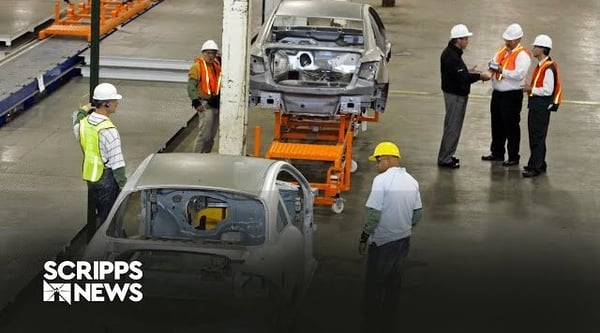
Narrator: From machine operators to welders and engineers, male employees have typically packed manufacturing jobs
Drew Greenblatt: At Marlin. On the factory floor, it's almost 100%.
Narrator: But the future of the traditional manufacturing workforce is somewhat fragile as less men are working.
Drew Greenblatt: "It's a huge concern that we cannot hire the amount of talent we need to hire to grow."
Narrator: Drew Greenblatt has been running Marlin Steel Wire Products in Baltimore since 1998. Coupled with post-pandemic hiring challenges, he says filling jobs these days is an obstacle unlike any other he's been dealt before.
Drew Greenblatt: "It's completely different. 20 years ago we could put a posting out and have the job filled in a day or three."
Narrator: Now Greenblatt relies on the help of temp agencies at a cost and he adds, the financial strain doesn't end there.
Drew Greenblatt: "We could accept more work and grow faster and make the company healthier if we had more talent."
Narrator: Over the past 50 years, the labor force participation rate—a measure of how many people are working or are actively seeking employment—has fallen among men aged 25 to 54 years old. Automation, government benefits, and even video games are commonly blamed as culprits. But there's one economist who doesn't find any of those theories very compelling.
Jonathan Rothwell: "Men who are struggling with health, either mental or physical, are a much more likely to be out of the labor market regardless of their other characteristics."
Narrator: Gallup economist Jonathan Rothwell says the decline in health among men in their prime working years offers the best explanation. He points to CDC data showing men aged 25 to 54 are increasingly health impaired physically and mentally. It's not yet clear what's causing this trend, but Rothwell has an idea.
Jonathan Rothwell: "Men who are in this prime age category who say they have experienced what—what the literature calls ACEs—of these Adverse Childhood Experiences, are just much less likely to be working."
Narrator: He believes the male participation rate will keep falling due to ACEs—everything from childhood abuse to neglect, which can have long-term consequences, including on a person's capability to work.
Jonathan Rothwell: "The forces dragging it down that come through family relationships and growing up in households that are experiencing difficult circumstances... I think unfortunately that's going to continue over the next decade."
Narrator: A lack of clear cause makes finding a workforce solution difficult. There is also no consensus on what the ideal participation rate is for men or women, but assuming it continues to decline, certain industries like manufacturing will continue to hang in the balance. Now, I quickly want to mention the labor force participation rate among working-aged women here. If you take a look at how that has changed over the past 50 to 100 years and compare it to the male labor force participation rate of working-aged men, it's completely different—mainly because over that time we saw more women enter the workforce. If you were to compare the graphs, they would just look completely opposite with the exception of the past few decades, where we see that the data has sort of stabilized for women. I also want to emphasize that the labor force participation rate among women—working-age women, that is, ages 25 to 54—is lower than that of men's. But they still have not seen as much of an impact, mainly through health, as we have seen among the male labor force participation rate. So, something interesting when you compare the data.
This isn't a new problem for the manufacturing industry, however. The engineering shortage in the US began several years ago and, according to a report put out by The Manufacturing Institute and Deloitte, the sector will experience a manufacturing shortage in excess of two million employees over the coming decade.
So why is there an engineering shortage? This is due to several factors, including an aging workforce, a lack of interest in manufacturing positions among younger generations, and a skills gap.
The Engineering Shortage Challenges for the Manufacturing Industry
One of the main challenges of the manufacturing labor shortage is the skills gap, or finding good talent. The manufacturing sector is constantly innovating, meaning that degreed engineers need to maintain a diverse knowledge base and set of skills to allow them to work with new technologies and advanced machinery. However, not many of the workers who are currently available in the job market have the necessary skills to fill these positions.
Another challenge is that the younger generation isn't interested in pursuing a career in manufacturing. Many young people are unaware of the opportunities that exist in this industry and are instead drawn to fields like technology and finance. This has led to a shortage of skilled workers in the manufacturing industry, which is only expected to worsen in the coming years as older skilled workers retire.
Solutions to the Engineering Shortage
To address these challenges, the manufacturing industry has been working to attract new talent. This includes partnering with educational institutions to create programs that teach students the skills they need to work in the industry. Many companies have also been investing in training programs to help their existing employees develop new skills.
Additionally, the manufacturing industry has been working to improve its image. Many people still have the perception that manufacturing jobs are dirty, dangerous, and low-paying. Instead, many of the positions in today's job market are actually well-paying and in clean, high-tech facilities. By improving its image and showcasing the many benefits of working in this industry, the manufacturing sector can attract more talented workers.
How Marlin Steel Is Attracting Workers
At Marlin Steel Wire Products LLC, we're solving the worker shortage problem in our own way: by showing our employees that they matter. We're a next-generation manufacturing company, and we're attracting skilled workers by focusing on employee needs and what they find valuable. This includes:
- Competitive compensation and benefits. We know what our employees are worth, which is why we offer competitive compensation, a comprehensive benefits package including paid time off and a 401k with matching, and much more.
- Employee bonuses. We have an incentive program to provide cash bonuses for employees who exceed the week's production target. By giving them a cut of the profits, we're incorporating our employees' success into that of the company.
- Worker safety. In the Workers Compensation Experience Rating, Marlin reached the 99th percentile, meaning that we outperform almost all similar companies in keeping our workers safe.
- Career advancement opportunities. At Marlin, we encourage cross-training and utilize a skills matrix to track and reward employees for learning new processes and equipment. Also, to support employee growth, we offer tuition reimbursement.
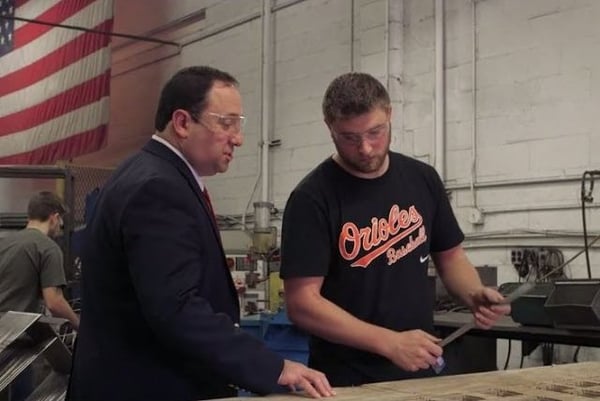
Drew Greenblatt: In 1998, when I bought the company, all we made were bagel baskets. All of a sudden, people stopped eating bagels because of the Atkins diet. We were really hurting for years. Shutting down would have been the right answer to most people, but I just was not going to give up. We've been able to transform, and now we've gone from bagels to Boeing.
Drew Greenblatt: My name's Drew Greenblatt. I'm the president of Marlin Steel Wire. Marlin Steel makes wire baskets, material handling baskets, and sheet metal fabrications for industrial clients, people like Caterpillar, Toyota, Pfizer, Merck. My real job is picking great talent, giving them clearly defined objectives, giving them the tools, invest in their training, and then get the heck out of their way. And now we've grown eight years in a row. Marlin's successful because of quality, engineered quick. These words are the essence of our transformation.
Drew Greenblatt: The techniques that Marlin uses are pretty simple. The Skills Matrix is a transparent way to show which employees have learned different tasks at our company.
Nathan Myers: The Skills Matrix here at Marlin is, uh, you're rewarded for learning new machines or procedures. When you do learn those machines or different skills, you make yourself a better employee. More valued to the company.
Drew Greenblatt: Cross-training's critical at Marlin. It makes us more adaptable, more nimble. This is expensive for our company, but it's a good investment. This enables us to weather the turbulence that's going on in the economy.
Roger Robertson: All of my training that I've had here at Marlin has been paid training, making sure that you can get things done as quickly as possible, not have one person who has all the skills be a bottleneck. Helps me grow, helps me be a better worker, helps the company out.
Liston Clise: Be more versatile is definitely a benefit to getting production done faster.
Drew Greenblatt: Classic Marlin story: This morning we got an order for a project we never made before. By 11:00 we had a print, by 1:00 our laser was cutting, by 2:00 our team had set up welders and benders to make the component, and by 4:00 we shipped it to California. So our client in California will have this tomorrow morning before they eat breakfast, and Liston didn't get introduced to the project until after lunch. So it's a real testament to Liston and his team to come up with a great product, tight tolerance, really fast.
Drew Greenblatt: We also have an incentive program so that each employee can receive a cash bonus if they hit their target. Money's a big motivator for our employees because it helps align our objectives. Our clients pay us to hit certain deadlines with certain quality expectations. We tie our clients' expectations with our employees.
Employee: We're given what's called a production goal of making a certain dollar amount a week. And if we do make that goal, we get a bonus. And that will appear on our check as a cut of the profits essentially, as kind of a pat on the back for saying, "You did a good job."
Drew Greenblatt: I think it's an innovative business model because we're sharing the wealth. We're incorporating our employees' success with the company's success. Our employees are with us for the long haul. They're critical to our future. And this is the reason why we're willing to stick our neck out and train them.
Kenny Browing: I've been working here seven years.
Hector Carmona: I work for 23 years.
Nathan Myers: I've worked here almost 13 years.
Andy Croniser: I've been at Marlin for seven years.
Employee: Uh, two years now. Lucky enough to work my way up to where I am now.
Drew Greenblatt: These are people. This is my team. I'm dedicated to their success. We're all in this together. We're fighting imports, we're fighting very sophisticated, savvy competitors. We don't import anything. It's all designed, engineered, fabricated, and made here in America. We're doing our part in Baltimore. We're doing our part in Maryland. This is the future. American manufacturing renaissance is happening, and we're an example of it.
The Marlin strategy is working, as we have more degreed engineers than the rest of our competition combined. Twenty percent of Marlin teammates are mechanical engineers, industrial engineers, or chemical engineers.
To apply to one of our open positions, visit our Careers page.
Looking Toward the Future
With over 800,000 open manufacturing jobs, finding good talent has become increasingly difficult in the US manufacturing industry. The skills gap and a lack of interest in manufacturing among younger generations are two of the main factors contributing to this challenge. However, by investing in training programs, partnering with educational institutions, and improving its image, the manufacturing industry can attract new talent and fill the many open positions that currently exist.
About Marlin Steel
The Marlin team specializes in custom metal forms and wire products constructed from American steel. Since 1968, our wire baskets, racks, trays, carts, and other material handling containers have been 100% American-made for customers both domestic and international. Through rapid prototyping, production lead times, and order fulfillment, as well as our commitment to innovation through automation, our highly skilled mechanical engineers deliver Quality Engineered Quick® to clients ranging from the government to Hollywood for full customer satisfaction. This trademarked mantra is the heart and soul of our success – amazing, novel innovations created by our talented mechanical engineers working in concert with our chemical engineering team.
To learn more about working with Marlin Steel, contact us today.