
Brass and copper are critical materials across electrical and mechanical applications, but they are also among the most challenging metals to process consistently.
Their high reflectivity, thermal conductivity, and sensitivity to heat require precise control during cutting. Without the right equipment and process strategy, manufacturers risk burrs, edge deformation, inconsistent tolerances, and excessive secondary finishing.
Marlin Steel’s investment in the TRUMPF TruMatic 3000 punch laser combo directly addresses these challenges, giving customers cleaner cuts, tighter control, and faster turnaround for brass and copper components.
Marlin Steel Sheet Metal Gauge Chart
Why Brass and Copper Require Advanced Laser Control
Both brass and copper conduct heat extremely well. While this is ideal for electrical performance, it makes cutting more difficult.
Excess heat can spread quickly through the material, causing edge distortion, surface discoloration, or dimensional instability. Traditional cutting methods often require slower speeds, additional finishing, or alternative tooling to compensate.
Modern fiber laser technology solves this problem by delivering concentrated energy precisely where it is needed. By tightly controlling heat input, the cutting process remains stable even on thin, intricate parts.
The TruMatic 3000 allows Marlin Steel to apply this level of control consistently across a wide range of brass and copper components.
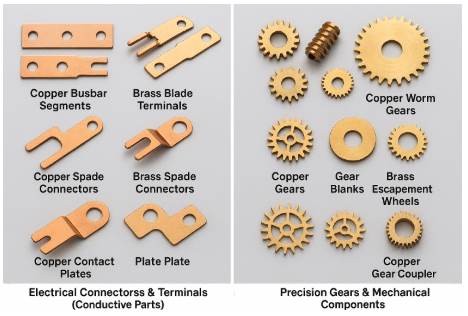
Electrical Connectors and Terminals
Brass is widely used for electrical connectors and terminals due to its excellent conductivity, corrosion resistance, and mechanical strength.
Typical components include
- Busbar segments
- Blade terminals
- Spade connectors
- Contact plates
These parts often require tight tolerances, smooth edges, and consistent geometry to ensure proper fit, electrical performance, and long-term reliability.
With the TruMatic 3000, Marlin Steel can punch repetitive hole patterns and form features while using the laser for precise outer contours. This combination minimizes handling, reduces part movement, and produces clean edges without excessive heat buildup.
The result is electrical components that meet both functional and cosmetic requirements without added processing steps.
Precision Gears and Mechanical Components
Copper and brass are also used in precision gears and mechanical components for clocks, instruments, and specialty machinery.
Examples include
- Small spur gears
- Worm gears
- Gear blanks
- Escapement wheels
- Couplers
These components demand accuracy, repeatability, and smooth edges to function correctly. Any distortion or inconsistency can affect motion wear and long-term performance.
Laser cutting with controlled heat input allows fine tooth profiles and intricate geometries to be produced without warping. When combined with punching for internal features, the TruMatic 3000 delivers stable results even at small scales.
This capability allows Marlin Steel to support complex mechanical applications while maintaining fast production cycles.
One Machine Multiple Advantages
What sets the TruMatic 3000 apart is its ability to combine punching, laser cutting, forming, and tapping within a single automated system.
For brass and copper parts, this means
- Fewer handoffs
- Less material handling
- Reduced risk of surface damage
- Shorter lead times
By eliminating secondary operations and stabilizing the cutting process, Marlin Steel can deliver high-quality components faster and more predictably.
Built for Precision and Speed
This investment places Marlin Steel among the top tier of sheet metal fabricators capable of processing brass and copper at scale with consistency.
Whether the application is electrical connectivity or precision mechanical motion, the TruMatic 3000 provides the control flexibility and reliability required to meet demanding specifications.
For customers, that means parts that perform as designed arrive on time and integrate seamlessly into finished assemblies. Contact Us Today!
.gif "View our in-stock products")