A Process Engineer’s Guide to Leaner, Faster, More Resilient Manufacturing
For process engineers, reshoring production to the United States is rarely a philosophical decision. It’s driven by measurable outcomes: lead time compression, defect reduction, inventory turns, uptime, and total cost of ownership.
At Marlin Steel, reshoring is enabled through advanced automation, high-tolerance manufacturing, and close engineering collaboration, allowing customers in medical, aerospace, defense, and industrial markets to build leaner, more resilient operations.
Take a look at our feature in the New York Times: Trump’s Trade Policies Sort Manufacturers Into Winners and Losers
Below are 10 actionable, engineering-focused reasons why reshoring production, particularly with a domestic partner like Marlin, delivers measurable performance gains.
1. Reduce Manufacturing Lead Times by 50–90%
Offshore supply chains often introduce 6–14 weeks of variability due to ocean freight, customs, and long planning cycles.
Marlin’s U.S.-based manufacturing model enables:
- 1–2 week order-to-delivery cycles for custom wire forms and metal components
- Rapid scheduling changes without overseas delays
- Shorter engineering and approval loops
Operational impact: Many Marlin customers reduce safety stock by 30–60%, freeing working capital while improving responsiveness to demand changes.
2. Minimize Defect Escape With Direct Engineering Access
Long-distance suppliers create slow feedback loops that allow manufacturability issues to surface late in production, or worse, in the field.
Marlin provides:
- Same-day access to manufacturing and process engineers
- Rapid drawing revisions and prototyping
- On-site collaboration without international travel
Operational impact: Design-for-manufacturability (DFM) issues are identified within hours rather than months, reducing defect escape risk by more than 80%.
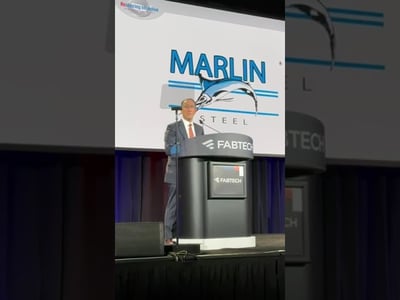
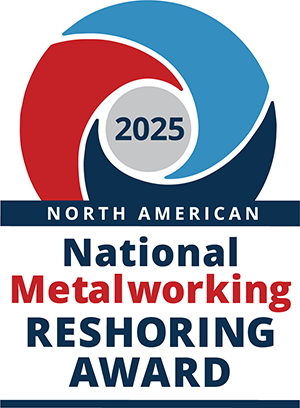
Harry Moser: ...can enable reshoring even if high volume commoditized products. So a lot of people think they say, "Well, the US should make the high-mix low-volume things," and let there's other people who can't compete with them on the high-volume thing. But this company has shown you can make the high-volume if you do the job right in terms of engineering, quality, and delivery. So I'm very, very impressed. Their success, focused specifically on quickness, mirrors our survey's finding about how much more companies are willing to pay for deliverance. I was pleased to see that.
The president owner is a strong supporter of US manufacturing, a highly visible leader in NAM, National Association of Manufacturing—the big gorilla in the manufacturing associations—and an excellent role model for supply chain companies throughout the United States. Please join me in honoring Drew Greenblatt, CEO of Marlin Steel Wire Products. Drew, join me.
Drew Greenblatt: Thank you. It's an honor to accept the National Metalworking Reshore Award on behalf of the 130 Marlin Steel and Madison Steel workers spanning four states: Michigan, Indiana, Maryland, and Massachusetts. Our employees are creative and innovative, coming up with novel ideas to differentiate ourselves from competitors overseas who offer prices below what we pay for steel alone. Our commitment to quality, on-time delivery, and extraordinary service is powering our growth.
Their commitment—our employees' commitment to each other—is off the charts. We have the most amazing safety committees and they've led our teams going over 2,200 days without a safety incident in our Indiana plant, over 1,700 days in our Baltimore plant, and 300 days in our brand new Michigan plant. We're so very optimistic. My exceptional team is winning in the game of reshoring.
Let me give you an example. In August, a client from Georgia that for years, decades, has been buying from another nation—instead, they bought from Marlin in Baltimore. This one order required us to buy 200,000 lb of steel from our mill in Tennessee. And this one order is emblematic of what the nation should see every day. This one order comprised 1.93 million parts which will be shipped and made by six talented employees in Marlin over three shifts for two months straight. Separately, we won a job from a Finnish company for aerospace bastings. These were engineered in Baltimore—we have seven degree engineers—and they hold jet engine blades and vanes. Normally this Finnish client would buy from a German competitor.
When we win, our employees win and our local communities win. That's a blessing. We anticipate doubling over the next three years with the addition of several key clients that just don't want the drama anymore of working with overseas vendors. Life is just too short if you're a purchasing manager.
When we bought Marlin Steel in 1998, we made commodity bagel baskets. My predecessor had done it for 30 years. It worked. Then China came on scene soon after I bought the company and they started dumping bagel baskets into the US for prices below what we would buy steel for. It was untenable. This is an untenable business proposition. And we were hemorrhaging money. We were about to go under.
Fortuitously, in these difficult times, an engineer from Boeing picked up the phone and requested a custom basket from us. And he was content with our pricing because he appreciated that we would deliver a quality product that was engineered or customized for his needs and we would ship quick. This epiphany to stop competing with a government subsidized entity in China changed the company from a commodity player of bagel baskets to an engineering company that happened to make baskets and racks. By the way, our bagel clients didn't even own a tape measure. So, if our wire spacing on a bagel basket held a bagel, it was good enough. Basically, our tolerance was plus or minus fail. Think about that with your clients.
This sea change of approach is now tattooed in everything we do: Quality Engineered Quick. What can we do to make a higher quality product? How can we engineer it to solve problems for the client? How can we make it so we can ship faster than China, faster than overseas? So we literally trademarked the name "Quality Engineered Quick" because this is our north star for our success. By the way, this is how USA factories can accelerate reshoring and bring millions of jobs back from overseas to the USA. We have to win at reshoring.
I want to say a special thanks to Harry Moser leading the charge to bring this guided principle to the nation's forum of ideas. He is preaching the gospel to manufacturing leaders that buy from overseas currently. He's having them relook at things—look at the whole picture, not just the quote you get in the email. He's alerting us and all of our clients to all the other huge costs that are just not accounted for in that quote: things like intellectual property theft, things like late shipments, things like heavier inventory, dock worker strikes, holdups at the customs line. Harry's a strong advocate for us domestic manufacturers. He's trying to clearly connect the dots for our US purchasing managers that need this illumination.
As a nation, we need to nurture our manufacturing industry for many reasons. Number one: manufacturing jobs are extraordinary jobs. They create dignity. Many with limited educations can get a middle-class job in manufacturing and live the American dream. We're talking about high pay, great benefits, a 401k plan, health insurance. We're talking about sick pay, tuition reimbursement. These are clean jobs, thought-provoking, fast-paced jobs with life-enhancing benefits.
Number two: self-sufficiency. As a nation, we need to make our own medicines, our own silicon chips, our own boats, our own ships. We need to make things here because if our adversaries drop the hammer on us, we're going to have to have the capacity and the knowledge base to make these things here. We should start now, not punt until an emergency, particularly on this day of 9/11. We may not have enough time. The reason we prevailed in World War II was more than just brave soldiers on the front lines. These brave soldiers had to be well-armed with food and material that was made in America. We need to rebuild the arsenal of democracy.
Number three: we have to build our local communities. We have to hire locals. We have to invest in the local infrastructure. We have to donate generously to our local charities. By the way, our overseas competitors don't support the United Way. They don't support the PTA bake sale. Number four: we have to fund our nation. Manufacturers pay huge taxes. We keep the local schools intact. We pay for the public employees like teachers, policemen, firemen. We keep them well compensated because of the taxes into our community. This honor again—thank you, Harry. I'm accepting on behalf of all my wonderful teammates in these four states: Michigan, Indiana, Massachusetts, and Maryland. We're proud of this honor. We're optimistic about the future. We're looking to grow fast and hire more locals and give more back to our community. Let's all join in this effort. Thanks again. Appreciate.3. Eliminate the Hidden 10–20% Landed Cost Penalty
Offshore piece pricing often masks significant hidden costs, including:
- Expediting and air freight
- Port demurrage and customs delays
- Rework shipments and tariff exposure
By reshoring with Marlin, manufacturers gain predictable pricing tied to true production costs, not logistics volatility.
Operational impact: Customers often stabilize margins and recover 5–15 percentage points in landed-cost variance.
4. Enable Pull-Based Manufacturing and Demand Agility
Lean manufacturing relies on pull systems and takt alignment—both of which are nearly impossible with long transpacific lead times.
Marlin’s domestic production supports:
- Weekly or even daily replenishment
- High-mix, low-volume production without long planning windows
- Fast response to demand shifts and engineering changes
Operational impact: On-time delivery improves from ~85% to 98–99.5%.
5. Protect Intellectual Property and Tooling
Offshore manufacturing increases exposure to:
- Tooling duplication
- Unauthorized “third-shift” production
- Design and process leakage
Marlin operates under strict U.S. IP protections and provides full audit transparency.
Operational impact: IP-related risk and product leakage are reduced by over 90%.
6. Improve Precision Through Automation and Skilled Labor
Marlin has made significant investments in advanced automation, including:
- CNC wire bending and forming
- Robotic and automated welding
- Laser measurement and statistical process control
These capabilities deliver:
- Repeatable tolerances of ±0.005–0.015 inches
- Consistent weld penetration and finish quality
- Reduced scrap and rework
Operational impact: Many customers experience 20–50% scrap reduction and meaningful quality cost savings.
7. Increase Supply Chain Resilience and Uptime
Global supply chains remain vulnerable to port congestion, labor disruptions, and geopolitical instability.
Marlin’s domestic footprint enables:
- Short-distance logistics
- Easier dual-sourcing strategies
- Lower exposure to global disruption
Operational impact: Supply chain uptime improves from ~92–95% to 99.8% or higher.
8. Simplify Regulatory Compliance, ESG, and Traceability
Manufacturers face increasing pressure around:
- Material traceability and certifications
- Labor practices and workplace safety
- ESG and sustainability reporting
Marlin provides:
- Full material certifications
- Documented, auditable production processes
- A predictable U.S. regulatory environment
Operational impact: Audit and ESG-related risk exposure is reduced by 70–90%.
9. Accelerate New Product Introduction (NPI)
When engineering, manufacturing, and suppliers operate in the same time zone:
- Validation cycles shorten
- Prototypes can be iterated within days
- Tooling and fixture changes happen quickly
Marlin’s engineering-driven approach supports rapid NPI without sacrificing quality.
Operational impact: Time to market is reduced by 20–40%, often translating to millions in revenue acceleration.
10. Lower Total Cost of Ownership Over the Product Lifecycle
Marlin-manufactured wire forms, baskets, fixtures, and material-handling components are built using:
- Higher-grade steels
- Robust weld practices
- Tight inspection standards
This results in:
- Longer service life
- Fewer line stoppages
- Reduced replacement frequency
Operational impact: Downtime decreases by 10–30%, while replacement rates drop by 50% or more.
Why Manufacturers Choose Marlin Steel for Reshoring Initiatives
Marlin Steel is purpose-built for reshoring success, offering:
- Robotic automation and precision manufacturing
- High-tolerance, repeatable processes
- Rapid engineering collaboration
- High-mix, low-volume flexibility
- Full material traceability
From a lean manufacturing perspective, Marlin simultaneously attacks muda (waste), mura (unevenness), and muri (overburden), helping manufacturers build faster, more resilient, and more efficient operations.
Reshoring isn’t a trend. It’s an operational advantage, and Marlin helps make it measurable. Contact Us Today!
.gif "View our in-stock products")