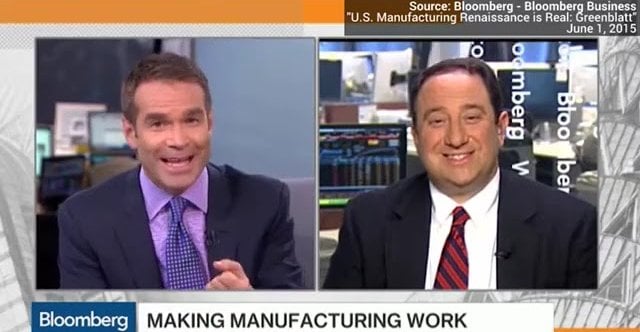
Host: How does uh, this better-than-expected ISM number match up with what you are actually seeing as a producer?
Drew Greenblatt: Well, this matches exactly what we're seeing. We're growing our factory floor 53% and bringing in seven times more power right now because we're very bullish and very optimistic about the future. Uh, what's happening right now is the American manufacturing renaissance is real and we're poised for great growth. Things are coming together. Uh, I'm very optimistic about the future.
Host: What—what makes you so optimistic, Drew?
Drew Greenblatt: Well, there's a lot of good things going in the right way for American manufacturing. For one thing, energy prices. Uh, they've been going down for years. Uh, we have this wonderful uh—uh, opportunity with fracking uh, that's going to keep the prices down in America that makes American manufacturers much more competitive against other countries.
Host: Drew, there are several things—I'm sorry. Go ahead.
Drew Greenblatt: Oh, no. It's—I didn't—I didn't mean to interrupt. Keep going, please. Uh, there are several things that we're also very excited about. Uh, President Obama is pursuing some aggressive trade deals uh, with the Pacific nations, also with the Atlantic nations.
Uh, and this is going to be really open up a lot of new markets for our exporting manufacturing powerhouses. Uh, America needs new uh, consumers to sell to. We need new clients. And by opening up these new markets, what's going to happen is we're going to have to hire more talent in America in our factories to sell to these wonderful new customers that we haven't been able to uh, approach yet because we have very high uh, duties, very high taxes when we try to sell overseas.
Host: All right, Drew, a bunch of things we want to talk to there. Uh, everything from the trade deal to US GDP. But uh, since—since you did just mention the trade deal, what do you say to critics who say that uh, no—in fact, this is going to cost American manufacturers their jobs?
Drew Greenblatt: 95% of the world's consumers are overseas. So what that means is that's where the big markets are. It's not domestically. The future of American manufacturing is to sell to more people overseas. And right now we're inhibited. We have all kinds of obstacles to sell into Japan, to sell into Peru and these other countries. If we can get the TPP done, the Trans-Pacific Partnership done, all of a sudden, we're going to be able to sell to these countries like never before.
That means our factories are going to have to ramp up production. That means we're going to have to hire more talent. We're going to uh, increase the number of people in the middle class. And these are great jobs. The average American manufacturer pays $77,000 a year for their employees. So these are the kind of jobs that we need and this is going to happen. So what we need is for Washington to come together, President Obama to lead on this, and Washington to sign off on these trade deals.
Host: Drew, what percentage of uh, your revenue is international—comes from outside the United States?
Drew Greenblatt: 25%. 25% of our sales—and we sell uh, all—all over Europe, Mexico, Canada. Those are our biggest markets. But we also sell to China.
Host: And you're not feeling the impact of the strong dollar?
Drew Greenblatt: Oh, it's been tough. The last couple months have been very tough. We lost a big job into Southern Europe. Uh, we—uh, because the Southern European client's perspective is that we raised our prices 25%. Of course, we didn't raise our prices 25%, but compared to our German competitor, we look very expensive. So, this has been really rough on us the first couple months.
Host: Now, isn't that going to continue being the case? Because Europe, as you know, right—the ECB is engaged in quantitative easing aggressively, beginning to do what the United States started doing in 2009. Bank of Japan is doing the same thing. Last I checked, they make a lot of steel in Japan as well. I mean, it just seems to me that at least from your perspective—you're in a steel manufacturing business, right—you're... Isn't that going to be challenging for years to come from a currency perspective?
Drew Greenblatt: You're correct. The—the currency is a headwind and it's not—it's not helpful to American manufacturers. We make everything 100% in the USA. But that's the reason why these trade deals have to happen, because what will happen is it'll give us new markets to access. It'll lower the barriers. It'll make the obstacles lower so we have more prospects.
For example, one of the things that uh, will happen is that we'll have more intellectual property protection. That's critical. That's our secret sauce in America. And if by having these trade deals, it makes uh, foreign countries uh, not—be able to pilfer our intellectual property as easy. So yes, the currency is a headwind. It's—it's not helpful to us. It's—it's inhibiting our growth. So let's try to find other ways like trade deals so that we can um, enter into new markets and grow our economy.
Host: Drew, I just want to press you on the issue of the manufacturing jobs. We have a chart that shows very clearly that manufacturing jobs peaked here in the US in the 1970s. It has been steadily declining there on the right side of the screen. You see it's slowly picking up. I recognize that the trans—that the trade deal would be good for exporters and their bottom line, but what kind of jobs are you creating? We were just showing video of robots producing steel. Are you actually going to be generating, you know, working-class manufacturing jobs or are you generating jobs for managers uh, and downstream opportunities?
Drew Greenblatt: There's no doubt that the jobs—the complexion of the jobs—is different than it used to be. Uh, when I first bought Marlin, everybody would hand bend. We had eight employees that would hand bend wire all day long. Now we have a series of employees that are getting paid four or five times what we—what we [paid] when I started the—the company—buying the uh, when I first bought the company—who are now running fancy machines, $4 million machines, and they're 10, 15, 20 times more productive than they ever were.
They're also doing more interesting things. Uh, they're using their brains. They're not using their brawn. They're also much safer. We've gone 2,300 days without a safety incident. That's a stunning number. Well, why did that happen? That's because our employees are not doing scary things anymore. They're doing very healthy things outside the cages. So, this is the, you know—so the jobs are changing in manufacturing. They're not dirty. They're clean jobs. They're brain jobs. And this is—this is a new paradigm that—that has to pierce uh, conventional wisdom. By the way, when you have really productive employees, you could pay them better and give them health insurance.
Host: Drew, we thank you very much for spending time with us this morning. Drew Greenblatt is president and owner of Marlin Steel.