

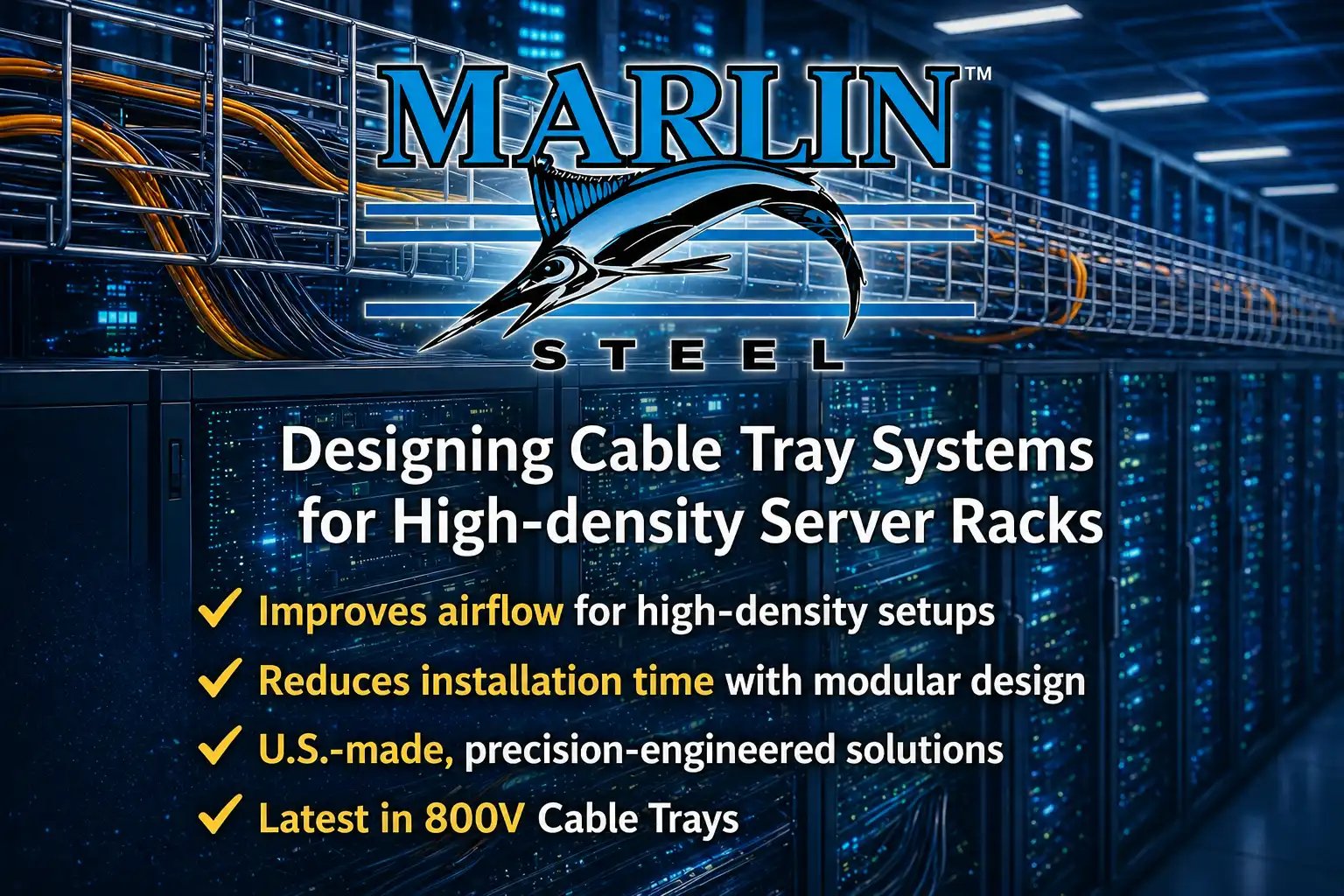
Why High-Density Server Racks Are Changing Data Center Cable Tray Requirements
As AI workloads drive higher compute density, modern AI data center infrastructure is placing new demands on power, cooling, and cabling. Compared to traditional environments, AI racks require significantly more cabling while generating greater heat loads, which directly impacts how data center cable tray systems must be designed.
This shift introduces a few consistent challenges:
- Higher cable volumes from GPU-based infrastructure
- Increased thermal output requires better airflow
- Faster deployment timelines for hyperscale data center infrastructure
Traditional enclosed systems often struggle under these conditions. In contrast, wire mesh cable tray systems provide a more scalable approach by supporting airflow, flexibility, and faster installation. By solving the unique cable management challenges in high-density racks, wire mesh cable trays are increasingly preferred over conventional cable ladders and other traditional methods.
What Should You Consider When Designing Data Center Cable Tray Systems?
Airflow and Thermal Performance
In high-density environments, airflow is directly tied to uptime and efficiency. Poor cable routing can create blockages that reduce cooling performance and increase operating costs.
Open-design data center cable trays, especially wire mesh systems, allow for better air circulation and more consistent thermal conditions. Designs that avoid overfilling trays and maintain clear routing paths are critical in preserving airflow integrity.
Supporting High Cable Density
AI-driven environments require data center cable management systems that can handle significantly heavier loads while remaining adaptable over time.
Key considerations include:
- Selecting high-capacity cable tray systems built for dense cabling
- Designing with future expansion in mind
- Maintaining separation between power and data pathways
Marlin Steel addresses this through precision manufacturing, delivering data center cable trays that maintain structural integrity across large-scale deployments.
Installation Speed and Pre-Fabrication
Installation speed is a major priority in hyperscale data center infrastructure, where delays can impact overall project timelines.
Pre-fabricated cable tray systems help streamline deployment by reducing field modifications and standardizing installation across sites. Marlin Steel leverages advanced fabrication technologies, including the TRUMPF TruMatic 3000 and automated wire forming, to produce ready-to-install components with tight tolerances.
This reduces labor requirements and accelerates time to deployment.
Modular Design for Scalability
Hyperscale data centers require repeatable infrastructure that can scale efficiently. Modular data center cable tray systems support this by enabling consistent designs across multiple locations.
This approach simplifies expansion, improves deployment speed, and ensures predictable performance as infrastructure evolves.
How Do Blanking Panels Improve Airflow in Data Centers?
In high-density racks, airflow control is just as important as cable routing. Data center blanking panels help prevent hot air recirculation and maintain proper separation between hot and cold air zones.
When combined with optimized cable tray systems, blanking panels improve cooling efficiency and support overall system reliability. Marlin Steel manufactures precision sheet metal blanking panels designed for consistent fit and long-term durability.
What Role Does Fabrication Play in Cable Tray Performance?
Cable tray performance is heavily influenced by manufacturing quality. Inconsistent fabrication can lead to installation challenges, misalignment, and long-term performance issues.
High-quality fabrication delivers:
- Consistent fit and alignment
- Repeatability across large production runs
- Faster, more predictable installation
Marlin Steel’s capabilities—including automated wire welding, robotic forming, and advanced laser systems—enable the production of data center cable trays and infrastructure components with a high degree of precision.
Why Are Wire Mesh Cable Tray Systems Ideal for Data Centers?
Wire mesh cable tray systems have become a preferred solution for modern data centers because they balance performance with flexibility.
Several key benefits of wire mesh cable tray systems include:
- Improved airflow compared to enclosed systems
- Strong support for high cable volumes
- Flexibility for custom layouts and future changes
For organizations building AI data center infrastructure, these characteristics make wire mesh systems a scalable and practical choice.
How to Evaluate the Right Data Center Cable Tray System
Selecting the right data center cable tray system requires balancing performance, scalability, and installation efficiency. Beyond load capacity, decision-makers should evaluate how well a system supports airflow, how quickly it can be deployed, and whether it can adapt to future infrastructure needs.
Just as important is the ability of the manufacturer to deliver consistent quality at scale. Marlin Steel provides precision-engineered cable trays and blanking panels, along with the manufacturing reliability needed for large data center builds.
Designing for Performance, Speed, and Scalability
Designing for high-density server racks requires a focus on airflow, structural performance, and installation efficiency. As data centers continue to evolve, the ability to deploy infrastructure quickly and consistently is becoming a key competitive advantage.
Marlin Steel supports this with advanced automation, precision fabrication, and U.S.-based manufacturing—delivering data center cable trays and blanking panels built for performance at scale. As an ISO 9001:2015-certified manufacturer, we deliver Quality Engineered Quick® to support hyperscale and enterprise-level data center buildouts.
Contact us to learn more about our AI data center infrastructure fabrication capabilities, or request a quote to start your project.
.gif "View our in-stock products")