

Why Reducing Construction Labor Is a Growing Challenge in Data Center Builds
As data center construction accelerates to support AI data centers and hyperscale infrastructure, reducing on-site labor has become a critical priority. Labor shortages, compressed timelines, and increasing system complexity are forcing organizations to rethink how infrastructure is designed and deployed.
Traditional construction approaches often rely heavily on field modification, increasing labor hours and introducing variability. As a result, many organizations are shifting toward design-for-install infrastructure to reduce installation time and labor costs in hyperscale builds.
Key factors driving labor challenges include:
- Limited availability of skilled installation crews
- Increasing system complexity requires precision alignment
- Compressed build timelines for hyperscale deployments
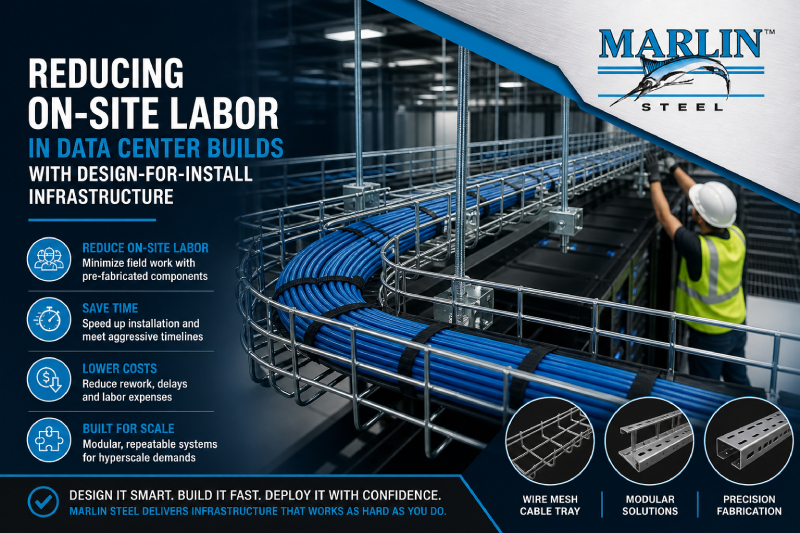
What Is Design-for-Install Infrastructure?
Design-for-install (DFI) infrastructure is an approach that prioritizes installation efficiency during the design and manufacturing process. Instead of solving problems in the field, components are engineered to arrive ready for placement and integration.
This approach emphasizes pre-fabrication, modularity, and precision manufacturing. The goal is to simplify installation, reduce labor dependency, and create more predictable project timelines.
How Can Infrastructure Design Reduce On-Site Labor?
How Does Pre-Fabrication Minimize Field Work?
Pre-fabrication shifts labor from the job site to the manufacturing environment. Components are produced to specification and delivered ready to install, eliminating the need for cutting, welding, or adjustments in the field.
This is especially critical for pre-fabricated cable tray systems, where off-site manufacturing eliminates the need for field modification. For installers, this means faster placement, fewer delays, and reduced reliance on specialized labor.
Why Is Precision Manufacturing Critical?
Inconsistent or poorly fabricated components can quickly disrupt installation timelines. Even small misalignments can lead to delays, rework, and increased labor costs.
Precision manufacturing ensures consistent fit and alignment across all components, allowing installation teams to work efficiently without constant adjustments. Marlin Steel utilizes advanced technologies such as TRUMPF TruMatic 3000 systems, automated wire welding, and robotic forming to maintain tight tolerances and repeatable quality.
How Does Modular Design Improve Installation Efficiency?
Modular data center infrastructure breaks systems into repeatable sections that can be installed quickly and consistently. This reduces complexity on-site and allows teams to replicate the same process across multiple zones or facilities.
For hyperscale data center builds, modularity supports scalability. Components can be deployed in phases without disrupting overall system integrity, helping teams reduce installation time while maintaining consistency.
How Can Standardization Reduce Labor Variability?
Standardization plays a key role in simplifying installation. When components are consistent across a project, installation becomes more predictable and less dependent on individual decision-making in the field.
This reduces errors, shortens training time for crews, and helps ensure that projects stay on schedule. Marlin Steel’s repeatable manufacturing processes support this level of consistency across high-volume production runs.
How Do You Minimize Rework and Delays?
Rework is one of the most significant drivers of excess labor. It often results from poor fit, inconsistent components, or a lack of alignment between design and installation requirements.
To reduce rework and labor overruns:
- Manufacture components to exact specifications with tight tolerances
- Deliver complete, ready-to-install assemblies
- Align design decisions with installation workflows early
Marlin Steel’s use of automated wire welding and advanced forming technologies helps ensure uniformity, minimizing the risk of field corrections.
How to Reduce On-Site Labor in Data Center Builds
To reduce on-site labor in data center builds, organizations should focus on three core strategies:
- Implement design-for-install infrastructure early in the planning phase
- Utilize pre-fabricated cable tray systems and modular components
- Partner with manufacturers capable of high-volume, precision production
These approaches help reduce installation time, minimize rework, and ensure predictable deployment timelines, especially in hyperscale and AI-driven environments.
What Role Does Cable Tray Design Play in Labor Reduction?
Cable tray systems are a critical component of data center infrastructure, and their design plays a direct role in reducing installation time and labor costs. Pre-fabricated cable tray systems, particularly wire mesh designs, allow for faster deployment, easier routing, and minimal field modification.
Well-designed systems eliminate the need for custom fitting and allow installers to focus on placement rather than modification.
Why Are Wire Mesh Cable Trays Ideal for Design-for-Install?
Wire mesh cable trays naturally align with design-for-install principles. Their open structure simplifies routing, reduces handling effort, and allows for quick adjustments during installation.
They are especially effective because they combine performance with installation efficiency:
- Open-grid design improves accessibility and speeds cable routing
- Lightweight construction reduces handling effort on-site
- Flexible configurations allow quick adaptation without rework
This makes them particularly well-suited for AI data centers and hyperscale deployments, where speed, airflow, and scalability are critical.
How Do You Reduce On-Site Labor Through Design?
Reducing on-site labor starts with making the right decisions early in the design phase. Prioritizing pre-fabrication, precision manufacturing, and modular systems allows teams to streamline installation and avoid unnecessary complexity in the field.
Partnering with a manufacturer like Marlin Steel ensures that components are delivered with the consistency and quality needed to support efficient deployment at scale.
Conclusion: Build Faster with Less Labor
Reducing on-site labor in data center construction is essential for meeting the demands of hyperscale and AI-driven infrastructure. Design-for-install infrastructure provides a clear path forward by shifting complexity into manufacturing and enabling faster, more predictable installation.
By leveraging pre-fabricated cable tray systems, modular data center infrastructure, and precision manufacturing, organizations can reduce installation time, control labor costs, and accelerate deployment at scale.
Marlin Steel supports this approach through advanced fabrication, automation, and U.S.-based manufacturing, helping data center operators build faster with less labor.
.gif "View our in-stock products")