
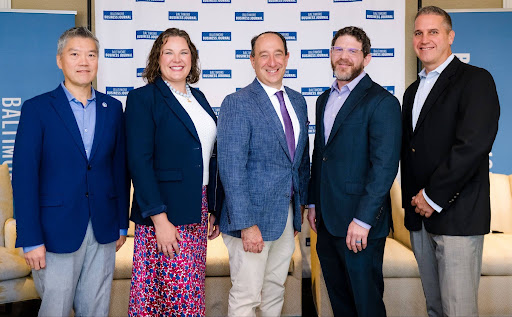
Panelists, left to right: Bob Zhang (Howard County Economic Development Authority), Renee Evans (Pompeian), Drew Greenblatt (Marlin Steel), Chad Schneider (Root3 Labs), and Mike Kelleher (Maryland MEP).
Labor shortages, supply chain disruptions, new technology, and shifting trade policy are testing manufacturers right now. Yet the mood in the room at Innovation in Motion: Maryland Manufacturing was optimistic. Presented by the Baltimore Business Journal and moderated by president and publisher Courtney Bode, the panel brought together five Maryland leaders to talk about where the industry stands and where it is headed.
Marlin Steel CEO and owner Drew Greenblatt joined Renee Evans of Pompeian, Mike Kelleher of the Maryland Manufacturing Extension Partnership, Chad Schneider of Root3 Labs, and Bob Zhang of the Howard County Economic Development Authority. The event was sponsored by Atlantic Union Bank and the Howard County EDA.
A manufacturing boom Maryland can seize
Drew opened with a message of opportunity. “There is a tremendous manufacturing boom going on, that’s something Maryland should be jumping on because we have an opportunity to get manufacturers back in our state,” he said. “The pendulum is coming our way, and we’ve got to jump on it and seize as many of these opportunities as we can so our neighborhoods can flourish and we can rebuild our middle class.”
Mike Kelleher backed that up with data. Maryland is home to about 3,000 manufacturers, with strength in aerospace and defense, food and beverage production, and life sciences. “Those three sectors are actually growing. We’re outperforming our neighbors,” he said.
Tariffs: a boost for some, a roller coaster for others
The panel was candid about trade policy. For Marlin Steel, tariffs have helped by making imported steel more expensive. Marlin manufactures only in America, in Baltimore, Michigan, Indiana, and Illinois, using American steel.
Not every company sees it that way. Pompeian, the largest importer of olive oil in the US, has had what Renee Evans called “a wild roller coaster ride,” where the timing of a ship’s arrival against a tariff announcement can swing millions of dollars. Still, she noted the disruption has pushed Pompeian to become more flexible and less reliant on a single supplier, much as the Key Bridge collapse forced a new way to unload oil.
Kelleher shared a striking example from a defense manufacturer whose tariff bill on a million-dollar order jumped from about $100,000 to $900,000. In his view, that pressure is creating a once-in-a-lifetime opportunity to bring manufacturing back to the US, and Maryland can be a destination for it.
Talent: a great time to work in manufacturing
Hiring remains a challenge as experienced workers retire. The panel pointed to Maryland’s universities and engineering schools as a strong pipeline. Howard Community College will open the Cathy and Danny Bell Workforce Development & Trades Center this fall, with hands-on training in trades like welding. Chad Schneider’s advice to young engineers was blunt: “internship, internship, internship.”
For Drew, the market is working in employees’ favor. “This is a fabulous time for a manufacturing employee,” he said. “Wages are going up because the only way to get great talent is we’ve got to pay.” Along with pay, top hires expect a safe workplace. “Our factory in Baltimore has gone over 2,000 days without a safety incident, and our factory in Indiana has gone over 2,800 days without a safety incident. We’re nuts about safety. The employees want to hear about that.”
AI, risk, and culture
On artificial intelligence, Kelleher described the landscape as “everywhere and nowhere at the same time.” Many manufacturers begin in the back office and then move to the plant floor for data analysis and predictive maintenance. On managing risk, panelists pointed to learning from non-competitors, designing for tighter yield and quality, and investing in people. As Evans put it, “When the challenges hit, whether it’s tariffs or some major disruption or pricing issue with a commodity, it’s that team that helps get you through it.”
Correcting the misconceptions
The panel closed by tackling myths about modern manufacturing. It is not dirty, it does not require brute strength, and it is not dying. Evans noted the careers include supply chain, data analytics, sales, and marketing, with good pay from entry level up. Kelleher said it best: “Behind those walls there’s somebody making something really cool right here in Maryland.”
Build with Marlin Steel
At Marlin Steel, we are proud to be part of Maryland’s manufacturing story, making precision steel products in America with American steel. Learn more about our capabilities at marlinwire.com, or contact our team to talk about your next project.
Thank you to the Baltimore Business Journal, presenting sponsor Atlantic Union Bank, and partner sponsor Howard County EDA for hosting a great conversation.