
When an S&P 100 company decides to audit a supplier, they don't cut corners, and neither do we. On September 21, 2026, Marlin Steel Wire Products hosted a full-day, top-to-bottom audit of our Integrated Management System (IMS) and manufacturing operations. It's the kind of scrutiny that separates suppliers who say they're quality-driven from suppliers who can prove it.
When a company this size chooses a supplier, they're putting their own reputation on the line. If a part fails, a shipment is late, or a process breaks down, it's not just Marlin's problem—it becomes theirs too. That's why audits like this one aren't a box-checking exercise. They're a rehearsal for exactly the kind of pressure our processes are built to handle every single day, not just when someone's watching.
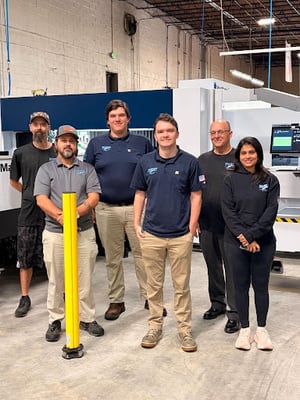
Marlin Steel engineers on the shop floor: the team spearheading this audit.
Here's what a day like this actually looks like inside our Baltimore facility, hour by hour.
8 a.m.: The Day Begins
The audit opens with introductions and a full scope review: who's being audited, what's being covered, and the site safety requirements everyone follows before stepping onto the floor. Department leaders across quality, procurement, and manufacturing are on hand, whether in person or dialed in remotely, so the audit team has direct access to the people who actually run these systems rather than a single spokesperson relaying secondhand answers.
A clear scope review at the start sets expectations for both sides, removes ambiguity about which areas will be examined, and lets department leads prepare to speak to their piece of the operation. And starting with a safety briefing sends its own message: Shop floor access is controlled, documented, and taken seriously from the very first minute an outside auditor walks through the door.
9:30 a.m.: Proving the System Works
Auditors don't just want to see our ISO 9001 and ISO 13485 (medical device) certifications on a wall. They want to see that the people managing our quality, environmental, and safety systems actually understand them. A quality management audit covers:
- Management responsibility
- KPIs and objectives
- Management review
- Legal and regulatory compliance
- Internal audits
- Document control
- Risk management
- ESG requirements
- Business continuity
This is where the real test happens. A framed certificate proves you paid for a certification audit, but it doesn't prove the system is live. So auditors probe whether leadership can speak fluently to current KPIs and objectives without notes, whether internal audit findings actually trigger corrective actions instead of gathering dust, and whether a business continuity plan has ever been tested against a real disruption rather than just written and filed away.
10:30 a.m.: Where Quality Starts, Our Suppliers
Before a single piece of wire reaches our shop floor, it's been vetted. Our Approved Supplier List, supplier qualification process, and incoming material controls all come under review, along with how we monitor supplier performance and manage corrective actions when something falls short.
A manufacturer's quality is only as strong as its weakest input. A single out-of-spec coil of wire or an unqualified subcontractor can undo weeks of careful process control downstream. That's why this stage of the audit digs into how suppliers are scored, how often that scoring is revisited, and what actually happens when a supplier's performance slips below standard.
11 a.m.: Walking the Floor
This is where the audit gets hands-on. Auditors walk our production lines to see manufacturing process flow, production controls, work instructions, traceability, and material handling firsthand, verifying that our preventive maintenance schedules, calibration records, nonconforming material controls, and health, safety, and environmental practices match what's on paper.
It's also the most visual, credibility-building part of the day. A good auditor will pick a part at random and trace it backward: from finished good to work instruction to the raw material lot it came from, to confirm traceability actually works in practice, not just in theory. They'll check maintenance logs against the real condition of a machine, and they'll look for nonconforming parts to be physically tagged and segregated on the floor, not just noted in a spreadsheet somewhere in the quality office.
It's also a chance to show off what makes Marlin different: American-made equipment, tight tolerances, and a shop floor built for precision fabrication, including wire forming, cable trays, sheet metal, and more, all running under one roof.
1 p.m.: Quality Control Under the Microscope
Incoming inspection, in-process inspection, final inspection, and testing activities are all reviewed in detail, along with quality records, nonconforming product controls, and the calibration system for measurement equipment.
Each inspection stage exists to catch a different kind of failure. Incoming inspection stops bad material before it ever reaches production. In-process inspection catches drift and deviation before small errors compound into scrapped batches. Final inspection is the last line of defense before a part ever reaches a customer's dock. And underlying all three is calibration, because a measurement is only as trustworthy as the instrument that took it, which is exactly why calibration records get just as much scrutiny as the inspection results themselves.
2 p.m.: Learning From What Goes Wrong
Every manufacturer has nonconformances. What matters is what happens next. This portion of the audit examines our corrective action process, customer complaint handling, internal nonconformances, root cause analysis, and how we verify that corrective actions are actually effective.
This section tends to separate mature quality systems from paperwork-driven ones. Any facility, no matter how well-run, will have things go wrong from time to time. The real question auditors are asking is whether there's a disciplined, documented method for finding the true root cause of a problem, and whether anyone goes back later to confirm the fix actually worked, rather than simply closing the ticket and moving on.
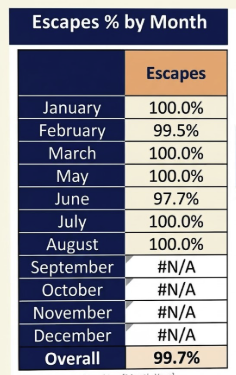
Marlin's Escapes metric, the percentage of shipments with zero customer-identified quality issues, is tracked monthly. Six of the last eight months came in at 100%.
2:30 p.m.: Investing in Our People
Our HR team walks auditors through the training program, competency records, and operator qualifications, proof that the people running our equipment are as rigorously vetted as the equipment itself.
Even the best-designed process is only as reliable as the person executing it. Auditors want to see documented training paths for every role, records showing skills were actually verified rather than assumed, and a clear process for keeping competency current as equipment, materials, or procedures change over time.
3:30 p.m.: Pulling It All Together
Before the day wraps, the local management team and department leaders regroup to review the day's findings together, comparing notes across quality, manufacturing, procurement, and HR before anything is presented back to the auditors. It's a chance to align internally, flag anything that needs a follow-up answer, and make sure the closing meeting reflects the full picture, not just one department's view of the day.
4 p.m.: Closing the Loop
The day ends with a closing meeting: a transparent readout of the audit summary, observations, opportunities for improvement, and any nonconformities, shared directly with our leadership team and department leads.
A strong closing meeting isn't about defending every finding. It's about showing that feedback, even critical feedback, gets taken seriously and acted on, which is the whole point of inviting this level of scrutiny in the first place.
Why This Matters
This level of audit rigor isn't unique to one customer. It's how Marlin Steel operates every day. Whether it's an S&P 100 company or a growing manufacturer placing their first order, the same standards apply: Made in the USA, Quality Engineered Quick®, and built to withstand scrutiny.
Passing an audit like this one isn't the real goal. It's evidence of something bigger: a system built to consistently deliver for every customer, audited or not, order after order. That's the standard we hold ourselves to whether an auditor is on site or not, and it's why customers who need to trust their supply chain keep coming back to Marlin Steel.
Contact us to learn more about our quality assurance process.