
 For manufacturing businesses in the U.S., exports can be a critical component for growth. By tapping into new markets, American manufacturers can expand their businesses, adding high-paying jobs that help grow the American middle class.
However, exporting to highly competitive markets such as Mexico and China, which have traditionally been strong sources of outsourced labor, can be difficult.
In a video from the U.S. Chamber of Commerce, there were three companies that were highlighted for managing to export to such difficult markets. One of these companies was Marlin Steel.
From Drowning in Imports to Making Exports
Years ago, the threat of Chinese competitors who could sell commodity baskets for less than the cost of the steel needed to make them once drove Marlin Steel to the brink of extinction. Today, things are a bit different.
Rather than being threatened by Chinese imports, Marlin Steel now exports custom steel baskets to companies in countries around the globe… including China. In his interview with the Chamber of Commerce, Drew Greenblatt, Marlin’s President, noted Marlin’s exporting of products to China as “the thing I’m most proud about.”
How did this remarkable turn of events come about? A large part of the reason why Marlin Steel now exports custom steel baskets to companies in China is that Marlin doesn’t compete based solely on price.
 Marlin’s clients, both foreign and domestic, require a certain amount of precision in the steel wire baskets and custom sheet metal fabrications that they use in their production processes. In many cases, part tolerances for containers used by these clients is measured in thousandths of an inch. This is something that cheap manual labor cannot easily guarantee.
To meet the demand for precision-engineered custom metal forms, Marlin Steel uses advanced manufacturing automation combined with highly-trained production engineers to create “Quality Engineered Quick” for clients around the globe.
Even companies in China need high-precision baskets that can consistently meet production tolerances. However, using manual labor to make a steel basket can produce part variances of several inches from one part to the next. Needless to say, this is an unacceptable margin of error for high-precision applications.
Now, when companies in China need an order of precision-crafted custom parts washing baskets for their parts finishing processes, they call Marlin Steel.
As Drew says in his interview with the Chamber of Commerce, “We use American labor, American robots and American steel and we export to China. We’re doing this because our equipment and our people ar so top-notch that we can make a higher level of quality that you can’t get from a typical Chinese vendor. So it’s worth it for Chinese companies to buy from us in Baltimore and put it on a boat all the way to Shanghai.”
By focusing on making products with extraordinary precision, Marlin is able to export goods to the country that once flooded American markets with ultra-cheap commodity baskets.

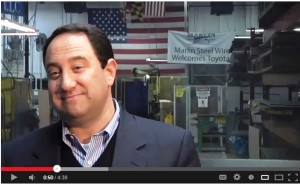
Drew Greenblatt: Marlin Steel is a factory. We build things in Baltimore, Maryland, we ship all over the world. We make material handling baskets and cleaning baskets and sheet metal fabrications for factories uh like that work in the medical, pharmaceutical and automotive industries. Marlin was established in 1968. I bought the company in 1998. However, we started exporting about a decade ago. We've really ramped up over the last couple years and it's really powered our growth, enabled us to hire more people, enabled us to bring on more equipment to satisfy our international client. We export mostly to Mexico and Canada and Europe. However, uh Asia has become very strong recently. The thing I'm most proud about is that we export to China. We use American labor, American robots, American steel, and we export to China. We're doing this because our equipment and our people are so topnotch that we can make a higher level of quality that you can't get from a typical Chinese vendor. So, it's worth it for Chinese companies to buy from us in Baltimore, put it on a boat all the way to Shanghai. It makes sense because of our quality and our engineering.
Roy Paulson: Paulson Manufacturing has been in business since 1947 as a producer of safety products. We uh protect the eyes and face, not only of industry, but of policemen, medical products, everything that you can imagine for protection for eyes and face. In the beginning, uh international trade was only of an importance when we got the occasional order. But what happened is as we developed our international trade over the months and years, it is now essential to our monthly production. About 25% of my uh total factory output is international trade, and some months it's quite a bit higher. The surprising part is that I traveled around to visit all of my major customers, and I found out that my domestic production was actually being re-exported. So, 30% of my domestic production, what I always thought was being consumed in the US, actually goes out to international trade. So if you add that 30 back to my 25, half of everything I do is exported out of this country. I was recently asked by my insurance company, where do I buy my raw materials? And you should have seen the broad smile on their face when they realized that I buy all my raw materials in the US because they realize that the materials made in the US are of a higher quality and more consistent. As far as for the US government and their facilitation is mostly to stay out of my way because I know how to get it done. But they need to make sure that we are all working on an even playing field. Because when we lose large contracts or we don't have the opportunities, and it's because there's an uneven playing field. That's that's where the US government can really come in and help even this thing out.
Bobby Patton: My brother and I started Patton Electronics Company in 1984. We were both students at the University of Maryland and looking for a way to pay our tuition. And so we started this little uh mail order company manufacturing, selling data communications equipment. We were early, early um on the internet in in the early 90s, uh when it first started to take hold. And so companies in our industry were also on the internet and found us. So we started to see the demand. About 70% of our sales are exports, um going to other countries. Uh that's been growing pretty steadily uh ever since we started exporting. Being an electronics manufacturer in the US has become a rare thing. And uh the there's so much of that business that's been driven to Asia in particular. Uh China and other places. Uh we do sell a tremendous amount of our equipment into Asia and China. Uh and the biggest reason is because we have a product that is differentiated um on the software level. And we uh we have a reputation for a very reliable product. Uh you know, our business has been growing at at 20% average annual compound rate uh since we started. And if we didn't have that international side, we wouldn't have been able to continue that kind of growth over the period. So, a significant portion of our employment was due wholly uh to our export business.
How Important Are Exports to American Manufacturers?
Being able to export manufactured goods to foreign markets can be critical to success for many American manufacturers. As the Chamber of Commerce states on their website, “Nearly 40 million American jobs depend on trade.”
Let that number sink in. 40 million jobs depend on trade. Without the ability to export to other countries, millions of workers in the U.S. would lose their livelihoods.
Considering that, according to the CoC, “98% of the 300,000 U.S. companies that export their products are small and medium-sized companies,” not being able to export to other countries would be a tremendous blow to the Amercan middle class.
By being able to make headway into foreign markets such as China, American manufacturers can build their businesses while growing American jobs and the U.S. economy.
Marlin Steel is proud to be a custom metal basket manufacturer that’s worth an 11,000 mile trip for Chinese manufacturers.
.gif "View our in-stock products")